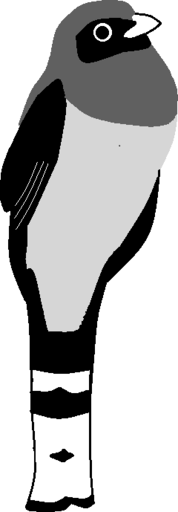
White-tailed Trogon

White-tailed Trogon

Trogon chionurus

Silhouette: Edwin Price · PhyloPic

LCLeast ConcernNTVUENCR
Daily sighting probability <5% · Rare
at Farallones de Cali National Natural Park

In 3 days <5%

19 Verified sightings at Farallones de Cali National Natural Park From 2019 to 2026
2,784 In all 8 parks
May Best month
☀️ Diurnal When it's spotted

About the White-tailed Trogon

The white-tailed trogon (Trogon chionurus) is a species of bird in the trogon family. It is found in tropical humid forests of the Chocó, ranging from Panama, through western Colombia, to western Ecuador. It was formerly considered a subspecies of T. viridis, which is widespread in South America east of the Andes, but under the English name white-tailed trogon (a name now reserved for T. chionurus, leaving T. viridis as the green-backed trogon).

This relatively large trogon is 28 to 30 centimetres (11 to 12 in) long. As most trogons, it is strongly sexually dimorphic. In the male the head and upper breast are dark blue (appears blackish in poor light), and the back is green, becoming bluer on the rump. The lower underparts are orange-yellow. The wings are black, vermiculated with white. The undertail is almost entirely white with only a very narrow black base to each feather. The complete eye-ring is pale bluish. The female white-tailed trogon resembles the male, but has a grey back, head and breast, and rather indistinct black-and-white barring mainly to the inner webs of each tail feather (less on outer webs).

For comparison, the similar but smaller gartered trogon... Wikipedia →

Sounds

Song0:29

Ecuador · 2025

© Manuel Sánchez-Nivicela · XC1154480 · CC BY-NC-ND 4.0

Call1:11

Colombia · 2011

© Peter Boesman · XC273552 · CC BY-NC-ND 4.0

Alarm call0:15

Ecuador · 1999

© Olaf Jahn · XC261801 · CC BY-NC-SA 4.0

Global Distribution

Parks Where Found

# Park Country Daily sighting probability
1 Utría National Natural Park 🇨🇴 Colombia
~50%
2 San Lorenzo Protected Forest 🇵🇦 Panama
~30%
3 Darién National Park 🇵🇦 Panama
~30%
4 Soberanía National Park 🇵🇦 Panama
~20%
5 Bastimentos Island National Marine Park 🇵🇦 Panama
<5%
6 Farallones de Cali National Natural Park 🇨🇴 Colombia
<5%
7 Parque Natural Metropolitano 🇵🇦 Panama
<5%
8 La Amistad International Park (Panama) 🇵🇦 Panama
<5%

Before you go

What are the chances of seeing a White-tailed Trogon in Farallones de Cali National Natural Park?

Rare

Under 5% of wildlife watchers report a White-tailed Trogon sighting in Farallones de Cali National Natural Park on a given day, based on 19 verified sightings from GBIF citizen-science data from 2019 to 2026. It is the 432nd most-seen of the 542 birds we can rate there. Over three days the chance rises to under 5%, if each day is a fresh chance.

When is the best time to see a White-tailed Trogon in Farallones de Cali National Natural Park?

Any time of year

In every month with enough records, under 5% of wildlife watchers report a White-tailed Trogon in Farallones de Cali National Natural Park on a given day, so our monthly data shows no clear season.

What time of day is best to see a White-tailed Trogon?

Between 8 and 11 am

Across all the parks we cover, that three-hour window holds the most White-tailed Trogon sightings with a recorded time, and about 9 in 10 of them come between 6 am and 6 pm: it is a daytime animal.

Which relatives of the White-tailed Trogon live in Farallones de Cali National Natural Park?

Same genus: Trogon

The closest relatives of the White-tailed Trogon that you can see in Farallones de Cali National Natural Park (genus Trogon, New World Trogons) are Collared Trogon (about 10%) and Masked Trogon (about 10%), with each one's daily chance of a sighting.

Where does the White-tailed Trogon sighting chance come from?

GBIF citizen-science records

It is estimated from how often the White-tailed Trogon is recorded against all the birds logged in Farallones de Cali National Natural Park (19 verified sightings from 2019 to 2026), calibrated against known sighting rates. Figures are rounded to the nearest 10% because citizen-science data supports honest approximations, not decimals, and months with records from fewer than five people show "—". How it works.

← Back to Farallones de Cali National Natural Park