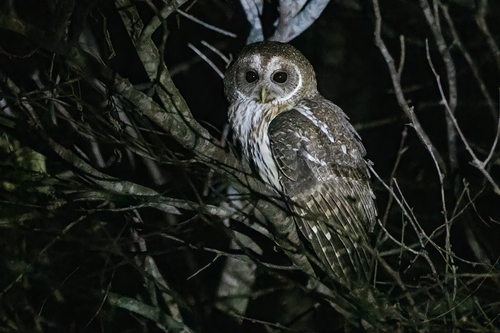
Rufous Banded Owl

Rufous Banded Owl

Strix albitarsis

Silhouette: Sharon Wegner-Larsen · PhyloPic

LCLeast ConcernNTVUENCR
Daily sighting probability <5% · Rare
at Farallones de Cali National Natural Park

In 3 days <5%

6 Verified sightings at Farallones de Cali National Natural Park From 2019 to 2026
75 In all 4 parks
July Best month
☀️🌙 Day & Night When it's spotted

About the Rufous Banded Owl

The rufous-banded owl (Strix albitarsis) is a species of owl in the family Strigidae. It is found in Bolivia, Colombia, Ecuador, Peru, and Venezuela. However, the South American Classification Committee of the American Ornithological Society (SACC/AOS), the Clements taxonomy, and BirdLife International's Handbook of the Birds of the World (HBW) assign it to genus Ciccaba. Even more confusingly, HBW agrees with the assignment of three subspecies but Clements considers the species to be monotypic.

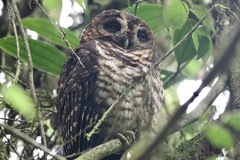
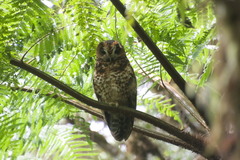
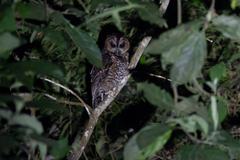
The rufous-banded owl is 30 to 35 cm (12 to 14 in) long; two specimens weighed 265 and 350 g (9.3 and 12.3 oz). It has a round head and no ear tufts. Adults have a rufous facial disk that is blacker around the orange eyes, white "brows", and white lores. The rest of the head and the upperparts are blackish brown with buffy rufous bars and spots. The tail is also blackish brown, with lighter bars. The chest is dark brown with whitish and tawny bars and spots... Wikipedia →

Sounds

Song0:38

Colombia · 2026

© Manuel Sánchez-Nivicela · XC1161945 · CC BY-NC-ND 4.0

Call0:46

Ecuador · 2024

© Barry Edmonston · XC1002101 · CC BY-NC-SA 4.0

Flight call0:10

Colombia · 2019

© David Monroy Rengifo · XC506954 · CC BY-NC-SA 4.0

Global Distribution

Parks Where Found

# Park Country Daily sighting probability
1 Podocarpus National Park 🇪🇨 Ecuador
<5%
2 Chingaza National Natural Park 🇨🇴 Colombia
<5%
3 Los Nevados National Natural Park 🇨🇴 Colombia
<5%
4 Farallones de Cali National Natural Park 🇨🇴 Colombia
<5%

Zoos & Centres Where Found

# Zoo / Centre Country
1 Dantas 🇨🇴 Colombia In captivity
2 Parque Cóndor 🇪🇨 Ecuador In captivity
3 Wiwa Quito 🇪🇨 Ecuador In captivity

Before you go

What are the chances of seeing a Rufous Banded Owl in Farallones de Cali National Natural Park?

Rare

Under 5% of wildlife watchers report a Rufous Banded Owl sighting in Farallones de Cali National Natural Park on a given day, based on 6 verified sightings from GBIF citizen-science data from 2019 to 2026. It is the 517th most-seen of the 542 birds we can rate there. Over three days the chance rises to under 5%, if each day is a fresh chance.

When is the best time to see a Rufous Banded Owl in Farallones de Cali National Natural Park?

Any time of year

In every month with enough records, under 5% of wildlife watchers report a Rufous Banded Owl in Farallones de Cali National Natural Park on a given day, so our monthly data shows no clear season.

What time of day is best to see a Rufous Banded Owl?

Between 7 and 10 pm

Across all the parks we cover, that three-hour window holds the most Rufous Banded Owl sightings with a recorded time, and about half of them come between 6 pm and 6 am: it is seen both by day and at night.

Is Farallones de Cali National Natural Park the best place to see a Rufous Banded Owl?

Among the best

Of the 4 parks where we can rate Rufous Banded Owl sightings, Farallones de Cali National Natural Park ranks 4th at under 5%, level with the leaders once rounded. The best odds are in Podocarpus National Park (Ecuador, under 5%), Chingaza National Natural Park (Colombia, under 5%) and Los Nevados National Natural Park (Colombia, under 5%).

Where does the Rufous Banded Owl sighting chance come from?

GBIF citizen-science records

It is estimated from how often the Rufous Banded Owl is recorded against all the birds logged in Farallones de Cali National Natural Park (6 verified sightings from 2019 to 2026), calibrated against known sighting rates. Figures are rounded to the nearest 10% because citizen-science data supports honest approximations, not decimals, and months with records from fewer than five people show "—". How it works.

← Back to Farallones de Cali National Natural Park