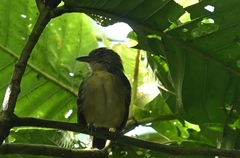
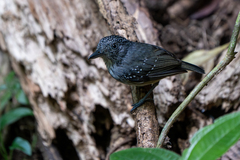

Spot-crowned Antvireo

Spot-crowned Antvireo

Dysithamnus puncticeps

Silhouette: Sheatherius · PhyloPic

LCLeast ConcernNTVUENCR
Daily sighting probability <5% · Rare
at Farallones de Cali National Natural Park

In 3 days <5% in a week ~10%

26 Verified sightings at Farallones de Cali National Natural Park From 2019 to 2026
959 In all 8 parks
June Best month
☀️ Diurnal When it's spotted

About the Spot-crowned Antvireo

The spot-crowned antvireo (Dysithamnus puncticeps) is a species of bird in subfamily Thamnophilinae of family Thamnophilidae, the "typical antbirds". It is found in Colombia, Costa Rica, Ecuador, and Panama. The spot-crowned antvireo is monotypic. It and the streak-crowned antvireo (D. striaticeps) are closely related and may form a superspecies.

The spot-crowned antvireo is 10 to 12 cm (3.9 to 4.7 in) long and weighs 15 to 17 g (0.53 to 0.60 oz). Adult males have a dark gray forehead, crown, and nape heavily marked with white spots. Their ear coverts are grayish. Their upperparts are grayish olive with a hidden white patch between the scapulars. Their flight feathers are dark grayish olive with wide buffy grayish edges; their wing coverts are blackish with white tips. Their tail is dark grayish olive with white tips on the feathers. Their throat, breast, and upper belly are white with dark streaks, their sides olive-gray, and their belly and undertail coverts whitish with an ochraceous tinge. Adult females have a rufous crown and nape with dark spots and pale buff ear coverts. Their wing coverts are less black than the male's. Their... Wikipedia →

Sounds

Song0:09

Panama · 2018

© Rainforest Connection · XC621787 · CC BY-NC-SA 4.0

Call0:47

Panama · 2015

© Peter Boesman · XC271240 · CC BY-NC-ND 4.0

Begging call0:16

Ecuador · 1997

© Olaf Jahn · XC262022 · CC BY-NC-SA 4.0

Global Distribution

Parks Where Found

# Park Country Daily sighting probability
1 Soberanía National Park 🇵🇦 Panama
~10%
2 Utría National Natural Park 🇨🇴 Colombia
~10%
3 Darién National Park 🇵🇦 Panama
<5%
4 Chagres National Park 🇵🇦 Panama
<5%
5 Gandoca-Manzanillo Wildlife Refuge 🇨🇷 Costa Rica
<5%
6 Cahuita National Park 🇨🇷 Costa Rica
<5%
7 Farallones de Cali National Natural Park 🇨🇴 Colombia
<5%
8 La Amistad International Park (Panama) 🇵🇦 Panama
<5%

Before you go

What are the chances of seeing a Spot-crowned Antvireo in Farallones de Cali National Natural Park?

Rare

Under 5% of wildlife watchers report a Spot-crowned Antvireo sighting in Farallones de Cali National Natural Park on a given day, based on 26 verified sightings from GBIF citizen-science data from 2019 to 2026. It is the 390th most-seen of the 542 birds we can rate there. Over three days the chance rises to under 5%, and over a week to about 10%, if each day is a fresh chance.

When is the best time to see a Spot-crowned Antvireo in Farallones de Cali National Natural Park?

Any time of year

In every month with enough records, under 5% of wildlife watchers report a Spot-crowned Antvireo in Farallones de Cali National Natural Park on a given day, so our monthly data shows no clear season.

What time of day is best to see a Spot-crowned Antvireo?

Between 9 am and noon

Across all the parks we cover, that three-hour window holds the most Spot-crowned Antvireo sightings with a recorded time, and about 9 in 10 of them come between 6 am and 6 pm: it is a daytime animal.

Is Farallones de Cali National Natural Park the best place to see a Spot-crowned Antvireo?

7th of 8

Of the 8 parks where we can rate Spot-crowned Antvireo sightings, Farallones de Cali National Natural Park ranks 7th at under 5%. The best odds are in Soberanía National Park (Panama, about 10%), Utría National Natural Park (Colombia, about 10%) and Darién National Park (Panama, under 5%).

Where does the Spot-crowned Antvireo sighting chance come from?

GBIF citizen-science records

It is estimated from how often the Spot-crowned Antvireo is recorded against all the birds logged in Farallones de Cali National Natural Park (26 verified sightings from 2019 to 2026), calibrated against known sighting rates. Figures are rounded to the nearest 10% because citizen-science data supports honest approximations, not decimals, and months with records from fewer than five people show "—". How it works.

← Back to Farallones de Cali National Natural Park