Cook's Petrel

Cook's Petrel

Pterodroma cookii

Silhouette: Kimberly Haddrell · PhyloPic

LCNTVUVulnerableENCR
Daily sighting probability <5% · Rare
at Fiordland National Park

In 3 days <5%

16 Verified sightings at Fiordland National Park From 2019 to 2026
51 In all 3 parks
December Best month
☀️ Diurnal When it's spotted

About the Cook's Petrel

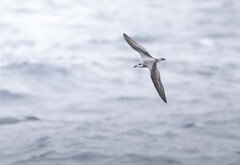
Cook's petrel (Pterodroma cookii) or tītī (Māori), blue-footed petrel, is a Procellariiform seabird endemic to New Zealand. It is a member of the gadfly petrels and part of the subgenus Cookilaria Bonaparte, 1856, which includes the very similar Stejneger's petrel.

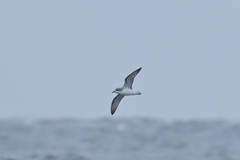
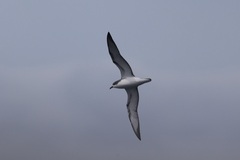
One of the smallest petrels, Cook's petrel is typically 25–30 cm (9.8–11.8 in) in length with a 65–66 cm (26–26 in) wingspan and a weight of around 200 g (7.1 oz). Its colouration is typical of gadfly petrels: pale grey upperparts with a dark grey "M" on the wings and white underparts.

The bill is long and black with tubular nostrils on both sides. As in all members of the order Procellariiformes, this nostril configuration enables an exceptionally acute sense of smell, which the birds use to locate food and nest sites in the dark.

Cook's petrel feeds mostly on fish and squid, with some crustaceans taken. The species is highly pelagic except when nesting. Cook's petrel breeds only in New Zealand on three small islands: Little Barrier Island, Great Barrier Island, and Codfish Island. The breeding season is the southern summer, from October to May. It nests in burrows and rock crevices... Wikipedia →

Sounds

Nocturnal flight call0:08

New Zealand · 2022

© Nathan El · XC776936 · CC BY-NC-SA 4.0

Recording0:10

New Zealand · 2022

© Oscar Dove · iNaturalist · CC BY 4.0

Recording0:02

New Zealand · 2023

Awhesian · iNaturalist · CC0

Global Distribution

Parks Where Found

# Park Country Daily sighting probability
1 Cabo Pulmo National Park 🇲🇽 Mexico
<5%
2 Rakiura National Park 🇳🇿 New Zealand
<5%
3 Fiordland National Park 🇳🇿 New Zealand
<5%

Before you go

What are the chances of seeing a Cook's Petrel in Fiordland National Park?

Rare

Under 5% of wildlife watchers report a Cook's Petrel sighting in Fiordland National Park on a given day, based on 16 verified sightings from GBIF citizen-science data from 2019 to 2026. It is the 83rd most-seen of the 94 birds we can rate there. Over three days the chance rises to under 5%, if each day is a fresh chance.

When is the best time to see a Cook's Petrel in Fiordland National Park?

Any time of year

In every month with enough records, under 5% of wildlife watchers report a Cook's Petrel in Fiordland National Park on a given day, so our monthly data shows no clear season.

What time of day is best to see a Cook's Petrel?

Between noon and 3 pm

Across all the parks we cover, that three-hour window holds the most Cook's Petrel sightings with a recorded time, and about 8 in 10 of them come between 6 am and 6 pm: it is a daytime animal.

Is Fiordland National Park the best place to see a Cook's Petrel?

Among the best

Of the 3 parks where we can rate Cook's Petrel sightings, Fiordland National Park ranks 3rd at under 5%, level with the leaders once rounded. The best odds are in Cabo Pulmo National Park (Mexico, under 5%) and Rakiura National Park (New Zealand, under 5%).

Where does the Cook's Petrel sighting chance come from?

GBIF citizen-science records

It is estimated from how often the Cook's Petrel is recorded against all the birds logged in Fiordland National Park (16 verified sightings from 2019 to 2026), calibrated against known sighting rates. Figures are rounded to the nearest 10% because citizen-science data supports honest approximations, not decimals, and months with records from fewer than five people show "—". How it works.

← Back to Fiordland National Park