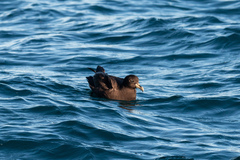
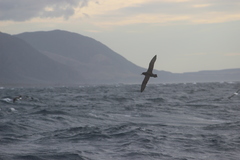
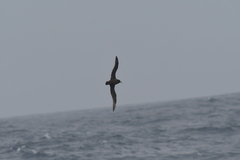
White-chinned Petrel

White-chinned Petrel

Procellaria aequinoctialis

Silhouette: Alexandre Vong · PhyloPic

LCNTVUVulnerableENCR
Daily sighting probability <5% · Rare
at Fiordland National Park

In 3 days <5% in a week ~10%

21 Verified sightings at Fiordland National Park From 2019 to 2026
452 In all 7 parks
February Best month
☀️ Diurnal When it's spotted

About the White-chinned Petrel

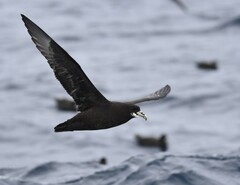
The white-chinned petrel (Procellaria aequinoctialis) also known as the Cape hen and shoemaker, is a large petrel in the family Procellariidae. It ranges around the Southern Ocean as far north as southern Australia, Peru and Namibia, and breeds colonially on scattered islands. The white-chinned petrel was formerly considered to be conspecific with the spectacled petrel (Procellaria conspicillata).

In 1747 the English naturalist George Edwards included an illustration and a description of the white-chinned petrel in the second volume of his A Natural History of Uncommon Birds. He used the English name "The great Black Peteril" and based his hand-coloured etching on a preserved specimen that had been brought to London. He believed that it had been collected near the Cape of Good Hope. When in 1758 the Swedish naturalist Carl Linnaeus updated his Systema Naturae for the tenth edition, he placed the white-chinned petrel with the other petrels in the genus Procellaria. Linnaeus included a brief description, coined the binomial name Procellaria aequinoctialis and cited Edwards' work.

There are two subspecies: P. a. aequinoctialis - breeds on islets of the temperate and subantarctic... Wikipedia →

Sounds

Recording1:29

France · 2020

© Hichem MACHOUK · XC622652 · CC BY-NC-SA 4.0

Call0:26

France · 2020

© Émile Brisson-Curadeau · XC555376 · CC BY-NC-SA 4.0

Call0:12

Chile · 2019

© Cristian Pinto · XC502559 · CC BY-NC-SA 4.0

Global Distribution

Parks Where Found

# Park Country Daily sighting probability
1 Table Mountain National Park 🇿🇦 South Africa
~10%
2 De Hoop Nature Reserve 🇿🇦 South Africa
<5%
3 Fiordland National Park 🇳🇿 New Zealand
<5%
4 Rakiura National Park 🇳🇿 New Zealand
<5%
5 West Coast National Park 🇿🇦 South Africa
<5%
6 iSimangaliso Wetland Park 🇿🇦 South Africa
<5%
7 Garden Route National Park 🇿🇦 South Africa
<5%

Cities Where Found

# City Country Daily sighting probability
1 Montevideo 🇺🇾 Uruguay
<5%

Before you go

What are the chances of seeing a White-chinned Petrel in Fiordland National Park?

Rare

Under 5% of wildlife watchers report a White-chinned Petrel sighting in Fiordland National Park on a given day, based on 21 verified sightings from GBIF citizen-science data from 2019 to 2026. It is the 79th most-seen of the 94 birds we can rate there. Over three days the chance rises to under 5%, and over a week to about 10%, if each day is a fresh chance.

When is the best time to see a White-chinned Petrel in Fiordland National Park?

Any time of year

In every month with enough records, under 5% of wildlife watchers report a White-chinned Petrel in Fiordland National Park on a given day, so our monthly data shows no clear season.

What time of day is best to see a White-chinned Petrel?

Between 8 and 11 am

Across all the parks we cover, that three-hour window holds the most White-chinned Petrel sightings with a recorded time, and about 9 in 10 of them come between 6 am and 6 pm: it is a daytime animal.

Is Fiordland National Park the best place to see a White-chinned Petrel?

3rd of 7

Of the 7 parks where we can rate White-chinned Petrel sightings, Fiordland National Park ranks 3rd at under 5%. The best odds are in Table Mountain National Park (South Africa, about 10%) and De Hoop Nature Reserve (South Africa, under 5%).

Where does the White-chinned Petrel sighting chance come from?

GBIF citizen-science records

It is estimated from how often the White-chinned Petrel is recorded against all the birds logged in Fiordland National Park (21 verified sightings from 2019 to 2026), calibrated against known sighting rates. Figures are rounded to the nearest 10% because citizen-science data supports honest approximations, not decimals, and months with records from fewer than five people show "—". How it works.

← Back to Fiordland National Park