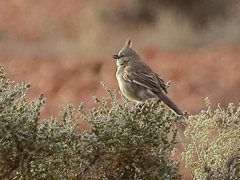
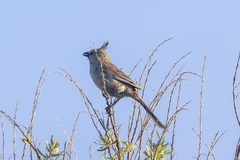

Chirruping Wedgebill

Chirruping Wedgebill

Psophodes cristatus

Silhouette: Sheatherius · PhyloPic

LCLeast ConcernNTVUENCR Endemic
Daily sighting probability ~10% · With luck
at Flinders Ranges National Park

In 3 days ~10% in a week ~30%

15 Verified sightings at Flinders Ranges National Park From 2019 to 2026
15 In 1 park
March Best month

About the Chirruping Wedgebill

The chirruping wedgebill (Psophodes cristatus) is a medium-sized member of the genus Psophodes, which consists or four to five songbirds endemic to Australia. Commonly found in low shrublands in south-eastern inland Australia, the species is distinguished by its distinctive, chirruping call. The chirruping wedgebill and chiming wedgebill (Psophodes occidentalis) were considered to be a single species until as late as 1973, when they were separated due to marked differences in their calls.

John Gould originally described P. cristatus and P. occidentalis as one species (Sphenostoma cristatum), and this remained common practice until c. 1973. The separation of the species at that date was based mainly on differences in song and range.

The chirruping wedgebill is a medium-sized bird, measuring approximately 18–21 cm and weighing 31-64 g. Its bill is dark and wedge-shaped when mature, and horn-coloured when immature. It possesses a slim upright crest, and long rounded tail. Adult plumage consists of pale brown upperparts, with white/pale grey underparts. Flight feathers are edged with white, and the tail is coloured dark black-brown with a white tip. Immature... Wikipedia →

Sounds

Song0:18

Australia · 2023

© Peter Boesman · XC860131 · CC BY-NC-ND 4.0

Call0:40

Australia · 2020

© Marc Anderson · XC611268 · CC BY-NC-ND 4.0

Song0:25

Australia · 2014

© Frank Lambert · XC407953 · CC BY-NC-ND 4.0

Global Distribution

Parks Where Found

# Park Country Daily sighting probability
1 Flinders Ranges National Park 🇦🇺 Australia
~10%

More parks will be added in future updates.

Before you go

What are the chances of seeing a Chirruping Wedgebill in Flinders Ranges National Park?

With luck

About 10% of wildlife watchers report a Chirruping Wedgebill sighting in Flinders Ranges National Park on a given day, based on 15 verified sightings from GBIF citizen-science data from 2019 to 2026. It is the 70th most-seen of the 94 birds we can rate there. Over three days the chance rises to about 10%, and over a week to about 30%, if each day is a fresh chance.

When is the best time to see a Chirruping Wedgebill in Flinders Ranges National Park?

March

In that month about 20% of wildlife watchers report a Chirruping Wedgebill in Flinders Ranges National Park on a given day, against under 5% in January–February, April–July, September and November, the lowest months. December has too few records to rate.

Where else can you see a Chirruping Wedgebill?

Only Flinders Ranges National Park, in our data

Flinders Ranges National Park is the only park on Wallace's Line with enough records to rate Chirruping Wedgebill sightings: about 10% of wildlife watchers there report one on a given day.

Which relatives of the Chirruping Wedgebill live in Flinders Ranges National Park?

Same order: Passeriformes

The closest relatives of the Chirruping Wedgebill that you can see in Flinders Ranges National Park (order Passeriformes, Perching Birds) are Australian Raven (about 80%), Australian Magpie (about 80%) and Yellow-throated Miner (about 80%), with each one's daily chance of a sighting.

Where does the Chirruping Wedgebill sighting chance come from?

GBIF citizen-science records

It is estimated from how often the Chirruping Wedgebill is recorded against all the birds logged in Flinders Ranges National Park (15 verified sightings from 2019 to 2026), calibrated against known sighting rates. Figures are rounded to the nearest 10% because citizen-science data supports honest approximations, not decimals, and months with records from fewer than five people show "—". How it works.

← Back to Flinders Ranges National Park