Red-capped Robin

Red-capped Robin

Petroica goodenovii

Silhouette: Sheatherius · PhyloPic

LCLeast ConcernNTVUENCR Endemic
Daily sighting probability ~60% · Likely
at Flinders Ranges National Park

In 3 days ~90% in a week >90%

282 Verified sightings at Flinders Ranges National Park From 2019 to 2026
1,029 In all 4 parks
April Best month
☀️ Diurnal When it's spotted

About the Red-capped Robin

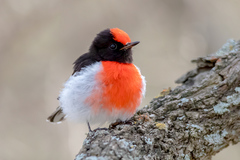
The red-capped robin (Petroica goodenovii) is a small passerine bird native to Australia. Found in drier regions across much of the continent, it inhabits scrub and open woodland. Like many brightly coloured robins of the family Petroicidae, it is sexually dimorphic. Measuring 10.5–12.5 cm (4.1–4.9 in) in length, the robin has a small, thin, black bill, and dark brown eyes and legs. The male has a distinctive red cap and red breast, black upperparts, and a black tail with white tips. The underparts and shoulders are white. The female is an undistinguished grey-brown. This species uses a variety of songs, and males generally sing to advertise territories and attract females. Birds are encountered in pairs or small groups, but the social behaviour has been little studied.

The position of the red-capped robin is unclear; it and its relatives are unrelated to European or American robins, but they appear to be an early offshoot of the songbird infraorder Passerida. The red-capped robin is a predominantly ground-feeding bird, and its prey consists of insects and spiders. Although widespread, it is uncommon in much of its range and has receded in some areas from human activity. Wikipedia →

Sounds

Call0:44

Australia · 2024

© Khristos Nizamis · XC957968 · CC BY-NC-ND 4.0

Song0:28

Australia · 2023

© Peter Boesman · XC860040 · CC BY-NC-ND 4.0

Call0:45

Australia · 2022

© Richard Boon · XC772306 · CC BY-NC-SA 4.0

Global Distribution

Parks Where Found

# Park Country Daily sighting probability
1 Flinders Ranges National Park 🇦🇺 Australia
~60%
2 Hattah-Kulkyne National Park 🇦🇺 Australia
~30%
3 Rottnest Island 🇦🇺 Australia
~30%
4 Uluru-Kata Tjuta National Park 🇦🇺 Australia
~20%

Cities Where Found

# City Country Daily sighting probability
1 Perth 🇦🇺 Australia
<5%
2 Melbourne 🇦🇺 Australia
<5%

Zoos & Centres Where Found

# Zoo / Centre Country
1 Alice Springs Desert Park 🇦🇺 Australia In captivity

Before you go

What are the chances of seeing a Red-capped Robin in Flinders Ranges National Park?

Likely

About 60% of wildlife watchers report a Red-capped Robin sighting in Flinders Ranges National Park on a given day, based on 282 verified sightings from GBIF citizen-science data from 2019 to 2026. It is the 7th most-seen of the 94 birds we can rate there. Over three days the chance rises to about 90%, and over a week to over 90%, if each day is a fresh chance.

When is the best time to see a Red-capped Robin in Flinders Ranges National Park?

April and November

In those months about 70% of wildlife watchers report a Red-capped Robin in Flinders Ranges National Park on a given day, against about 40% in January and August–September, the lowest months. Those are among Flinders Ranges National Park's wettest months, with about 35 mm of rain a month against 5 mm in February. December has too few records to rate.

What time of day is best to see a Red-capped Robin?

Between 10 am and 1 pm

Across all the parks we cover, that three-hour window holds the most Red-capped Robin sightings with a recorded time, and nearly all of them come between 6 am and 6 pm: it is a daytime animal.

Is Flinders Ranges National Park the best place to see a Red-capped Robin?

Yes

Of the 4 parks where we can rate Red-capped Robin sightings, Flinders Ranges National Park has the highest daily chance: about 60%. Next come Hattah-Kulkyne National Park (Australia, about 30%) and Rottnest Island (Australia, about 30%). All parks ranked.

Where does the Red-capped Robin sighting chance come from?

GBIF citizen-science records

It is estimated from how often the Red-capped Robin is recorded against all the birds logged in Flinders Ranges National Park (282 verified sightings from 2019 to 2026), calibrated against known sighting rates. Figures are rounded to the nearest 10% because citizen-science data supports honest approximations, not decimals, and months with records from fewer than five people show "—". How it works.

← Back to Flinders Ranges National Park

