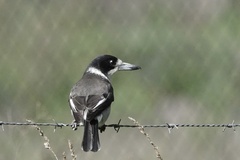

Grey Butcherbird

Grey Butcherbird

Cracticus torquatus

Silhouette: Sheatherius · PhyloPic

LCLeast ConcernNTVUENCR Endemic
Daily sighting probability ~50% · Likely
at Flinders Ranges National Park

In 3 days ~90% in a week >90%

189 Verified sightings at Flinders Ranges National Park From 2019 to 2026
6,228 In all 17 parks
June Best month
☀️ Diurnal When it's spotted

About the Grey Butcherbird

The grey butcherbird (Cracticus torquatus) is a widely distributed species endemic to Australia. It occurs in a range of different habitats including arid, semi-arid and temperate zones. It is found across southern Australia, but is absent from the deserts of central Australia and the monsoon tropics of northern Australia. It has a characteristic rollicking birdsong. It appears to be adapting well to city living, and can be encountered in the suburbs of many Australian cities including Brisbane, Melbourne, Perth, Sydney and Hobart. The grey butcherbird preys on small vertebrates including other birds.

Other birds in the same family include the Australian magpie, the currawongs, woodswallows and other members of the butcherbird genus Cracticus. The grey butcherbird was first described by the English ornithologist John Latham in 1801 under the binomial name Lanius torquatus.

Closely related species include the silver-backed butcherbird (Cracticus argenteus) and the black-backed butcherbird (Cracticus mentalis). The silver-backed butcherbird (Cracticus argenteus) from Arnhem Land and northwestern Australia over to Port Hedland, originally described by John Gould in 1841... Wikipedia →

Sounds

Begging call0:05

Australia · 2024

© Romuald Mikusek · XC1173633 · CC BY-NC-SA 4.0

Song0:24

Australia · 2026

© Nick Talbot · XC1105549 · CC BY-NC-SA 4.0

Call0:16

Australia · 2021

© Marc Anderson · XC695194 · CC BY-NC-ND 4.0

Global Distribution

Parks Where Found

# Park Country Daily sighting probability
1 Hattah-Kulkyne National Park 🇦🇺 Australia
~60%
2 Flinders Ranges National Park 🇦🇺 Australia
~50%
3 Blue Mountains National Park 🇦🇺 Australia
~40%
4 Royal National Park 🇦🇺 Australia
~40%
5 Freycinet National Park 🇦🇺 Australia
~30%
6 Wilsons Promontory National Park 🇦🇺 Australia
~30%
7 Noosa National Park 🇦🇺 Australia
~30%
8 Booderee National Park 🇦🇺 Australia
~20%
9 Springbrook National Park 🇦🇺 Australia
~20%
10 Great Otway National Park 🇦🇺 Australia
~10%
11 Kosciuszko National Park 🇦🇺 Australia
~10%
12 Lamington National Park 🇦🇺 Australia
~10%
13 Kakadu National Park 🇦🇺 Australia
~10%
14 Litchfield National Park 🇦🇺 Australia
<5%
15 Uluru-Kata Tjuta National Park 🇦🇺 Australia
<5%
16 Nitmiluk National Park 🇦🇺 Australia
<5%
17 Grampians National Park 🇦🇺 Australia
<5%

Cities Where Found

# City Country Daily sighting probability
1 Brisbane 🇦🇺 Australia
~60%
2 Sydney 🇦🇺 Australia
~50%
3 Melbourne 🇦🇺 Australia
~50%
4 Hobart 🇦🇺 Australia
~30%
5 Perth 🇦🇺 Australia
~20%

Zoos & Centres Where Found

# Zoo / Centre Country
1 Currumbin Wildlife Sanctuary 🇦🇺 Australia In captivity
2 Bonorong Wildlife Sanctuary 🇦🇺 Australia In captivity

Before you go

What are the chances of seeing a Grey Butcherbird in Flinders Ranges National Park?

Likely

About 50% of wildlife watchers report a Grey Butcherbird sighting in Flinders Ranges National Park on a given day, based on 189 verified sightings from GBIF citizen-science data from 2019 to 2026. It is the 13th most-seen of the 94 birds we can rate there. Over three days the chance rises to about 90%, and over a week to over 90%, if each day is a fresh chance.

When is the best time to see a Grey Butcherbird in Flinders Ranges National Park?

June

In that month about 70% of wildlife watchers report a Grey Butcherbird in Flinders Ranges National Park on a given day, against about 20% in April, the lowest month. December has too few records to rate.

What time of day is best to see a Grey Butcherbird?

Between 1 and 4 pm

Across all the parks we cover, that three-hour window holds the most Grey Butcherbird sightings with a recorded time, and nearly all of them come between 6 am and 6 pm: it is a daytime animal.

Is Flinders Ranges National Park the best place to see a Grey Butcherbird?

2nd of 17

Of the 17 parks where we can rate Grey Butcherbird sightings, Flinders Ranges National Park ranks 2nd at about 50%. The best odds are in Hattah-Kulkyne National Park (Australia, about 60%). All parks ranked.

Where does the Grey Butcherbird sighting chance come from?

GBIF citizen-science records

It is estimated from how often the Grey Butcherbird is recorded against all the birds logged in Flinders Ranges National Park (189 verified sightings from 2019 to 2026), calibrated against known sighting rates. Figures are rounded to the nearest 10% because citizen-science data supports honest approximations, not decimals, and months with records from fewer than five people show "—". How it works.

← Back to Flinders Ranges National Park