Small Grass-Yellow

Small Grass-Yellow

Eurema smilax

Daily sighting probability ~30% · Possible
at Flinders Ranges National Park

In 3 days ~60% in a week ~90%

11 Verified sightings at Flinders Ranges National Park From 2019 to 2026
28 In all 4 parks
September Best month
☀️ Diurnal When it's spotted

About the Small Grass-Yellow

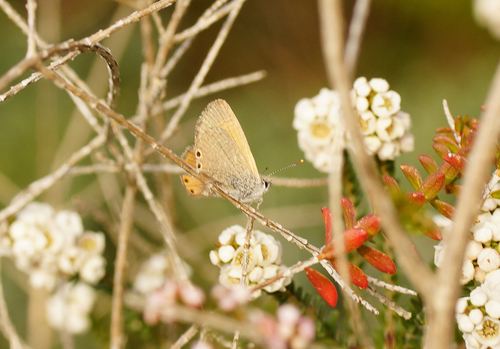
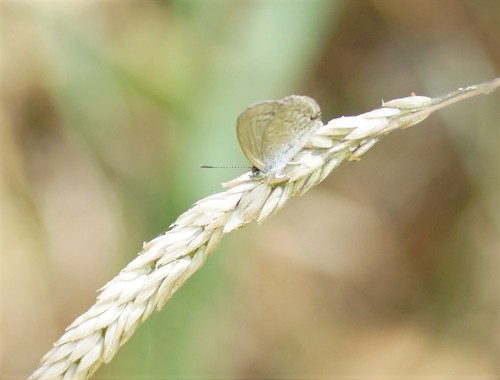
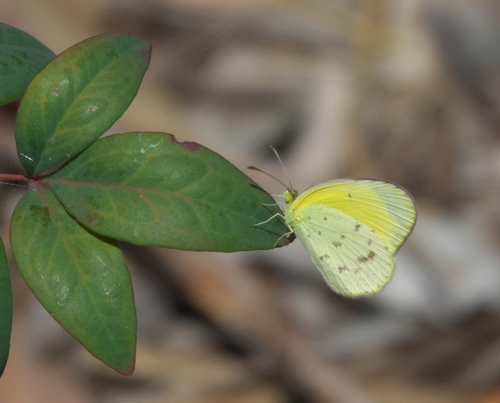
Eurema smilax, the small grass yellow, is a small pierid butterfly species found in Australia, with some additional records from India, Indonesia and Niger. The wingspan is about 30 mm. The larvae mostly feed on plants of the Senna and Neptunia genera.

The species was first described by Edward Donovan in 1805. Eurema smilax adults have a wingspan of 30–34 mm, with females being slightly larger than males. They are yellow, with black tips on the upper surface of the forewings. This colouration can vary depending on flight period. In southern Australia, the summer flying forms are usually pale yellow, with few or no brown markings on the wing undersides. The winter forms are a brighter yellow, with pronounced brown markings on the wing undersides. The males are generally a brighter yellow than the females.

The eggs are initially white, later turning yellowish. They are spindle-shaped, with a height of about 1.2 mm, and laid singly on a host plant. They hatch in about 7–11 days during spring. The caterpillar is initially pale yellow, soon becoming greenish. Third and fourth instars develop a darker dorsal line and a yellow lateral line. Mature larvae are... Wikipedia →
Global Distribution

Parks Where Found

# Park Country Daily sighting probability
1 Flinders Ranges National Park 🇦🇺 Australia
~30%
2 Uluru-Kata Tjuta National Park 🇦🇺 Australia
~10%
3 Lamington National Park 🇦🇺 Australia
~10%
4 Blue Mountains National Park 🇦🇺 Australia
<5%

Cities Where Found

# City Country Daily sighting probability
1 Brisbane 🇦🇺 Australia
~10%
2 Melbourne 🇦🇺 Australia
<5%
3 Sydney 🇦🇺 Australia
<5%

Before you go

What are the chances of seeing a Small Grass-Yellow in Flinders Ranges National Park?

Possible

About 30% of wildlife watchers report a Small Grass-Yellow sighting in Flinders Ranges National Park on a given day, based on 11 verified sightings from GBIF citizen-science data from 2019 to 2026. It is the 7th most-seen of the 25 insects we can rate there. Over three days the chance rises to about 60%, and over a week to about 90%, if each day is a fresh chance.

When is the best time to see a Small Grass-Yellow in Flinders Ranges National Park?

September

In that month about 50% of wildlife watchers report a Small Grass-Yellow in Flinders Ranges National Park on a given day, against under 5% in July and October–March, the lowest months.

What time of day is best to see a Small Grass-Yellow?

Between 9 am and noon

Across all the parks we cover, that three-hour window holds the most Small Grass-Yellow sightings with a recorded time, and about 9 in 10 of them come between 6 am and 6 pm: it is a daytime animal.

Is Flinders Ranges National Park the best place to see a Small Grass-Yellow?

Yes

Of the 4 parks where we can rate Small Grass-Yellow sightings, Flinders Ranges National Park has the highest daily chance: about 30%. Next come Uluru-Kata Tjuta National Park (Australia, about 10%) and Lamington National Park (Australia, about 10%).

Which relatives of the Small Grass-Yellow live in Flinders Ranges National Park?

Same order: Lepidoptera

The closest relatives of the Small Grass-Yellow that you can see in Flinders Ranges National Park (order Lepidoptera, Butterflies and Moths) are Meadow Argus (about 50%), Plain Tiger Butterfly (about 40%) and Heliotrope Moth (about 30%), with each one's daily chance of a sighting.

Where does the Small Grass-Yellow sighting chance come from?

GBIF citizen-science records

It is estimated from how often the Small Grass-Yellow is recorded against all the insects logged in Flinders Ranges National Park (11 verified sightings from 2019 to 2026), calibrated against known sighting rates. Figures are rounded to the nearest 10% because citizen-science data supports honest approximations, not decimals, and months with records from fewer than five people show "—". How it works.

← Back to Flinders Ranges National Park