Southern Scrub-Robin

Southern Scrub-Robin

Drymodes brunneopygia

Silhouette: Sheatherius · PhyloPic

LCLeast ConcernNTVUENCR Endemic
Daily sighting probability ~10% · With luck
at Flinders Ranges National Park

In 3 days ~30% in a week ~50%

38 Verified sightings at Flinders Ranges National Park From 2019 to 2026
103 In all 2 parks
November Best month
☀️ Diurnal When it's spotted

About the Southern Scrub-Robin

The southern scrub robin (Drymodes brunneopygia) is a species of bird in the family Petroicidae. It is endemic to Australia, where it occurs in mallee and heathland in the semi-arid southern parts of the continent. Its range includes several disjoint regions from central New South Wales through western Victoria and southern South Australia, through to the southwestern area of Western Australia.

The southern scrub robin was formally described in 1841 by the English ornithologist John Gould under the current binomial name Drymodes brunneopygia. Gould noted that the bird was found near the Murray River in South Australia. The specific epithet combines the Modern Latin brunneus, meaning "brown", with the Ancient Greek -pugios, meaning "-rumped". The species is monotypic: no subspecies are recognised.

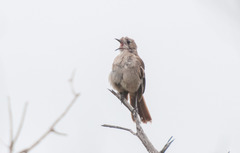
It is a relatively dull and large robin, adults being around 19–20 centimetres (7.5–7.9 in) in length, of which around a third is the tail feathers. Most of the plumage is grey, except for a dullish red tail and patterned black-and-white wings. The legs are unusually long for a passerine, and are frequently used to hop through the dense heathland that forms... Wikipedia →

Sounds

Song0:20

Australia · 2025

© Nick Talbot · XC993332 · CC BY-NC-SA 4.0

Call0:31

Australia · 2022

© Khristos Nizamis · XC715864 · CC BY-NC-ND 4.0

Song1:03

Australia · 2023

© Peter Boesman · XC859849 · CC BY-NC-ND 4.0

Global Distribution

Parks Where Found

# Park Country Daily sighting probability
1 Flinders Ranges National Park 🇦🇺 Australia
~10%
2 Hattah-Kulkyne National Park 🇦🇺 Australia
<5%

Before you go

What are the chances of seeing a Southern Scrub-Robin in Flinders Ranges National Park?

With luck

About 10% of wildlife watchers report a Southern Scrub-Robin sighting in Flinders Ranges National Park on a given day, based on 38 verified sightings from GBIF citizen-science data from 2019 to 2026. It is the 52nd most-seen of the 94 birds we can rate there. Over three days the chance rises to about 30%, and over a week to about 50%, if each day is a fresh chance.

When is the best time to see a Southern Scrub-Robin in Flinders Ranges National Park?

August and November

In those months about 20% of wildlife watchers report a Southern Scrub-Robin in Flinders Ranges National Park on a given day, against under 5% in March and May, the lowest months. Those are among Flinders Ranges National Park's wettest months, with about 35 mm of rain a month against 5 mm in February. December has too few records to rate.

What time of day is best to see a Southern Scrub-Robin?

Between 9 am and noon

Across all the parks we cover, that three-hour window holds the most Southern Scrub-Robin sightings with a recorded time, and about 9 in 10 of them come between 6 am and 6 pm: it is a daytime animal.

Is Flinders Ranges National Park the best place to see a Southern Scrub-Robin?

Yes

Of the 2 parks where we can rate Southern Scrub-Robin sightings, Flinders Ranges National Park has the highest daily chance: about 10%. Next come Hattah-Kulkyne National Park (Australia, under 5%).

Where does the Southern Scrub-Robin sighting chance come from?

GBIF citizen-science records

It is estimated from how often the Southern Scrub-Robin is recorded against all the birds logged in Flinders Ranges National Park (38 verified sightings from 2019 to 2026), calibrated against known sighting rates. Figures are rounded to the nearest 10% because citizen-science data supports honest approximations, not decimals, and months with records from fewer than five people show "—". How it works.

← Back to Flinders Ranges National Park

