Cuvier's Beaked Whale

Cuvier's Beaked Whale

Ziphius cavirostris

Silhouette: Chris huh · PhyloPic

LCLeast ConcernNTVUENCR
Daily sighting probability <5% · Rare
at Galápagos Islands

In 3 days ~10% in a week ~20%

5 Verified sightings at Galápagos Islands From 2019 to 2026
5 In 1 park
October Best month
☀️ Diurnal When it's spotted

About the Cuvier's Beaked Whale

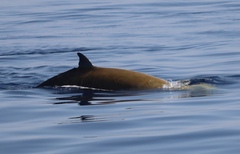
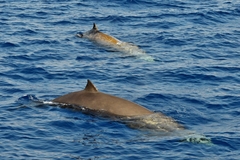
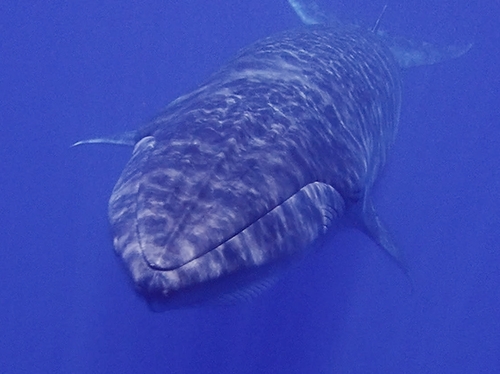
Cuvier's beaked whale, goose-beaked whale, or ziphius (Ziphius cavirostris) is the most widely distributed of all beaked whales in the family Ziphiidae. It is among the largest beaked whales but smaller than most baleen whales, reaching lengths of about 4.5–8 metres (15–26 ft) and weights of 1,800–3,100 kg (4,000–6,800 lb).

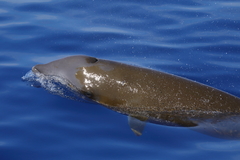
This species is pelagic, inhabiting deep offshore waters far from coastlines, typically deeper than 1,000 metres (3,300 ft). They reside mostly in temperate, tropical, and subtropical areas of the Atlantic, Pacific, and Indian Oceans.

Cuvier's beaked whale holds the record for both the deepest and longest recorded dives among mammals. Recorded dives have reached depths of 2,992 m (9,816 ft) and durations of 222 minutes. Although the species is currently listed as Least Concern by the International Union of Conservation of Nature, it faces several anthropogenic (human-made) threats, including entanglement in fishing gear, hunting, and ocean noise.

The body of Cuvier's beaked whale is robust and cigar-shaped, similar to those of other beaked whales. Adult Cuvier beaked whales vary in length from 4.5–8 metres (15–26 ft... Wikipedia →

Global Distribution

Parks Where Found

# Park Country Daily sighting probability
1 Galápagos Islands 🇪🇨 Ecuador
<5%

More parks will be added in future updates.

Before you go

What are the chances of seeing a Cuvier's Beaked Whale in Galápagos Islands?

Rare

Under 5% of wildlife watchers report a Cuvier's Beaked Whale sighting in Galápagos Islands on a given day, based on 5 verified sightings from GBIF citizen-science data from 2019 to 2026. It is the 12th most-seen of the 12 mammals we can rate there. Over three days the chance rises to about 10%, and over a week to about 20%, if each day is a fresh chance.

When is the best time to see a Cuvier's Beaked Whale in Galápagos Islands?

April and October

In those months about 10% of wildlife watchers report a Cuvier's Beaked Whale in Galápagos Islands on a given day, against under 5% in May–September and November–March, the lowest months.

What time of day is best to see a Cuvier's Beaked Whale?

Between 9 am and noon

Across all the parks we cover, that three-hour window holds the most Cuvier's Beaked Whale sightings with a recorded time, and about 8 in 10 of them come between 6 am and 6 pm: it is a daytime animal.

Where else can you see a Cuvier's Beaked Whale?

Only Galápagos Islands, in our data

Galápagos Islands is the only park on Wallace's Line with enough records to rate Cuvier's Beaked Whale sightings: under 5% of wildlife watchers there report one on a given day.

Which relatives of the Cuvier's Beaked Whale live in Galápagos Islands?

Same order: Cetacea

The closest relatives of the Cuvier's Beaked Whale that you can see in Galápagos Islands (order Cetacea) are Bottlenose Dolphin (about 20%), Killer Whale (about 10%) and Humpback Whale (about 10%), with each one's daily chance of a sighting.

Where does the Cuvier's Beaked Whale sighting chance come from?

GBIF citizen-science records

It is estimated from how often the Cuvier's Beaked Whale is recorded against all the mammals logged in Galápagos Islands (5 verified sightings from 2019 to 2026), calibrated against known sighting rates. Figures are rounded to the nearest 10% because citizen-science data supports honest approximations, not decimals, and months with records from fewer than five people show "—". How it works.

← Back to Galápagos Islands