Sperm Whale

Sperm Whale

Physeter macrocephalus

Silhouette: Chris huh · PhyloPic

LCNTVUVulnerableENCR
Daily sighting probability <5% · Rare
at Galápagos Islands

In 3 days ~10% in a week ~30%

7 Verified sightings at Galápagos Islands From 2019 to 2026
12 In all 2 parks
February Best month
☀️ Diurnal When it's spotted

About the Sperm Whale

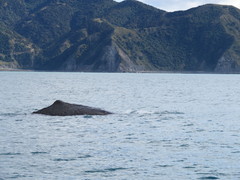
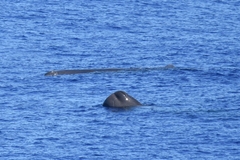
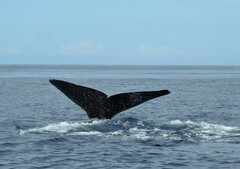
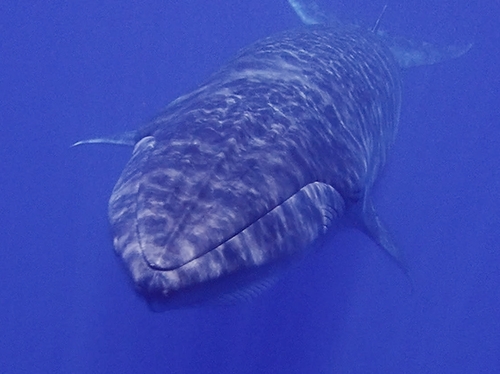
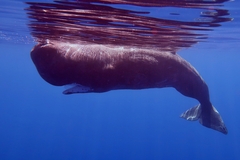
The sperm whale or cachalot (Physeter macrocephalus) is the largest of the toothed whales and the largest toothed predator. It is the only living member of the genus Physeter and one of three extant species in the sperm whale superfamily Physeteroidea, along with the pygmy sperm whale and dwarf sperm whale of the genus Kogia.

The sperm whale is a pelagic mammal with a worldwide range, and will migrate seasonally for feeding and breeding. Females and young males live together in groups, while mature males (bulls) live solitary lives outside of the mating season. The females cooperate to protect and nurse their young. Females give birth every four to twenty years and care for the calves for more than a decade. A mature, healthy sperm whale has no natural predators, although calves and weakened adults are sometimes killed by pods of orcas.

Mature males average 16 metres (52 ft) in length, with the head representing up to one-third of the animal's length. Plunging to 2,250 metres (7,380 ft), it is the third deepest diving mammal, exceeded only by the southern elephant seal and Cuvier's beaked whale. The sperm whale uses echolocation and vocalization with source level as loud as 236 decibels (re 1 μPa m) underwater, the loudest of any animal. It has the largest brain on Earth, more than five times heavier than a human's. Sperm whales can live 70 years or more.

Sperm whales' heads are filled with a waxy substance called "spermaceti" (sperm oil), from which the whale derives its name. Spermaceti was a prime target of the whaling industry and was sought after for use in oil lamps, lubricants, and candles. Ambergris, a solid waxy waste product sometimes present in its digestive system, is still highly valued as a fixative in perfumes, among other uses. Beachcombers look out for ambergris as flotsam. Sperm whaling was a major industry in the 19th century, depicted in the novel Moby-Dick. The species is protected by the International Whaling Commission moratorium, and is listed as vulnerable by the International Union for Conservation of Nature. Wikipedia →

Sounds

Recording0:20

United States · 2022

© Robin Gwen Agarwal · iNaturalist · CC BY-NC 4.0

Recording0:22

Dominica · 2024

© sandiwheeler · iNaturalist · CC BY-NC 4.0

Recording0:07

Portugal · 2025

© Valentin Moser · iNaturalist · CC BY 4.0

Global Distribution

Parks Where Found

# Park Country Daily sighting probability
1 Galápagos Islands 🇪🇨 Ecuador
<5%
2 Wadden Sea National Park 🇩🇪 Germany
<5%

Zoos & Centres Where Found

# Zoo / Centre Country
1 Copenhagen Zoo 🇩🇰 Denmark In captivity
2 Ostrava Zoo 🇨🇿 Czechia In captivity
3 Aqua World 🇯🇵 Japan In captivity
4 Parque Marino de La Magdalena 🇪🇸 Spain In captivity

Before you go

What are the chances of seeing a Sperm Whale in Galápagos Islands?

Rare

Under 5% of wildlife watchers report a Sperm Whale sighting in Galápagos Islands on a given day, based on 7 verified sightings from GBIF citizen-science data from 2019 to 2026. It is the 10th most-seen of the 12 mammals we can rate there. Over three days the chance rises to about 10%, and over a week to about 30%, if each day is a fresh chance.

When is the best time to see a Sperm Whale in Galápagos Islands?

February, April, July–August and October

In those months about 10% of wildlife watchers report a Sperm Whale in Galápagos Islands on a given day, against under 5% in March, May–June, September and November–January, the lowest months.

What time of day is best to see a Sperm Whale?

Between 10 am and 1 pm

Across all the parks we cover, that three-hour window holds the most Sperm Whale sightings with a recorded time, and about 9 in 10 of them come between 6 am and 6 pm: it is a daytime animal.

Is Galápagos Islands the best place to see a Sperm Whale?

Yes

Of the 2 parks where we can rate Sperm Whale sightings, Galápagos Islands has the highest daily chance: under 5%. Next come Wadden Sea National Park (Germany, under 5%).

Which relatives of the Sperm Whale live in Galápagos Islands?

Same order: Cetacea

The closest relatives of the Sperm Whale that you can see in Galápagos Islands (order Cetacea) are Bottlenose Dolphin (about 20%), Killer Whale (about 10%) and Humpback Whale (about 10%), with each one's daily chance of a sighting.

Where does the Sperm Whale sighting chance come from?

GBIF citizen-science records

It is estimated from how often the Sperm Whale is recorded against all the mammals logged in Galápagos Islands (7 verified sightings from 2019 to 2026), calibrated against known sighting rates. Figures are rounded to the nearest 10% because citizen-science data supports honest approximations, not decimals, and months with records from fewer than five people show "—". How it works.

← Back to Galápagos Islands