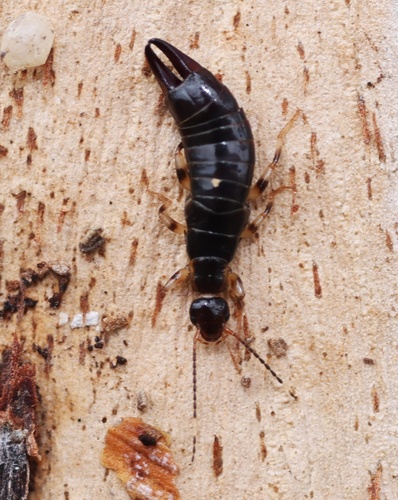
Ring-Legged Earwig

Ring-Legged Earwig

Euborellia annulipes

Daily sighting probability <5% · Rare
at Galápagos Islands

In 3 days ~10% in a week ~20%

7 Verified sightings at Galápagos Islands From 2019 to 2026
7 In 1 park
August Best month
☀️ Diurnal When it's spotted

About the Ring-Legged Earwig

The ringlegged earwig (Euborellia annulipes) is a species of earwig in the family Anisolabididae. Adult Euborellia annulipes are typically dark brown, and 10 mm (0.4 in) to 25 mm (1.0 in) in length. It is a wingless species, and like most earwigs, the females are larger than the males. Their legs are a pale brown color, and have a noticeable dark band around the middle of the femur, or occasionally the tibia, hence their common name. Their antenna generally have sixteen segments, although other numbers are possible.

Their cerci share similar characteristics to most earwigs, as males' cerci are more curved than females'. Further sex differences can be found in the species abdomen: males have ten abdominal segments, while females have eight.

Described by Hippolyte Lucas in 1847, the ringlegged earwig has been known to inhabit the United States since 1902. Over the years, it has obtained a cosmopolitan status, documented all over the world. The species, like other earwigs, tends to inhabit both tropical and temperate climates.

Adult females generally lay eggs in batches, with an average of fifty eggs in each batch, and two... Wikipedia →
Global Distribution

Parks Where Found

# Park Country Daily sighting probability
1 Galápagos Islands 🇪🇨 Ecuador
<5%

More parks will be added in future updates.

Cities Where Found

# City Country Daily sighting probability
1 Mendoza 🇦🇷 Argentina
~20%
2 Buenos Aires 🇦🇷 Argentina
~10%
3 Athens 🇬🇷 Greece
~10%
4 Tel Aviv 🇮🇱 Israel
~10%
5 Sacramento 🇺🇸 United States
~10%
6 Las Vegas 🇺🇸 United States
<5%
7 Los Angeles 🇺🇸 United States
<5%
8 Hyderabad 🇮🇳 India
<5%
9 Mesa 🇺🇸 United States
<5%
10 Lima 🇵🇪 Peru
<5%

Before you go

What are the chances of seeing a Ring-Legged Earwig in Galápagos Islands?

Rare

Under 5% of wildlife watchers report a Ring-Legged Earwig sighting in Galápagos Islands on a given day, based on 7 verified sightings from GBIF citizen-science data from 2019 to 2026. It is the 68th most-seen of the 83 insects we can rate there. Over three days the chance rises to about 10%, and over a week to about 20%, if each day is a fresh chance.

When is the best time to see a Ring-Legged Earwig in Galápagos Islands?

May, August and October

In those months about 10% of wildlife watchers report a Ring-Legged Earwig in Galápagos Islands on a given day, against under 5% in June–July, September and November–April, the lowest months. Those are among Galápagos Islands's driest months, with about 5 mm of rain a month against 50 mm in March.

What time of day is best to see a Ring-Legged Earwig?

Between 6 and 9 am

Across all the parks we cover, that three-hour window holds the most Ring-Legged Earwig sightings with a recorded time, and about 9 in 10 of them come between 6 am and 6 pm: it is a daytime animal.

Where else can you see a Ring-Legged Earwig?

Only Galápagos Islands, in our data

Galápagos Islands is the only park on Wallace's Line with enough records to rate Ring-Legged Earwig sightings: under 5% of wildlife watchers there report one on a given day.

Where does the Ring-Legged Earwig sighting chance come from?

GBIF citizen-science records

It is estimated from how often the Ring-Legged Earwig is recorded against all the insects logged in Galápagos Islands (7 verified sightings from 2019 to 2026), calibrated against known sighting rates. Figures are rounded to the nearest 10% because citizen-science data supports honest approximations, not decimals, and months with records from fewer than five people show "—". How it works.

← Back to Galápagos Islands