Sooty Tern

Sooty Tern

Onychoprion fuscatus

Silhouette: Sheatherius · PhyloPic

LCLeast ConcernNTVUENCR
Daily sighting probability <5% · Rare
at Galápagos Islands

In 3 days <5%

46 Verified sightings at Galápagos Islands From 2019 to 2026
69 In all 3 parks
June Best month
☀️ Diurnal When it's spotted

About the Sooty Tern

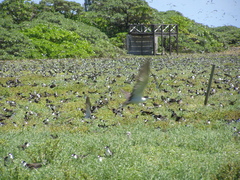
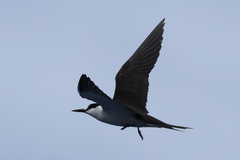
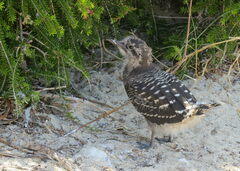
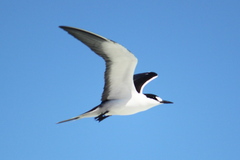
The sooty tern (Onychoprion fuscatus) is a tern in the family Laridae. It is a seabird of the tropical oceans and can fly for years at a time, skimming the sea surface for food, and returning to land only to breed, on islands throughout the equatorial zone.

The sooty tern was described by Carl Linnaeus in 1766 as Sterna fuscata, bearing this name for many years until the genus Sterna was split up; it is now classified in the genus Onychoprion as Onychoprion fuscatus. The genus name is from ancient Greek onux, "claw" or "nail", and prion, "saw". The species name fuscatus is Latin for "dark".

The sooty tern has little interspecific variation, but it is usually divided into six to eight allopatric subspecies. Some recent authors further subdivide the Indopacific population into up to eight subspecies altogether, but much of the variation is clinal. The affinities of eastern Pacific birds (including O. f. manutarus of Easter Island) are most strongly contested. Six subspecies are currently accepted by the IOC:

Onychoprion fuscatus fuscatus (Linnaeus, 1766) – breeds on tropical Atlantic Ocean, Gulf of Mexico, and Caribbean islands. Underparts white. Onychoprion fuscatus nubilosus... Wikipedia →

Sounds

Alarm call0:55

Australia · 2022

© Craig Robertson · XC766526 · CC BY-NC-SA 4.0

Flight call0:08

France · 2021

© AUDEVARD Aurélien · XC620158 · CC BY-NC-SA 4.0

Call0:28

Seychelles · 2018

© Simon Elliott · XC589457 · CC BY-NC-ND 4.0

Global Distribution

Parks Where Found

# Park Country Daily sighting probability
1 Raja Ampat 🇮🇩 Indonesia
<5%
2 Galápagos Islands 🇪🇨 Ecuador
<5%
3 Everglades National Park 🇺🇸 United States
<5%

Cities Where Found

# City Country Daily sighting probability
1 Auckland 🇳🇿 New Zealand
~10%
2 Mumbai 🇮🇳 India
<5%
3 Colombo [Sri Jayawardenepura Kotte] 🇱🇰 Sri Lanka
<5%
4 Miami 🇺🇸 United States
<5%

Before you go

What are the chances of seeing a Sooty Tern in Galápagos Islands?

Rare

Under 5% of wildlife watchers report a Sooty Tern sighting in Galápagos Islands on a given day, based on 46 verified sightings from GBIF citizen-science data from 2019 to 2026. It is the 87th most-seen of the 114 birds we can rate there. Over three days the chance rises to under 5%, if each day is a fresh chance.

When is the best time to see a Sooty Tern in Galápagos Islands?

Any time of year

In every month with enough records, under 5% of wildlife watchers report a Sooty Tern in Galápagos Islands on a given day, so our monthly data shows no clear season.

What time of day is best to see a Sooty Tern?

Between 7 and 10 am

Across all the parks we cover, that three-hour window holds the most Sooty Tern sightings with a recorded time, and about 9 in 10 of them come between 6 am and 6 pm: it is a daytime animal.

Is Galápagos Islands the best place to see a Sooty Tern?

Among the best

Of the 3 parks where we can rate Sooty Tern sightings, Galápagos Islands ranks 2nd at under 5%, level with the leaders once rounded. The best odds are in Raja Ampat (Indonesia, under 5%).

Which relatives of the Sooty Tern live in Galápagos Islands?

Same family: Laridae

The closest relatives of the Sooty Tern that you can see in Galápagos Islands (family Laridae, Gulls, Terns, and Skimmers) are Brown Noddy (about 60%), Lava Gull (about 40%) and Swallow-tailed Gull (about 40%), with each one's daily chance of a sighting.

Where does the Sooty Tern sighting chance come from?

GBIF citizen-science records

It is estimated from how often the Sooty Tern is recorded against all the birds logged in Galápagos Islands (46 verified sightings from 2019 to 2026), calibrated against known sighting rates. Figures are rounded to the nearest 10% because citizen-science data supports honest approximations, not decimals, and months with records from fewer than five people show "—". How it works.

← Back to Galápagos Islands