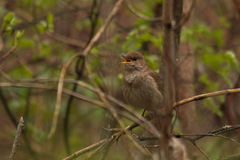
Thrush Nightingale

Thrush Nightingale

Luscinia luscinia

Silhouette: Stephan Sprinz · PhyloPic

LCLeast ConcernNTVUENCR
Daily sighting probability ~20% · Possible
at Gauja National Park

In 3 days ~50% in a week ~80%

119 Verified sightings at Gauja National Park From 2019 to 2026
1,477 In all 14 parks
May Best month
☀️ Diurnal When it's spotted

About the Thrush Nightingale

The thrush nightingale (Luscinia luscinia), also known as the sprosser, is a small passerine bird in the Old World flycatcher family. It is a migratory species breeding in forests in Europe and the Palearctic and overwintering in Africa. An insectivore, it nests near the ground in dense undergrowth. Its distribution is more northerly than the very closely related common nightingale (Luscinia megarhynchos), which it closely resembles in appearance. Hybrids between the two have occurred in areas where their ranges overlap.

The thrush nightingale is similar in size to the European robin. Sexes are similar, both being plain greyish-brown above and white and greyish-brown below. Its greyer tones, giving a cloudy appearance to the underside, and lack of the common nightingale's obvious rufous tail side patches are the clearest plumage differences from that species. It also has a similar but somewhat more solemn song than that of L. megarhynchos. The nightingales, and similar small European species, are often called chats.

The thrush nightingale belongs to a distinctive group of Old World flycatchers, known as chats, that were formerly thought to be thrushes. It was formally... Wikipedia →

Sounds

Song1:11

Finland · 2026

© Eetu Paljakka · XC1139387 · CC BY-NC-SA 4.0

Alarm call0:23

Latvia · 2026

© Kaspars Funts · XC1136921 · CC BY-NC-SA 4.0

Begging call1:28

Ukraine · 2025

© Taras Vykhovanets · XC1018588 · CC BY-NC-ND 4.0

Global Distribution

Parks Where Found

# Park Country Daily sighting probability
1 Biebrza National Park 🇵🇱 Poland
~40%
2 Białowieża National Park 🇵🇱 Poland
~30%
3 Gauja National Park 🇱🇻 Latvia
~20%
4 Tsavo West National Park 🇰🇪 Kenya
~10%
5 Meru National Park 🇰🇪 Kenya
~10%
6 Ruaha National Park 🇹🇿 Tanzania
<5%
7 Tsavo East National Park 🇰🇪 Kenya
<5%
8 Mana Pools National Park 🇿🇼 Zimbabwe
<5%
9 Samburu National Reserve 🇰🇪 Kenya
<5%
10 South Luangwa National Park 🇿🇲 Zambia
<5%
11 Amboseli National Park 🇰🇪 Kenya
<5%
12 Nairobi National Park 🇰🇪 Kenya
<5%
13 Kruger National Park 🇿🇦 South Africa
<5%
14 Wadden Sea National Park 🇩🇪 Germany
<5%

Cities Where Found

# City Country Daily sighting probability
1 Jerusalem 🇮🇱 Israel
~20%
2 Nizhny Novgorod 🇷🇺 Russia
~20%
3 Moscow 🇷🇺 Russia
~10%
4 Minsk 🇧🇾 Belarus
~10%
5 Kharkiv 🇺🇦 Ukraine
~10%
6 Helsinki 🇫🇮 Finland
~10%
7 Saint Petersburg 🇷🇺 Russia
~10%
8 Yekaterinburg 🇷🇺 Russia
~10%
9 Kazan 🇷🇺 Russia
~10%
10 Kyiv 🇺🇦 Ukraine
~10%

Before you go

What are the chances of seeing a Thrush Nightingale in Gauja National Park?

Possible

About 20% of wildlife watchers report a Thrush Nightingale sighting in Gauja National Park on a given day, based on 119 verified sightings from GBIF citizen-science data from 2019 to 2026. It is the 34th most-seen of the 124 birds we can rate there. Over three days the chance rises to about 50%, and over a week to about 80%, if each day is a fresh chance.

When is the best time to see a Thrush Nightingale in Gauja National Park?

May

In that month about 70% of wildlife watchers report a Thrush Nightingale in Gauja National Park on a given day, against under 5% in September to February, the lowest months.

What time of day is best to see a Thrush Nightingale?

Between 9 am and noon

Across all the parks we cover, that three-hour window holds the most Thrush Nightingale sightings with a recorded time, and about 8 in 10 of them come between 6 am and 6 pm: it is a daytime animal.

Is Gauja National Park the best place to see a Thrush Nightingale?

3rd of 14

Of the 14 parks where we can rate Thrush Nightingale sightings, Gauja National Park ranks 3rd at about 20%. The best odds are in Biebrza National Park (Poland, about 40%) and Białowieża National Park (Poland, about 30%).

Which relatives of the Thrush Nightingale live in Gauja National Park?

Same family: Muscicapidae

The closest relatives of the Thrush Nightingale that you can see in Gauja National Park (family Muscicapidae, Old World Flycatchers, Robins, and Chats) are European Robin (about 40%), Common Redstart (about 20%) and Black Redstart (about 10%), with each one's daily chance of a sighting.

Where does the Thrush Nightingale sighting chance come from?

GBIF citizen-science records

It is estimated from how often the Thrush Nightingale is recorded against all the birds logged in Gauja National Park (119 verified sightings from 2019 to 2026), calibrated against known sighting rates. Figures are rounded to the nearest 10% because citizen-science data supports honest approximations, not decimals, and months with records from fewer than five people show "—". How it works.

← Back to Gauja National Park