Williamson's Sapsucker

Williamson's Sapsucker

Sphyrapicus thyroideus

Silhouette: Nancy Wyman (photo), John E. McCormack, Michael G. Harvey, Brant C. Faircloth, Nicholas G. Crawford, Travis C. Glenn, Robb T. Brumfield & T. Michael Keesey · PhyloPic

LCLeast ConcernNTVUENCR
Daily sighting probability <5% · Rare
at Glacier National Park

In 3 days <5%

10 Verified sightings at Glacier National Park From 2019 to 2026
1,640 In all 10 parks
July Best month
☀️ Diurnal When it's spotted

About the Williamson's Sapsucker

Williamson's sapsucker (Sphyrapicus thyroideus) is a medium-sized woodpecker belonging to the genus Sphyrapicus (sapsuckers). Breeding habitat is open forested areas with conifers, mainly ponderosa pine, douglas-fir, and grand fir. Subalpine fir and western larch may also be important components of good habitat for these birds. Partially migratory, they breed in western North America from northern Mexico as far north as British Columbia. They are permanent residents in some parts of their range; migrating birds form small flocks and may travel as far south as central Mexico.

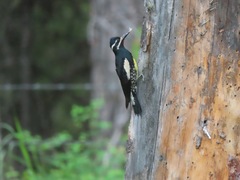
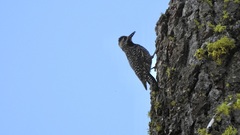
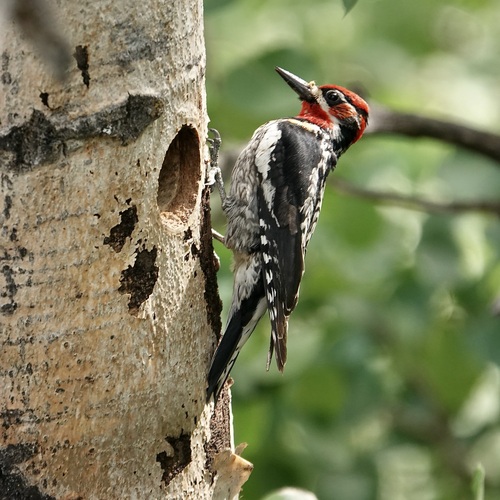
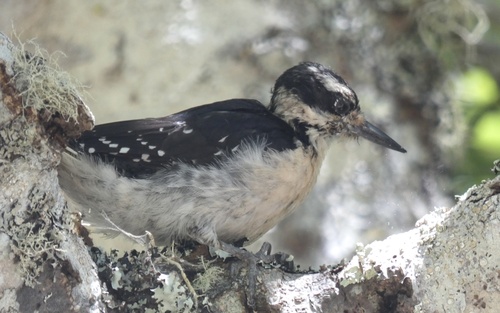
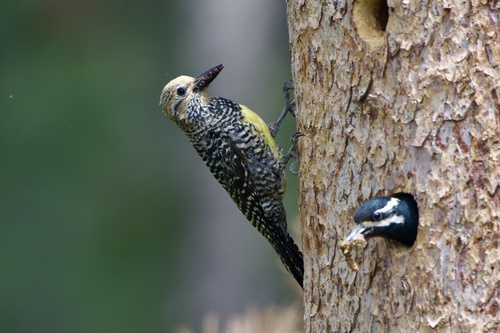
Adult males are iridescent black on their head, back, sides and tail. They have a white stripe behind the eye and a lower white stripe across each side of the head, a red chin and a bright yellow belly. They have black wings with large white patches. The female is completely different in appearance: mainly black, with a pale yellow breast, a brownish head with black streaking and fine barring on the back, breast and sides. Originally, the female was considered to be a different species and named the black-breasted woodpecker by Cassin.

Measurements: Length: 8.3–9.8 in... Wikipedia →
Sounds

Drumming1:05

United States · 2022

© Paul Marvin · XC737526 · CC BY-NC-SA 4.0

Call0:26

United States · 2020

© Richard E. Webster · XC663254 · CC BY-NC-SA 4.0

Nest carving1:20

United States · 2016

© Bruce Lagerquist · XC340363 · CC BY-NC-SA 4.0

Global Distribution

Parks Where Found

# Park Country Daily sighting probability
1 Rocky Mountain National Park 🇺🇸 United States
~10%
2 Yellowstone National Park 🇺🇸 United States
~10%
3 Yosemite National Park 🇺🇸 United States
~10%
4 Grand Canyon National Park 🇺🇸 United States
<5%
5 Sequoia and Kings Canyon National Parks 🇺🇸 United States
<5%
6 Guadalupe Mountains National Park 🇺🇸 United States
<5%
7 Grand Teton National Park 🇺🇸 United States
<5%
8 Zion National Park 🇺🇸 United States
<5%
9 Glacier National Park 🇺🇸 United States
<5%
10 Big Bend National Park 🇺🇸 United States
<5%

Cities Where Found

# City Country Daily sighting probability
1 Monterrey 🇲🇽 México
<5%
2 Portland 🇺🇸 United States
<5%
3 Phoenix 🇺🇸 United States
<5%
4 Mesa 🇺🇸 United States
<5%
5 San Francisco 🇺🇸 United States
<5%

Before you go

What are the chances of seeing a Williamson's Sapsucker in Glacier National Park?

Rare

Under 5% of wildlife watchers report a Williamson's Sapsucker sighting in Glacier National Park on a given day, based on 10 verified sightings from GBIF citizen-science data from 2019 to 2026. It is the 168th most-seen of the 174 birds we can rate there. Over three days the chance rises to under 5%, if each day is a fresh chance.

When is the best time to see a Williamson's Sapsucker in Glacier National Park?

Any time of year

In every month with enough records, under 5% of wildlife watchers report a Williamson's Sapsucker in Glacier National Park on a given day, so our monthly data shows no clear season.

What time of day is best to see a Williamson's Sapsucker?

Between 11 am and 2 pm

Across all the parks we cover, that three-hour window holds the most Williamson's Sapsucker sightings with a recorded time, and about 9 in 10 of them come between 6 am and 6 pm: it is a daytime animal.

Is Glacier National Park the best place to see a Williamson's Sapsucker?

9th of 10

Of the 10 parks where we can rate Williamson's Sapsucker sightings, Glacier National Park ranks 9th at under 5%. The best odds are in Rocky Mountain National Park (United States, about 10%), Yellowstone National Park (United States, about 10%) and Yosemite National Park (United States, about 10%).

Where does the Williamson's Sapsucker sighting chance come from?

GBIF citizen-science records

It is estimated from how often the Williamson's Sapsucker is recorded against all the birds logged in Glacier National Park (10 verified sightings from 2019 to 2026), calibrated against known sighting rates. Figures are rounded to the nearest 10% because citizen-science data supports honest approximations, not decimals, and months with records from fewer than five people show "—". How it works.

← Back to Glacier National Park