Long-toed Stint

Long-toed Stint

Calidris subminuta

Silhouette: Edwin Price · PhyloPic

LCLeast ConcernNTVUENCR
Daily sighting probability ~10% · With luck
at Gobi Gurvansaikhan National Park

In 3 days ~10% in a week ~30%

12 Verified sightings at Gobi Gurvansaikhan National Park From 2019 to 2026
164 In all 2 parks
August Best month
☀️ Diurnal When it's spotted

About the Long-toed Stint

The long-toed stint (Calidris subminuta) is a small wader. The genus name is from Ancient Greek kalidris or skalidris, a term used by Aristotle for some grey-coloured waterside birds. The specific subminuta is from Latin sub, "near to" and minuta, "small" from its similarity to the little stint, Calidris minuta.

Within the genus Calidris the long-toed stint is most closely related to Temminck's stint (Calidris temminckii). It breeds across northern Asia and is strongly migratory, wintering in south and south east Asia and Australasia. It occurs in western Europe only as a very rare vagrant.

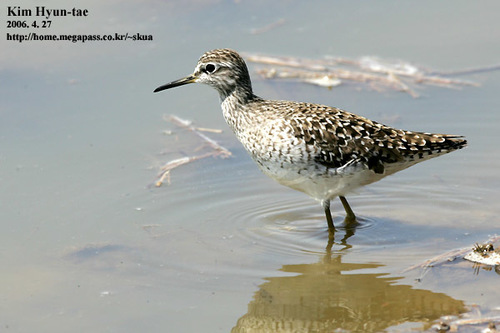
This bird has yellowish legs and a short thin dark bill. Breeding adults are a rich brown with darker feather centres above and white underneath. They have a light line above the eye and a brown crown. In winter, long-toed stints are grey above. The juveniles are brightly patterned above with rufous colouration and white mantle stripes.

This bird can be difficult to distinguish from other similar tiny waders which are known collectively as "peeps" or "stints". In particular, the long-toed stint is very similar to its North American counterpart, the least sandpiper. It differs from that species in its more slender, longer-necked appearance, longer toes, somewhat brighter colours, and weaker wingbar.

These birds forage on mudflats, picking up food by sight, sometimes by probing. They mainly eat small crustaceans, insects and snails. Little is known of the breeding habits of this species, although it nests on the ground, and the male has a display flight. Wikipedia →

Sounds

Flight call0:06

Laos · 2022

© Bram Piot · XC746718 · CC BY-NC-SA 4.0

Call0:14

Russian Federation · 2015

© Albert Lastukhin · XC266364 · CC BY-NC-SA 4.0

Nocturnal flight call0:19

China · 2024

© 小菜鸟 · XC922797 · CC BY-NC-SA 4.0

Global Distribution

Parks Where Found

# Park Country Daily sighting probability
1 Bali Barat National Park 🇮🇩 Indonesia
~20%
2 Gobi Gurvansaikhan National Park 🇲🇳 Mongolia
~10%

Cities Where Found

# City Country Daily sighting probability
1 Naha 🇯🇵 Japan
~20%
2 Quanzhou 🇨🇳 China
~20%
3 Makassar 🇮🇩 Indonesia
~10%
4 Manila 🇵🇭 Philippines
<5%
5 Kaohsiung 🇹🇼 Taiwan
<5%
6 Bangkok 🇹🇭 Thailand
<5%
7 Tainan 🇹🇼 Taiwan
<5%
8 Chennai 🇮🇳 India
<5%
9 Kochi 🇮🇳 India
<5%
10 Taipei 🇹🇼 Taiwan
<5%

Before you go

What are the chances of seeing a Long-toed Stint in Gobi Gurvansaikhan National Park?

With luck

About 10% of wildlife watchers report a Long-toed Stint sighting in Gobi Gurvansaikhan National Park on a given day, based on 12 verified sightings from GBIF citizen-science data from 2019 to 2026. It is the 86th most-seen of the 122 birds we can rate there. Over three days the chance rises to about 10%, and over a week to about 30%, if each day is a fresh chance.

When is the best time to see a Long-toed Stint in Gobi Gurvansaikhan National Park?

May and August

In those months about 10% of wildlife watchers report a Long-toed Stint in Gobi Gurvansaikhan National Park on a given day, against under 5% in June–July, September and December, the lowest months. January–April and October–November have too few records to rate.

What time of day is best to see a Long-toed Stint?

Between 2 and 5 pm

Across all the parks we cover, that three-hour window holds the most Long-toed Stint sightings with a recorded time, and about 9 in 10 of them come between 6 am and 6 pm: it is a daytime animal.

Is Gobi Gurvansaikhan National Park the best place to see a Long-toed Stint?

2nd of 2

Of the 2 parks where we can rate Long-toed Stint sightings, Gobi Gurvansaikhan National Park ranks 2nd at about 10%. The best odds are in Bali Barat National Park (Indonesia, about 20%).

Where does the Long-toed Stint sighting chance come from?

GBIF citizen-science records

It is estimated from how often the Long-toed Stint is recorded against all the birds logged in Gobi Gurvansaikhan National Park (12 verified sightings from 2019 to 2026), calibrated against known sighting rates. Figures are rounded to the nearest 10% because citizen-science data supports honest approximations, not decimals, and months with records from fewer than five people show "—". How it works.

← Back to Gobi Gurvansaikhan National Park