Eastern Sand Plover

Eastern Sand Plover

Charadrius veredus

Silhouette: Ferran Sayol · PhyloPic

LCLeast ConcernNTVUENCR
Daily sighting probability ~10% · With luck
at Gobi Gurvansaikhan National Park

In 3 days ~20% in a week ~30%

26 Verified sightings at Gobi Gurvansaikhan National Park From 2019 to 2026
51 In all 4 parks
August Best month
☀️ Diurnal When it's spotted

About the Eastern Sand Plover

The oriental plover (Anarhynchus veredus), also known as the oriental dotterel, is a medium-sized plover closely related to the Caspian plover. It breeds in parts of Mongolia and China, migrating southwards each year to spend its non-breeding season in Indonesia, New Guinea and northern Australia.

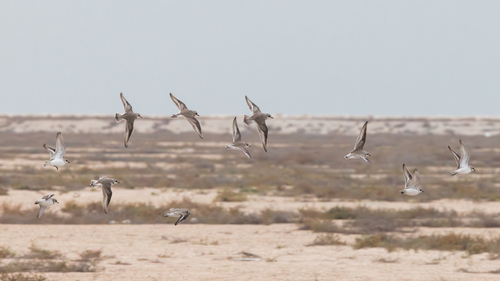
Adult male in breeding plumage: white face, throat and fore-crown; grey-brown hind-crown, hind-neck and back; belly white, demarcated with narrow black band and then broad chestnut breast band merging into white throat. Female, juvenile and non-breeding male: generally grey-brown upperparts and white belly; pale face with white streak above eye. Measurements: length 21–25 cm; wingspan 46–53 cm; weight 95 g.

Among the red-breasted Charadrius plovers, this bird is relatively large, long-legged and long-winged. Breeds in Mongolia, eastern Russia and Manchuria; migrates through eastern China and South-East Asia to Indonesia and northern Australia. Rare in New Guinea; straggler to New Zealand and Europe four times (Finland, Norway, Sweden and the Netherlands). The oriental plover breeds in dry steppes, deserts, arid grasslands and saltpans. Its... Wikipedia →

Sounds

Call1:13

Mongolia · 2017

© Frank Lambert · XC411921 · CC BY-NC-ND 4.0

Flight call0:28

Mongolia · 2019

© Philippe J. DUBOIS · XC493330 · CC BY-NC-SA 4.0

Call0:27

Australia · 2009

© Mark Harper · XC40557 · CC BY-NC-ND 2.5

Global Distribution

Parks Where Found

# Park Country Daily sighting probability
1 Gobi Gurvansaikhan National Park 🇲🇳 Mongolia
~10%
2 Bali Barat National Park 🇮🇩 Indonesia
<5%
3 Raja Ampat 🇮🇩 Indonesia
<5%
4 Kakadu National Park 🇦🇺 Australia
<5%

Cities Where Found

# City Country Daily sighting probability
1 Davao City 🇵🇭 Philippines
<5%
2 Singapore 🇸🇬 Singapore
<5%
3 Taipei 🇹🇼 Taiwan
<5%

Before you go

What are the chances of seeing an Eastern Sand Plover in Gobi Gurvansaikhan National Park?

With luck

About 10% of wildlife watchers report an Eastern Sand Plover sighting in Gobi Gurvansaikhan National Park on a given day, based on 26 verified sightings from GBIF citizen-science data from 2019 to 2026. It is the 83rd most-seen of the 122 birds we can rate there. Over three days the chance rises to about 20%, and over a week to about 30%, if each day is a fresh chance.

When is the best time to see an Eastern Sand Plover in Gobi Gurvansaikhan National Park?

May and August

In those months about 10% of wildlife watchers report an Eastern Sand Plover in Gobi Gurvansaikhan National Park on a given day, against under 5% in June–July, September and December, the lowest months. January–April and October–November have too few records to rate.

What time of day is best to see an Eastern Sand Plover?

Between noon and 3 pm

Across all the parks we cover, that three-hour window holds the most Eastern Sand Plover sightings with a recorded time, and about 9 in 10 of them come between 6 am and 6 pm: it is a daytime animal.

Is Gobi Gurvansaikhan National Park the best place to see an Eastern Sand Plover?

Yes

Of the 4 parks where we can rate Eastern Sand Plover sightings, Gobi Gurvansaikhan National Park has the highest daily chance: about 10%. Next come Bali Barat National Park (Indonesia, under 5%) and Raja Ampat (Indonesia, under 5%).

Where does the Eastern Sand Plover sighting chance come from?

GBIF citizen-science records

It is estimated from how often the Eastern Sand Plover is recorded against all the birds logged in Gobi Gurvansaikhan National Park (26 verified sightings from 2019 to 2026), calibrated against known sighting rates. Figures are rounded to the nearest 10% because citizen-science data supports honest approximations, not decimals, and months with records from fewer than five people show "—". How it works.

← Back to Gobi Gurvansaikhan National Park