Bennett's Woodpecker

Bennett's Woodpecker

Campethera bennettii

Silhouette: Pepe Reigada · PhyloPic

LCLeast ConcernNTVUENCR
Daily sighting probability <5% · Rare
at Gorongosa National Park

In 3 days ~10% in a week ~20%

5 Verified sightings at Gorongosa National Park From 2019 to 2026
1,056 In all 11 parks
September Best month
☀️ Diurnal When it's spotted

About the Bennett's Woodpecker

Bennett's woodpecker (Campethera bennettii) is a species of bird in the family Picidae. It is found in woodlands and bushes in Africa. The International Union for Conservation of Nature (IUCN) has assessed it as a least-concern species.

This species was described by Andrew Smith in 1836. Two subspecies are recognised: Campethera bennettii bennettii and C. b. capricorni. The common name and Latin binomial commemorate the British naturalist Edward Turner Bennett. Bennett's woodpecker, the fine-spotted woodpecker, the Nubian woodpecker and the speckle-throated woodpecker form a superspecies.

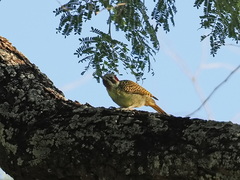
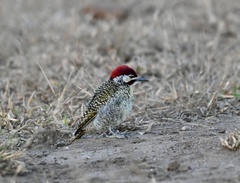
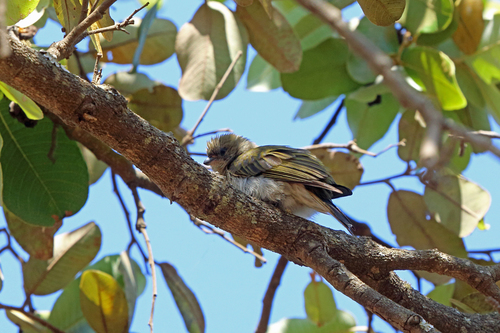
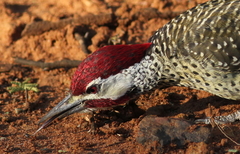
Bennett's woodpecker is about 24 cm (9.4 in) long and weighs 61–84 g (2.2–3.0 oz). The male's forehead, crown and nape are red. The chin and throat are white. The upperparts are brown, yellow and white. The underparts are pale yellow, and there are dark spots on the breast and flanks. The eyes are red, the beak is grey, and the legs are bluish-green or grey-green. The female has a black forehead with white spots, and its ear coverts and throat are brown or blackish-brown. The juvenile bird has a black forehead and crown and darker upperparts. The subspecies capricorni... Wikipedia →

Sounds

Song0:12

Botswana · 2023

© Marc Anderson · XC1071233 · CC BY-NC-ND 4.0

Call0:13

Zambia · 2021

© Dries Van de Loock · XC682056 · CC BY-NC-SA 4.0

Call0:14

Zambia · 2017

© Peter Boesman · XC397886 · CC BY-NC-ND 4.0

Global Distribution

Parks Where Found

# Park Country Daily sighting probability
1 Gonarezhou National Park 🇿🇼 Zimbabwe
~20%
2 Moremi Game Reserve 🇧🇼 Botswana
~20%
3 Lower Zambezi National Park 🇿🇲 Zambia
~10%
4 Mana Pools National Park 🇿🇼 Zimbabwe
~10%
5 Kafue National Park 🇿🇲 Zambia
~10%
6 South Luangwa National Park 🇿🇲 Zambia
~10%
7 Kruger National Park 🇿🇦 South Africa
~10%
8 Hwange National Park 🇿🇼 Zimbabwe
~10%
9 Liwonde National Park 🇲🇼 Malawi
<5%
10 Gorongosa National Park 🇲🇿 Mozambique
<5%
11 Chobe National Park 🇧🇼 Botswana
<5%

Before you go

What are the chances of seeing a Bennett's Woodpecker in Gorongosa National Park?

Rare

Under 5% of wildlife watchers report a Bennett's Woodpecker sighting in Gorongosa National Park on a given day, based on 5 verified sightings from GBIF citizen-science data from 2019 to 2026. It is the 235th most-seen of the 250 birds we can rate there. Over three days the chance rises to about 10%, and over a week to about 20%, if each day is a fresh chance.

When is the best time to see a Bennett's Woodpecker in Gorongosa National Park?

Any time of year

In every month with enough records, under 5% of wildlife watchers report a Bennett's Woodpecker in Gorongosa National Park on a given day, so our monthly data shows no clear season. March and December–January have too few records to rate.

What time of day is best to see a Bennett's Woodpecker?

Between 7 and 10 am

Across all the parks we cover, that three-hour window holds the most Bennett's Woodpecker sightings with a recorded time, and about 9 in 10 of them come between 6 am and 6 pm: it is a daytime animal.

Is Gorongosa National Park the best place to see a Bennett's Woodpecker?

10th of 11

Of the 11 parks where we can rate Bennett's Woodpecker sightings, Gorongosa National Park ranks 10th at under 5%. The best odds are in Gonarezhou National Park (Zimbabwe, about 20%), Moremi Game Reserve (Botswana, about 20%) and Lower Zambezi National Park (Zambia, about 10%).

Where does the Bennett's Woodpecker sighting chance come from?

GBIF citizen-science records

It is estimated from how often the Bennett's Woodpecker is recorded against all the birds logged in Gorongosa National Park (5 verified sightings from 2019 to 2026), calibrated against known sighting rates. Figures are rounded to the nearest 10% because citizen-science data supports honest approximations, not decimals, and months with records from fewer than five people show "—". How it works.

← Back to Gorongosa National Park