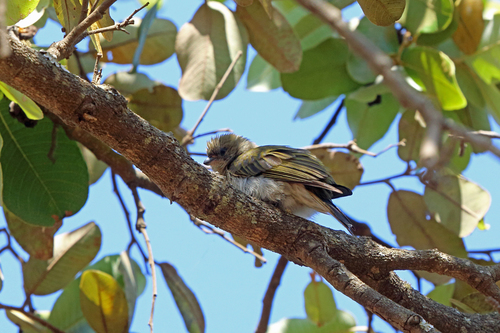

Pallid Honeyguide

Pallid Honeyguide

Indicator meliphilus

Silhouette: Sheatherius · PhyloPic

LCLeast ConcernNTVUENCR
Daily sighting probability <5% · Rare
at Gorongosa National Park

In 3 days ~10% in a week ~20%

6 Verified sightings at Gorongosa National Park From 2019 to 2026
25 In all 4 parks
April Best month
☀️ Diurnal When it's spotted

About the Pallid Honeyguide

The pallid honeyguide (Indicator meliphilus) is a species of bird in the family Indicatoridae. The species is also known as the eastern least honyeguide. It is found in Angola, Democratic Republic of the Congo, Kenya, Malawi, Mozambique, Tanzania, Uganda, Zambia, and Zimbabwe.

The species is very closely related to Willcocks's honeyguide, and the two species are very similar in size, and this species will even respond to recordings of the Willcocks's honeyguide's voice. Another species, Indicator narokensis, has been described from the border of Kenya and Tanzania; this appears to have been described from a juvenile pallid honeyeater and is not accepted as a valid species.

(Eastern honeyguide =) Pallid honeyguide - Species text in The Atlas of Southern African Birds. Wikipedia →

Sounds

Song0:11

Kenya · 2017

© James Bradley · XC396113 · CC BY-NC-SA 4.0

Global Distribution

Parks Where Found

# Park Country Daily sighting probability
1 Gorongosa National Park 🇲🇿 Mozambique
<5%
2 Arusha National Park 🇹🇿 Tanzania
<5%
3 Nairobi National Park 🇰🇪 Kenya
<5%
4 Ngorongoro Conservation Area 🇹🇿 Tanzania
<5%

Cities Where Found

# City Country Daily sighting probability
1 Mombasa 🇰🇪 Kenya
<5%

Before you go

What are the chances of seeing a Pallid Honeyguide in Gorongosa National Park?

Rare

Under 5% of wildlife watchers report a Pallid Honeyguide sighting in Gorongosa National Park on a given day, based on 6 verified sightings from GBIF citizen-science data from 2019 to 2026. It is the 219th most-seen of the 250 birds we can rate there. Over three days the chance rises to about 10%, and over a week to about 20%, if each day is a fresh chance.

When is the best time to see a Pallid Honeyguide in Gorongosa National Park?

April and November

In those months about 10% of wildlife watchers report a Pallid Honeyguide in Gorongosa National Park on a given day, against under 5% in February and May–October, the lowest months. March and December–January have too few records to rate.

What time of day is best to see a Pallid Honeyguide?

Between 3 and 6 pm

Across all the parks we cover, that three-hour window holds the most Pallid Honeyguide sightings with a recorded time, and nearly all of them come between 6 am and 6 pm: it is a daytime animal.

Is Gorongosa National Park the best place to see a Pallid Honeyguide?

Yes

Of the 4 parks where we can rate Pallid Honeyguide sightings, Gorongosa National Park has the highest daily chance: under 5%. Next come Arusha National Park (Tanzania, under 5%) and Nairobi National Park (Kenya, under 5%).

Where does the Pallid Honeyguide sighting chance come from?

GBIF citizen-science records

It is estimated from how often the Pallid Honeyguide is recorded against all the birds logged in Gorongosa National Park (6 verified sightings from 2019 to 2026), calibrated against known sighting rates. Figures are rounded to the nearest 10% because citizen-science data supports honest approximations, not decimals, and months with records from fewer than five people show "—". How it works.

← Back to Gorongosa National Park