Gambel's Quail

Gambel's Quail

Callipepla gambelii

Silhouette: Edwin Price · PhyloPic

LCLeast ConcernNTVUENCR
Daily sighting probability <5% · Rare
at Grand Canyon National Park

In 3 days <5%

12 Verified sightings at Grand Canyon National Park From 2019 to 2026
7,119 In all 6 parks
October Best month
☀️ Diurnal When it's spotted

About the Gambel's Quail

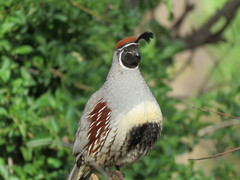
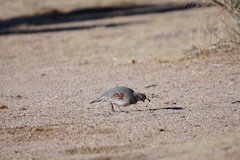
Gambel's quail (Callipepla gambelii) is a small ground-dwelling bird in the New World quail family. It inhabits the desert regions of Arizona, California, Colorado, New Mexico, Nevada, Utah, Texas, and Sonora; also New Mexico-border Chihuahua and the Colorado River region of Baja California. Gambel's quail is named in honor of William Gambel, a 19th-century naturalist and explorer of the Southwestern United States.

The species is not as widely introduced as the related California quail. It was, however, released on San Clemente Island in 1912 by Charles T. Howland et al., where it is currently still established. The Callipepla gambelii birds are easily recognized by their top knots and scaly plumage on their undersides. Gambel's quail have bluish-gray plumage on much of their bodies, and males have copper feathers on the top of their heads, black faces, and white stripes above their eyes. Their average length is 11 in (28 cm) with a wingspan of 14–16 in (36–41 cm). These birds have relatively short, rounded wings and long, featherless legs. Their diet consists primarily of plant matter and seeds.

Gambel's quail can be commonly confused with California quail due to... Wikipedia →

Sounds

Song0:49

United States · 2017

© Pat Goltz · XC1148854 · CC BY-NC-SA 4.0

Call0:40

United States · 2026

© Scott Olmstead · XC1105142 · CC BY-NC-SA 4.0

Alarm call0:34

United States · 2020

© Bobby Wilcox · XC548857 · CC BY-NC-SA 4.0

Global Distribution

Parks Where Found

# Park Country Daily sighting probability
1 Saguaro National Park 🇺🇸 United States
~50%
2 Joshua Tree National Park 🇺🇸 United States
~50%
3 Death Valley National Park 🇺🇸 United States
~20%
4 Zion National Park 🇺🇸 United States
~20%
5 Big Bend National Park 🇺🇸 United States
<5%
6 Grand Canyon National Park 🇺🇸 United States
<5%

Cities Where Found

# City Country Daily sighting probability
1 Mesa 🇺🇸 United States
~60%
2 Phoenix 🇺🇸 United States
~60%
3 Las Vegas 🇺🇸 United States
~30%

Zoos & Centres Where Found

# Zoo / Centre Country
1 Zoo Miami 🇺🇸 United States In captivity
2 Phoenix Zoo 🇺🇸 United States In captivity
3 Burgers' Ocean 🇳🇱 Netherlands In captivity
4 Royal Burgers' Zoo 🇳🇱 Netherlands In captivity
5 Arizona-Sonora Desert Museum 🇺🇸 United States In captivity
6 Riverbanks Zoo 🇺🇸 United States In captivity
7 ZooAmerica 🇺🇸 United States In captivity
8 Alameda Park Zoo 🇺🇸 United States In captivity
9 Staten Island Zoo 🇺🇸 United States In captivity

Before you go

What are the chances of seeing a Gambel's Quail in Grand Canyon National Park?

Rare

Under 5% of wildlife watchers report a Gambel's Quail sighting in Grand Canyon National Park on a given day, based on 12 verified sightings from GBIF citizen-science data from 2019 to 2026. It is the 183rd most-seen of the 194 birds we can rate there. Over three days the chance rises to under 5%, if each day is a fresh chance.

When is the best time to see a Gambel's Quail in Grand Canyon National Park?

Any time of year

In every month with enough records, under 5% of wildlife watchers report a Gambel's Quail in Grand Canyon National Park on a given day, so our monthly data shows no clear season.

What time of day is best to see a Gambel's Quail?

Between 7 and 10 am

Across all the parks we cover, that three-hour window holds the most Gambel's Quail sightings with a recorded time, and about 8 in 10 of them come between 6 am and 6 pm: it is a daytime animal.

Where does the Gambel's Quail sighting chance come from?

GBIF citizen-science records

It is estimated from how often the Gambel's Quail is recorded against all the birds logged in Grand Canyon National Park (12 verified sightings from 2019 to 2026), calibrated against known sighting rates. Figures are rounded to the nearest 10% because citizen-science data supports honest approximations, not decimals, and months with records from fewer than five people show "—". How it works.

← Back to Grand Canyon National Park