About the Virginia's Warbler
Virginia's warbler (Leiothlypis virginiae) is a species of New World warbler. Despite what its name may suggest, Virginia's warbler is not actually named after the American State of Virginia, which makes sense as the birds' typical range only reaches as far east as the state of Texas. The bird's common eastern range is central and southern mountains of Colorado, central Wyoming, and central and western New Mexico. The bird was named for Virginia Anderson, the wife of an army surgeon who discovered the bird at Fort Burgwin, New Mexico, in 1858. When Spencer Fullerton Baird of the Smithsonian Institution fully described the bird for science in 1860 he honored the wishes of the warbler's discoverer and designated Virginia to be both the bird's common and scientific name.
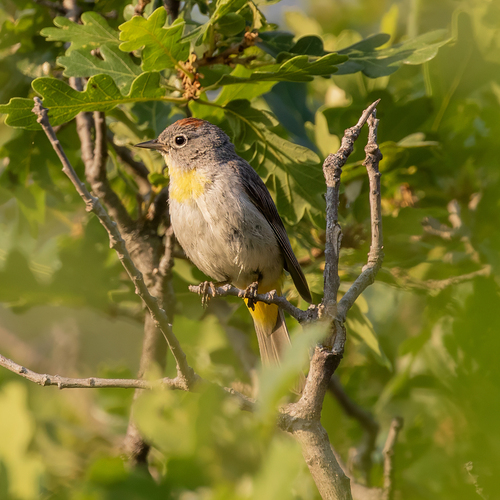
Virginia's warbler is a small bird, only 4 to 4+1⁄2 inches (100 to 110 mm) in length. It is mainly gray in color, with a lighter colored under-belly and a white eye ring. The rump and undertail coverts are yellow. They also have a yellow patch on their breast and a partially hidden dark reddish crest. Females are slightly duller, with less yellow on breast. Virginia's warbler can be easily mistaken for... Wikipedia →