Grace's Warbler

Grace's Warbler

Setophaga graciae

Silhouette: Dylan GE Gomes · PhyloPic

LCLeast ConcernNTVUENCR
Daily sighting probability ~10% · With luck
at Grand Canyon National Park

In 3 days ~20% in a week ~50%

249 Verified sightings at Grand Canyon National Park From 2019 to 2026
916 In all 10 parks
June Best month
☀️ Diurnal When it's spotted

About the Grace's Warbler

Grace's warbler (Setophaga graciae) is a small New World warbler that specializes in pine woods. Grace's warbler was discovered by Elliott Coues in the Rocky Mountains in 1864. He requested that the new species be named after his 18-year-old sister, Grace Darling Coues, and his request was honored when Spencer Fullerton Baird described the species scientifically in 1865.

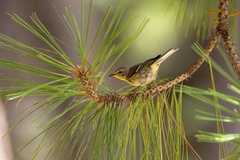
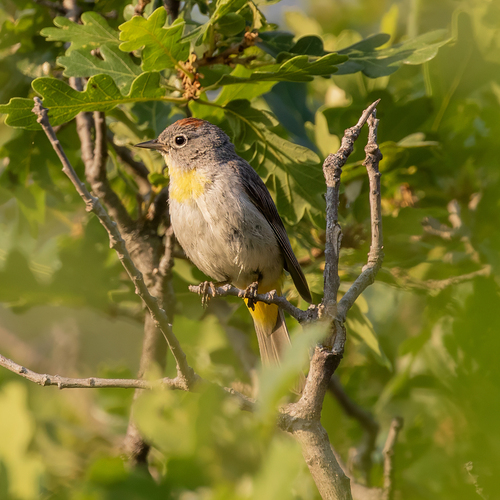
Grace's warbler is a small bird, 11–13 cm long. It is mostly gray on top, with broken black streaks across the back and flanks and two white bars on the wings. The throat and breast are a vibrant yellow, and the rest of the underparts are white. It has a yellow half-eye ring under the eye and a long yellow "eyebrow" stripe that starts at the base of the beak and runs above the eye, fading to white after it passes the eye.

Grace's warblers breed from the south-western United States to Nicaragua and winter in their breeding range from north-eastern Sinaloa and north-western Durango south. They are almost always found in pine forests, even in migration, though at the northern end of their range (in southern Nevada and Utah and southwestern Colorado) they... Wikipedia →

Sounds

Song1:12

United States · 2024

© Matt Wistrand · XC915543 · CC BY-NC-SA 4.0

Call0:19

Mexico · 2018

© Richard E. Webster · XC451084 · CC BY-NC-SA 4.0

Flight call0:08

United States · 2012

© Paul Marvin · XC153515 · CC BY-NC-SA 3.0

Global Distribution

Parks Where Found

# Park Country Daily sighting probability
1 Celaque National Park 🇭🇳 Honduras
~30%
2 La Tigra National Park 🇭🇳 Honduras
~20%
3 Guadalupe Mountains National Park 🇺🇸 United States
~10%
4 Zion National Park 🇺🇸 United States
~10%
5 Grand Canyon National Park 🇺🇸 United States
~10%
6 Cerro Azul Meámbar National Park 🇭🇳 Honduras
<5%
7 Cusuco National Park 🇭🇳 Honduras
<5%
8 Lago de Yojoa 🇭🇳 Honduras
<5%
9 Big Bend National Park 🇺🇸 United States
<5%
10 Cockscomb Basin Wildlife Sanctuary 🇧🇿 Belize
<5%

Cities Where Found

# City Country Daily sighting probability
1 Guatemala City 🇬🇹 Guatemala
~20%
2 Toluca 🇲🇽 México
~10%
3 Guadalajara 🇲🇽 México
<5%
4 Tegucigalpa 🇭🇳 Honduras
<5%
5 Mexico City 🇲🇽 México
<5%
6 San Francisco 🇺🇸 United States
<5%
7 San Diego 🇺🇸 United States
<5%
8 Los Angeles 🇺🇸 United States
<5%

Before you go

What are the chances of seeing a Grace's Warbler in Grand Canyon National Park?

With luck

About 10% of wildlife watchers report a Grace's Warbler sighting in Grand Canyon National Park on a given day, based on 249 verified sightings from GBIF citizen-science data from 2019 to 2026. It is the 54th most-seen of the 194 birds we can rate there. Over three days the chance rises to about 20%, and over a week to about 50%, if each day is a fresh chance.

When is the best time to see a Grace's Warbler in Grand Canyon National Park?

June

In that month about 30% of wildlife watchers report a Grace's Warbler in Grand Canyon National Park on a given day, against under 5% in September to March, the lowest months. That is one of Grand Canyon National Park's driest months, with almost no rain against 40 mm in March.

What time of day is best to see a Grace's Warbler?

Between 8 and 11 am

Across all the parks we cover, that three-hour window holds the most Grace's Warbler sightings with a recorded time, and about 9 in 10 of them come between 6 am and 6 pm: it is a daytime animal.

Where does the Grace's Warbler sighting chance come from?

GBIF citizen-science records

It is estimated from how often the Grace's Warbler is recorded against all the birds logged in Grand Canyon National Park (249 verified sightings from 2019 to 2026), calibrated against known sighting rates. Figures are rounded to the nearest 10% because citizen-science data supports honest approximations, not decimals, and months with records from fewer than five people show "—". How it works.

← Back to Grand Canyon National Park