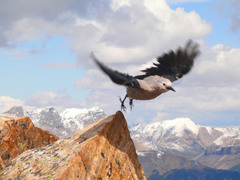
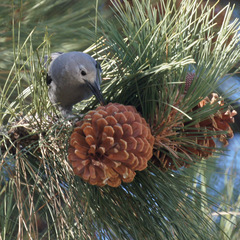
About the Clark's Nutcracker
Clark's nutcracker (Nucifraga columbiana), also known as Clark's crow, is a passerine bird in the family Corvidae, native to the mountains of western North America. The nutcracker is an omnivore, but subsists mainly on pine nuts, burying seeds in the ground in the late summer and fall, and then retrieving them in the winter and spring by memory. The bird was described by the Lewis and Clark Expedition, with William Clark first observing it in 1805 along the banks of the Salmon River, a tributary of the Columbia River.
In William Clark's initial description of the bird, he mistakenly described it as a woodpecker, writing "I saw today [a] bird of the woodpecker kind, which fed on pine burrs. Its bill and tail white; the wings black; every other part of a light brown, and about the size of a robin."
Clark's nutcracker's scientific name literally means "nutcracker of the Columbia". In 1806, Meriwether Lewis recorded a more detailed description from specimens collected along the Clearwater River in Idaho. A skin collected by the expedition was obtained by the ornithologist Alexander Wilson, who used it to produce an engraving for his American Ornithology work... Wikipedia →