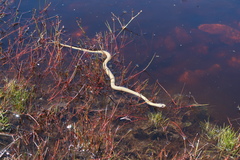
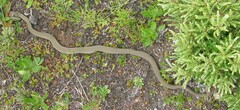
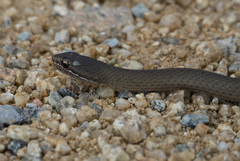

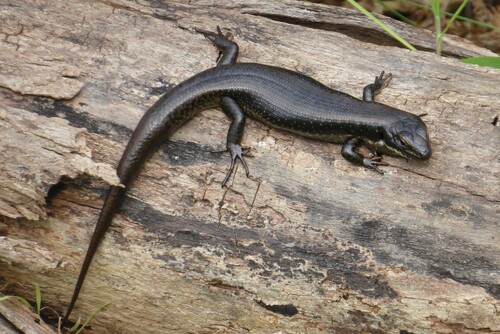
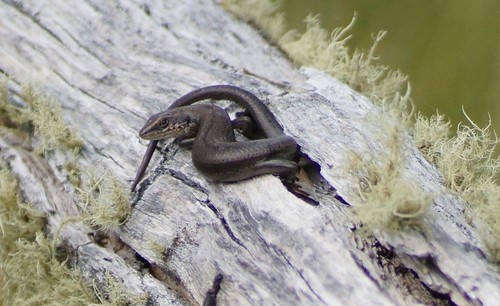
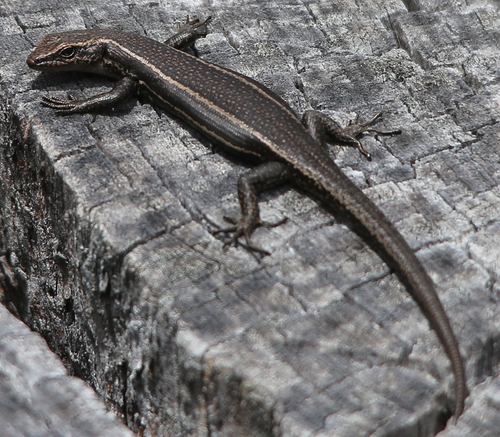
White-lipped Snake

White-lipped Snake

Drysdalia coronoides

Silhouette: SeismicShrimp · PhyloPic

LCLeast ConcernNTVUENCR Endemic
Daily sighting probability ~10% · With luck
at Great Otway National Park

In 3 days ~30% in a week ~60%

22 Verified sightings at Great Otway National Park From 2019 to 2026
147 In all 6 parks
March Best month
☀️ Diurnal When it's spotted

About the White-lipped Snake

The white-lipped snake (Drysdalia coronoides) is a small species of venomous snake in the family Elapidae. The species is endemic to south-eastern mainland Australia and Tasmania. D. coronoides is the smallest of three species of snake found in Tasmania, and is Australia's most cold-tolerant snake, even inhabiting areas on Mount Kosciuszko above the snow line. Growing to only about 40 cm (16 in) in length (including tail), it feeds almost exclusively on skinks.

It belongs to the genus Drysdalia, and is often referred to as the whip snake in Tasmania (whip snake in mainland Australia usually refers to snakes from the genus Demansia which are only found on the mainland). The species gets its common name from a thin, white line that runs along the upper lip, bordered above by a narrow black line. D. coronoides is viviparous.

Boulenger GA (1896). Catalogue of the Snakes in the British Museum (Natural History). Volume III., Containing the Colubridæ (Opisthoglyphæ and Proteroglyphæ)... London: Trustees of the British Museum (Natural History). (Taylor and Francis, printers). xiv + 727 pp. + Plates I-XXV. (Denisonia coronoides, new combination... Wikipedia →

Global Distribution

Parks Where Found

# Park Country Daily sighting probability
1 Wilsons Promontory National Park 🇦🇺 Australia
~40%
2 Cradle Mountain-Lake St Clair National Park 🇦🇺 Australia
~40%
3 Kosciuszko National Park 🇦🇺 Australia
~40%
4 Freycinet National Park 🇦🇺 Australia
~10%
5 Grampians National Park 🇦🇺 Australia
~10%
6 Great Otway National Park 🇦🇺 Australia
~10%

Cities Where Found

# City Country Daily sighting probability
1 Melbourne 🇦🇺 Australia
<5%

Closest Relatives at Great Otway National Park

Before you go

What are the chances of seeing a White-lipped Snake in Great Otway National Park?

With luck

About 10% of wildlife watchers report a White-lipped Snake sighting in Great Otway National Park on a given day, based on 22 verified sightings from GBIF citizen-science data from 2019 to 2026. It is the 8th most-seen of the 19 reptiles we can rate there. Over three days the chance rises to about 30%, and over a week to about 60%, if each day is a fresh chance.

When is the best time to see a White-lipped Snake in Great Otway National Park?

January, March–April and September

In those months about 20% of wildlife watchers report a White-lipped Snake in Great Otway National Park on a given day, against under 5% in June–July and October–December, the lowest months.

What time of day is best to see a White-lipped Snake?

Between 10 am and 1 pm

Across all the parks we cover, that three-hour window holds the most White-lipped Snake sightings with a recorded time, and about 9 in 10 of them come between 6 am and 6 pm: it is a daytime animal.

Which relatives of the White-lipped Snake live in Great Otway National Park?

Same family: Elapidae

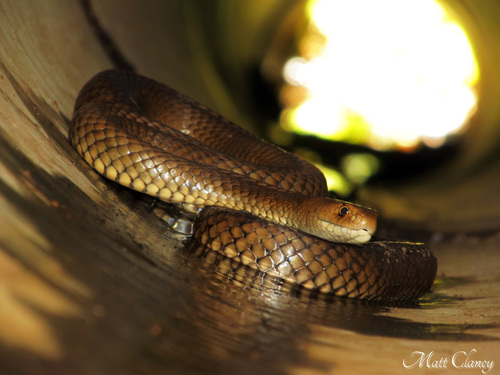
The closest relatives of the White-lipped Snake that you can see in Great Otway National Park (family Elapidae, Elapid Snakes) are Eastern Tiger Snake (about 30%), Lowlands Copperhead (about 20%) and Eastern Brown Snake (about 10%), with each one's daily chance of a sighting.

Where does the White-lipped Snake sighting chance come from?

GBIF citizen-science records

It is estimated from how often the White-lipped Snake is recorded against all the reptiles logged in Great Otway National Park (22 verified sightings from 2019 to 2026), calibrated against known sighting rates. Figures are rounded to the nearest 10% because citizen-science data supports honest approximations, not decimals, and months with records from fewer than five people show "—". How it works.

← Back to Great Otway National Park