
Black Kingsnake

Black Kingsnake

Lampropeltis nigra

Silhouette: Andy Wilson · PhyloPic

LCLeast ConcernNTVUENCR Endemic
Daily sighting probability <5% · Rare
at Great Smoky Mountains National Park

In 3 days ~10% in a week ~30%

5 Verified sightings at Great Smoky Mountains National Park From 2019 to 2026
5 In 1 park
February Best month
☀️ Diurnal When it's spotted

About the Black Kingsnake

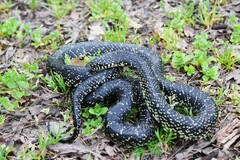
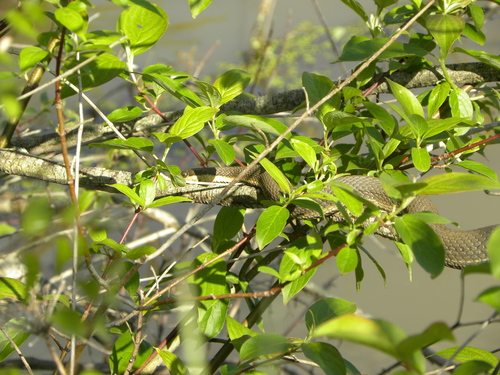
Lampropeltis nigra, commonly known as the black kingsnake, is a species of nonvenomous colubrid snake indigenous to the United States. It is a species of kingsnake. The black kingsnake is a large to medium constrictor. Adult specimens attain an average size of 90 to 122 centimetres (35 to 48 in) in total length, with some reaching maximum total lengths of 147 to 183 centimetres (58 to 72 in). It is generally similar to L. getula getula, although it can be distinguished by its geography and appearance. It has a black body that is interspersed with widely spaced yellow or cream-colored speckles, larger and more numerous along the sides. The dorsum in some is unpatterned and in others crossbanded. The venter displays a checked black and yellow (or cream) pattern. Ventral scales range from 197 to 222 in both sexes, with subcaudal scales ranging from 45 to 59 in males and 37 to 51 in females.

Black kingsnakes are also ophiophagous (snake-eating) and are immune to the venom of some snake species. The black kingsnake is found in the southeastern quarter of the United States, ranging from southern Illinois to Ohio, then down along the foothills... Wikipedia →

Global Distribution

Parks Where Found

# Park Country Daily sighting probability
1 Great Smoky Mountains National Park 🇺🇸 United States
<5%

More parks will be added in future updates.

Zoos & Centres Where Found

# Zoo / Centre Country
1 Naples Zoo 🇺🇸 United States In captivity
2 Espace zoologique de Saint-Martin-la-Plaine 🇫🇷 France In captivity
3 Tennessee Aquarium 🇺🇸 United States In captivity
4 Maymont Farm 🇺🇸 United States In captivity

Before you go

What are the chances of seeing a Black Kingsnake in Great Smoky Mountains National Park?

Rare

Under 5% of wildlife watchers report a Black Kingsnake sighting in Great Smoky Mountains National Park on a given day, based on 5 verified sightings from GBIF citizen-science data from 2019 to 2026. It is the 27th most-seen of the 27 reptiles we can rate there. Over three days the chance rises to about 10%, and over a week to about 30%, if each day is a fresh chance.

When is the best time to see a Black Kingsnake in Great Smoky Mountains National Park?

February, May–June and August

In those months about 10% of wildlife watchers report a Black Kingsnake in Great Smoky Mountains National Park on a given day, against under 5% in March–April, July and September–January, the lowest months.

What time of day is best to see a Black Kingsnake?

Between 10 am and 1 pm

Across all the parks we cover, that three-hour window holds the most Black Kingsnake sightings with a recorded time, and about 8 in 10 of them come between 6 am and 6 pm: it is a daytime animal.

Where else can you see a Black Kingsnake?

Only Great Smoky Mountains National Park, in our data

Great Smoky Mountains National Park is the only park on Wallace's Line with enough records to rate Black Kingsnake sightings: under 5% of wildlife watchers there report one on a given day.

Where does the Black Kingsnake sighting chance come from?

GBIF citizen-science records

It is estimated from how often the Black Kingsnake is recorded against all the reptiles logged in Great Smoky Mountains National Park (5 verified sightings from 2019 to 2026), calibrated against known sighting rates. Figures are rounded to the nearest 10% because citizen-science data supports honest approximations, not decimals, and months with records from fewer than five people show "—". How it works.

← Back to Great Smoky Mountains National Park