
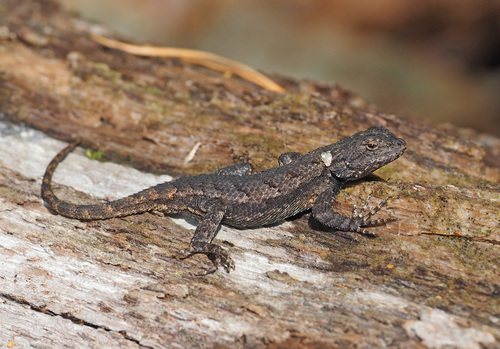
Six-lined Racerunner

Six-lined Racerunner

Aspidoscelis sexlineatus

Silhouette: Jose Carlos Arenas-Monroy · PhyloPic

Daily sighting probability ~10% · With luck
at Great Smoky Mountains National Park

In 3 days ~10% in a week ~30%

6 Verified sightings at Great Smoky Mountains National Park From 2019 to 2026
92 In all 3 parks
May Best month
☀️ Diurnal When it's spotted

About the Six-lined Racerunner

The six-lined racerunner (Aspidoscelis sexlineatus) is a species of lizard native to the United States and Mexico. The six-lined racerunner is found throughout much of the southeastern and south-central portion of the United States, from Maryland to Florida in the east, across the Great Plains to South Texas and northern Mexico. In a study conducted on A. sexlineata in Mexico, the majority of the individuals found were inhabiting areas near the seashore that were formed and influenced from maritime climate and hurricanes. The species' range also reaches north to Wisconsin and Minnesota. A small disjunct population is found in Tuscola County, Michigan.

The six-lined racerunner is typically dark green, brown, or black in color, with six yellow or green-yellow stripes that extend down the body from head to tail. Between the stripes are dark-colored fields ranging from dark brown to black and pale-colored fields near ventral scales on each side. A distinct lemon-yellow coloration is on the sides of the head both above and below the lateral stripe. Also, white mental and gular stripes occur. The posterior gular fold is bordered by enlarged mesoptychial... Wikipedia →

Global Distribution

Parks Where Found

# Park Country Daily sighting probability
1 Padre Island National Seashore 🇺🇸 United States
~20%
2 Merritt Island National Wildlife Refuge 🇺🇸 United States
~10%
3 Great Smoky Mountains National Park 🇺🇸 United States
~10%

Cities Where Found

# City Country Daily sighting probability
1 Denver 🇺🇸 United States
~10%
2 Miami 🇺🇸 United States
~10%
3 Orlando 🇺🇸 United States
<5%

Closest Relatives at Great Smoky Mountains National Park

No species of the same family or order lives in Great Smoky Mountains National Park, so these are its closest relatives here: other reptiles.

Before you go

What are the chances of seeing a Six-lined Racerunner in Great Smoky Mountains National Park?

With luck

About 10% of wildlife watchers report a Six-lined Racerunner sighting in Great Smoky Mountains National Park on a given day, based on 6 verified sightings from GBIF citizen-science data from 2019 to 2026. It is the 25th most-seen of the 27 reptiles we can rate there. Over three days the chance rises to about 10%, and over a week to about 30%, if each day is a fresh chance.

When is the best time to see a Six-lined Racerunner in Great Smoky Mountains National Park?

April to June

In those months about 10% of wildlife watchers report a Six-lined Racerunner in Great Smoky Mountains National Park on a given day, against under 5% in July to March, the lowest months.

What time of day is best to see a Six-lined Racerunner?

Between noon and 3 pm

Across all the parks we cover, that three-hour window holds the most Six-lined Racerunner sightings with a recorded time, and nearly all of them come between 6 am and 6 pm: it is a daytime animal.

Is Great Smoky Mountains National Park the best place to see a Six-lined Racerunner?

3rd of 3

Of the 3 parks where we can rate Six-lined Racerunner sightings, Great Smoky Mountains National Park ranks 3rd at about 10%. The best odds are in Padre Island National Seashore (United States, about 20%) and Merritt Island National Wildlife Refuge (United States, about 10%).

Where does the Six-lined Racerunner sighting chance come from?

GBIF citizen-science records

It is estimated from how often the Six-lined Racerunner is recorded against all the reptiles logged in Great Smoky Mountains National Park (6 verified sightings from 2019 to 2026), calibrated against known sighting rates. Figures are rounded to the nearest 10% because citizen-science data supports honest approximations, not decimals, and months with records from fewer than five people show "—". How it works.

← Back to Great Smoky Mountains National Park