Blue-crowned Hanging-Parrot

Blue-crowned Hanging-Parrot

Loriculus galgulus

Silhouette: Farelli (photo), John E. McCormack, Michael G. Harvey, Brant C. Faircloth, Nicholas G. Crawford, Travis C. Glenn, Robb T. Brumfield & T. Michael Keesey · PhyloPic

LCLeast ConcernNTVUENCR
Daily sighting probability ~40% · Likely
at Gunung Leuser National Park

In 3 days ~70% in a week >90%

100 Verified sightings at Gunung Leuser National Park From 2019 to 2026
2,511 In all 7 parks
March Best month
🌅 Crepuscular When it's spotted

About the Blue-crowned Hanging-Parrot

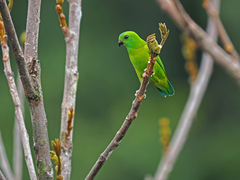
The blue-crowned hanging parrot (Loriculus galgulus) is a parrot species endemic to southern Burma and Thailand, Malaya, Singapore, and Indonesia (Sumatra, Java, Borneo). These parrots are 12 cm (4.7 in) in height and weigh 28 g (0.99 oz) and have a longevity of 14 years. They are recognized by their green plumage, black beak and characteristic blue feathers arranged like a crown on their head.

The blue-crowned hanging parrot was formally described in 1758 by the Swedish naturalist Carl Linnaeus in the tenth edition of his Systema Naturae. He placed it with all the other parrots in the genus Psittacus and coined the binomial name Psittacus galgulus. The type locality is the Malaysian state of Malacca. The blue-crowned hanging parrot is now one of 14 hanging parrots placed in the genus Loriculus that was introduced in 1849 by the English zoologist Edward Blyth. The genus name is a diminutive of the genus Lorius that was introduced by Nicholas Aylward Vigors for the lorys in 1825. The specific epithet galgulus is an unidentified small bird described by the Roman author Pliny the Elder as hanging by its feet. The species is monotypic: no subspecies are recognised.

��2�... Wikipedia →

Sounds

Flight call0:40

Singapore · 2026

© Ding Li Yong · XC1069807 · CC BY-NC-ND 4.0

Call0:41

Singapore · 2018

© Okamoto Keita Sin · XC528906 · CC BY-NC-SA 4.0

Flight call0:10

Indonesia · 2019

© Frank Lambert · XC498444 · CC BY-NC-ND 4.0

Global Distribution

Parks Where Found

# Park Country Daily sighting probability
1 Way Kambas National Park 🇮🇩 Indonesia
~40%
2 Taman Negara National Park 🇲🇾 Malaysia
~40%
3 Gunung Leuser National Park 🇮🇩 Indonesia
~40%
4 Danum Valley Conservation Area 🇲🇾 Malaysia
~30%
5 Sepilok 🇲🇾 Malaysia
~30%
6 Kinabatangan Wildlife Sanctuary 🇲🇾 Malaysia
~20%
7 Kinabalu Park 🇲🇾 Malaysia
<5%

Cities Where Found

# City Country Daily sighting probability
1 Singapore 🇸🇬 Singapore
~30%
2 Kuala Lumpur 🇲🇾 Malaysia
~10%
3 Jakarta 🇮🇩 Indonesia
<5%

Zoos & Centres Where Found

# Zoo / Centre Country
1 San Diego Zoo 🇺🇸 United States In captivity
2 Pairi Daiza 🇧🇪 Belgium In captivity
3 Basel Zoo 🇨🇭 Switzerland In captivity
4 Barcelona Zoo 🇪🇸 Spain In captivity
5 North Carolina Zoo 🇺🇸 United States In captivity
6 Chester Zoo 🇬🇧 United Kingdom In captivity
7 Phoenix Zoo 🇺🇸 United States In captivity
8 Memphis Zoo 🇺🇸 United States In captivity
9 Wilhelma 🇩🇪 Germany In captivity
10 Blank Park Zoo 🇺🇸 United States In captivity
11 Philadelphia Zoo 🇺🇸 United States In captivity
12 Łódź Zoo 🇵🇱 Poland In captivity
13 Ueno Zoo 🇯🇵 Japan In captivity
14 Bird Paradise 🇸🇬 Singapore In captivity
15 Aquarama Barcelona 🇪🇸 Spain In captivity
16 Rainforest Wild Asia 🇸🇬 Singapore In captivity
17 Frankfurt Zoological Garden 🇩🇪 Germany In captivity
18 Ueno Zoological Gardens (West Garden) 🇯🇵 Japan In captivity
19 Newquay Zoo 🇬🇧 United Kingdom In captivity
20 Central Park Zoo 🇺🇸 United States In captivity

Before you go

What are the chances of seeing a Blue-crowned Hanging-Parrot in Gunung Leuser National Park?

Likely

About 40% of wildlife watchers report a Blue-crowned Hanging-Parrot sighting in Gunung Leuser National Park on a given day, based on 100 verified sightings from GBIF citizen-science data from 2019 to 2026. It is the 6th most-seen of the 166 birds we can rate there. Over three days the chance rises to about 70%, and over a week to over 90%, if each day is a fresh chance.

When is the best time to see a Blue-crowned Hanging-Parrot in Gunung Leuser National Park?

March

In that month about 70% of wildlife watchers report a Blue-crowned Hanging-Parrot in Gunung Leuser National Park on a given day, against about 20% in January and April–May, the lowest months. That is one of Gunung Leuser National Park's driest months, with about 180 mm of rain against 700 mm in September.

What time of day is best to see a Blue-crowned Hanging-Parrot?

Between 2 and 5 am

Across all the parks we cover, that three-hour window holds the most Blue-crowned Hanging-Parrot sightings with a recorded time, and about 7 in 10 of them come between 6 pm and 6 am: it is most active around dawn and dusk.

Is Gunung Leuser National Park the best place to see a Blue-crowned Hanging-Parrot?

Among the best

Of the 7 parks where we can rate Blue-crowned Hanging-Parrot sightings, Gunung Leuser National Park ranks 3rd at about 40%, level with the leaders once rounded. The best odds are in Way Kambas National Park (Indonesia, about 40%) and Taman Negara National Park (Malaysia, about 40%). All parks ranked.

Where does the Blue-crowned Hanging-Parrot sighting chance come from?

GBIF citizen-science records

It is estimated from how often the Blue-crowned Hanging-Parrot is recorded against all the birds logged in Gunung Leuser National Park (100 verified sightings from 2019 to 2026), calibrated against known sighting rates. Figures are rounded to the nearest 10% because citizen-science data supports honest approximations, not decimals, and months with records from fewer than five people show "—". How it works.

← Back to Gunung Leuser National Park