



Completed



Rhinoceros Hornbill
Buceros rhinoceros
Silhouette: Ferran Sayol · PhyloPic
- KingdomAnimalia (Animals)
- PhylumChordata (Chordates)
- ClassAves (Birds)
- OrderBucerotiformes (Hornbills and Hoopoes)
- FamilyBucerotidae (Hornbills)
- GenusBuceros (Large Asian Hornbills)
- SpeciesBuceros rhinoceros (Rhinoceros Hornbill)
In 3 days ~80% in a week >90%
157 Verified sightings at Gunung Leuser National Park From 2019 to 2026
4,709 In all 8 parks
October Best month
🌅 Crepuscular When it's spotted
About the Rhinoceros Hornbill
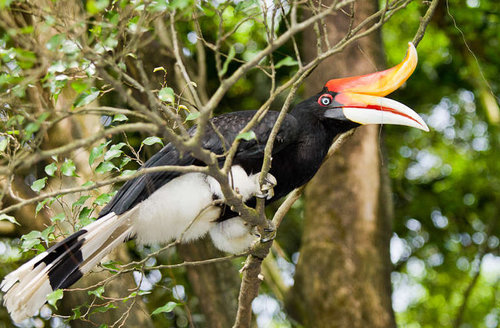
The rhinoceros hornbill (Buceros rhinoceros) is a large species of forest hornbill. In captivity, it can live for up to 35 years. It is found in lowland and montane, tropical and subtropical climates and in mountain rain forests up to 1,400 metres in the Malay Peninsula from southern Thailand; and the islands of Singapore, Borneo, Sumatra and Java.
The rhinoceros hornbill is the state bird of the Malaysian state of Sarawak and the country's national bird. It is scheduled as a "totally protected animal" under Sarawak law through the 1998 Wild Life Protection Ordinance.
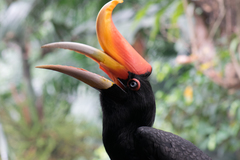
The rhinoceros hornbill was formally described by the Swedish naturalist Carl Linnaeus in 1758 in the tenth edition of his Systema Naturae. He placed it with the great hornbill in the genus Buceros and coined the binomial name Buceros rhinoceros, where he specified the location as India. The genus name comes from Ancient Greek βοῦς boûs meaning "ox", and κέρας kéras meaning "horn"; the species epithet rhinoceros comes from how the species' bill resembles a rhinoceros' horn.
Three subspecies are recognised: Wikipedia →
Recent sightings of Rhinoceros Hornbill in Gunung Leuser National Park
LIVEiNaturalistGlobal Distribution
Parks Where Found
| # | Park | Country | Daily sighting probability |
|---|---|---|---|
| 1 | Danum Valley Conservation Area | 🇲🇾 Malaysia | |
| 2 | Kinabatangan Wildlife Sanctuary | 🇲🇾 Malaysia | |
| 3 | Sepilok | 🇲🇾 Malaysia | |
| 4 | Gunung Leuser National Park | 🇮🇩 Indonesia | |
| 5 | Taman Negara National Park | 🇲🇾 Malaysia | |
| 6 | Kerinci Seblat National Park | 🇮🇩 Indonesia | |
| 7 | Tanjung Puting National Park | 🇮🇩 Indonesia | |
| 8 | Kinabalu Park | 🇲🇾 Malaysia |
Cities Where Found
| # | City | Country | Daily sighting probability |
|---|---|---|---|
| 1 | Kuala Lumpur | 🇲🇾 Malaysia |
Zoos & Centres Where Found
| # | Zoo / Centre | Country | |
|---|---|---|---|
| 1 | ZooParc de Beauval | 🇫🇷 France | |
| 2 | Denver Zoo | 🇺🇸 United States | |
| 3 | Zlín-Lešná Zoo | 🇨🇿 Czechia | |
| 4 | Walsrode World Bird Park | 🇩🇪 Germany | |
| 5 | San Diego Zoo Safari Park | 🇺🇸 United States | |
| 6 | Beijing Wildlife Park | 🇨🇳 China | |
| 7 | Assam State Zoo cum Botanical Garden | 🇮🇳 India | |
| 8 | Minnesota Zoo | 🇺🇸 United States | |
| 9 | Khao Kheow Open Zoo | 🇹🇭 Thailand | |
| 10 | Kansas City Zoo | 🇺🇸 United States | |
| 11 | Badoca Safari Park | 🇵🇹 Portugal | |
| 12 | Nakhon Ratchasima Zoo | 🇹🇭 Thailand | |
| 13 | Nashville Zoo at Grassmere | 🇺🇸 United States | |
| 14 | Chester Zoo | 🇬🇧 United Kingdom | |
| 15 | Milwaukee County Zoo | 🇺🇸 United States | |
| 16 | Safari World | 🇹🇭 Thailand | |
| 17 | Kemaman Zoo & Recreation Park | 🇲🇾 Malaysia | |
| 18 | Dallas Zoo | 🇺🇸 United States | |
| 19 | Phoenix Zoo | 🇺🇸 United States | |
| 20 | Toledo Zoo | 🇺🇸 United States | |
| 21 | Jacksonville Zoo and Gardens | 🇺🇸 United States | |
| 22 | Fuzhou Zoo | 🇨🇳 China | |
| 23 | Woodland Park Zoo | 🇺🇸 United States | |
| 24 | National Zoo of Malaysia | 🇲🇾 Malaysia | |
| 25 | Virginia Zoological Park | 🇺🇸 United States | |
| 26 | Lok Kawi Wildlife Park | 🇲🇾 Malaysia | |
| 27 | Gembira Loka Zoo | 🇮🇩 Indonesia | |
| 28 | Fresno Chaffee Zoo | 🇺🇸 United States | |
| 29 | Zoo Atlanta | 🇺🇸 United States | |
| 30 | Bandung Zoo | 🇮🇩 Indonesia | |
| 31 | El Paso Zoo | 🇺🇸 United States | |
| 32 | Pittsburgh Zoo & Aquarium | 🇺🇸 United States | |
| 33 | Chai Nat Bird Park | 🇹🇭 Thailand | |
| 34 | Vogelpark Avifauna | 🇳🇱 Netherlands | |
| 35 | Kuala Lumpur Bird Park | 🇲🇾 Malaysia | |
| 36 | Santa Barbara Zoo | 🇺🇸 United States | |
| 37 | Stone Zoo | 🇺🇸 United States | |
| 38 | Palm Beach Zoo | 🇺🇸 United States | |
| 39 | Hong Kong Zoological and Botanical Gardens | 🇨🇳 China | |
| 40 | Scovill Zoo | 🇺🇸 United States | |
| 41 | Zoo Lagos | 🇵🇹 Portugal | |
| 42 | Bioparc Fuengirola | 🇪🇸 Spain | |
| 43 | Johor Zoo | 🇲🇾 Malaysia | |
| 44 | Penang Bird Park | 🇲🇾 Malaysia | |
| 45 | National Aviary | 🇺🇸 United States | |
| 46 | Newport Aquarium | 🇺🇸 United States | |
| 47 | Zoo de Lourosa | 🇵🇹 Portugal | |
| 48 | OdySea Aquarium | 🇺🇸 United States | |
| 49 | Aviary | 🇭🇰 Hong Kong SAR China | |
| 50 | Aquaria KLCC | 🇲🇾 Malaysia |
Closest Relatives at Gunung Leuser National Park


Before you go
What are the chances of seeing a Rhinoceros Hornbill in Gunung Leuser National Park?
Likely
About 40% of wildlife watchers report a Rhinoceros Hornbill sighting in Gunung Leuser National Park on a given day, based on 157 verified sightings from GBIF citizen-science data from 2019 to 2026. It is the 5th most-seen of the 166 birds we can rate there. Over three days the chance rises to about 80%, and over a week to over 90%, if each day is a fresh chance.
When is the best time to see a Rhinoceros Hornbill in Gunung Leuser National Park?
October
In that month about 60% of wildlife watchers report a Rhinoceros Hornbill in Gunung Leuser National Park on a given day, against about 30% in February–March, May, July, September and November–December, the lowest months.
What time of day is best to see a Rhinoceros Hornbill?
Between 9 am and noon
Across all the parks we cover, that three-hour window holds the most Rhinoceros Hornbill sightings with a recorded time, and about 6 in 10 of them come between 6 am and 6 pm: it is most active around dawn and dusk.
Is Gunung Leuser National Park the best place to see a Rhinoceros Hornbill?
4th of 8
Of the 8 parks where we can rate Rhinoceros Hornbill sightings, Gunung Leuser National Park ranks 4th at about 40%. The best odds are in Danum Valley Conservation Area (Malaysia, about 60%), Kinabatangan Wildlife Sanctuary (Malaysia, about 50%) and Sepilok (Malaysia, about 40%). All parks ranked.
Which relatives of the Rhinoceros Hornbill live in Gunung Leuser National Park?
Same family: Bucerotidae
The closest relatives of the Rhinoceros Hornbill that you can see in Gunung Leuser National Park (family Bucerotidae, Hornbills) are Bushy-crested Hornbill (about 10%), Wreathed Hornbill (about 10%) and Wrinkled Hornbill (about 10%), with each one's daily chance of a sighting.
Where does the Rhinoceros Hornbill sighting chance come from?
GBIF citizen-science records
It is estimated from how often the Rhinoceros Hornbill is recorded against all the birds logged in Gunung Leuser National Park (157 verified sightings from 2019 to 2026), calibrated against known sighting rates. Figures are rounded to the nearest 10% because citizen-science data supports honest approximations, not decimals, and months with records from fewer than five people show "—". How it works.
