Apostlebird

Apostlebird

Struthidea cinerea

Silhouette: Michael Scroggie · PhyloPic

LCLeast ConcernNTVUENCR Endemic
Daily sighting probability ~40% · Likely
at Hattah-Kulkyne National Park

In 3 days ~80% in a week >90%

731 Verified sightings at Hattah-Kulkyne National Park From 2019 to 2026
970 In all 3 parks
November Best month
🌙 Nocturnal When it's spotted

About the Apostlebird

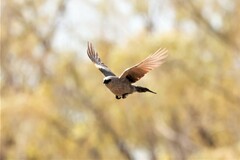
The apostlebird (Struthidea cinerea), also known as the grey jumper, lousy jack or happy family, is a quick-moving, gray or black bird about 33 cm (13 in) long. It is a native to Australia where it roams woodlands, eating insects and seeds at, or near, ground level. Apostlebirds often travel in groups of about 12; for this reason, they were named after the 12 Biblical apostles.

Originally described by ornithologist John Gould in 1837, its specific epithet is Latin cinerea "grey". In its own genus Struthidea, it is placed in the family known as the mud-nest builders or Corcoracidae, written as Grallinidae in older books before the removal of the genus Grallina to the monarch family. It is one of two remaining species, with the white-winged chough (Corcorax melanorhamphos), which differs in appearance but exhibits many behavioural similarities. The mudnest builder family Corcoracidae itself is now placed in a narrower "core corvine" group, which contains the crows and ravens, shrikes, birds of paradise, fantails, monarch flycatchers, and drongos.

The apostlebird was named after the Biblical apostles, the twelve followers of Jesus Christ. In fact, the species travel in... Wikipedia →

Sounds

Call0:16

Australia · 2025

© Peter Boesman · XC1066996 · CC BY-NC-ND 4.0

Recording0:39

Australia · 2022

© James Lambert · XC749836 · CC BY-NC-ND 4.0

Alarm call0:38

Australia · 2021

© Eddy Smith · XC681213 · CC BY-NC-SA 4.0

Global Distribution

Parks Where Found

# Park Country Daily sighting probability
1 Hattah-Kulkyne National Park 🇦🇺 Australia
~40%
2 Flinders Ranges National Park 🇦🇺 Australia
~40%
3 Nitmiluk National Park 🇦🇺 Australia
~10%

Cities Where Found

# City Country Daily sighting probability
1 Sydney 🇦🇺 Australia
<5%
2 Brisbane 🇦🇺 Australia
<5%

Zoos & Centres Where Found

# Zoo / Centre Country
1 Featherdale Sydney Wildlife Park 🇦🇺 Australia In captivity

Before you go

What are the chances of seeing an Apostlebird in Hattah-Kulkyne National Park?

Likely

About 40% of wildlife watchers report an Apostlebird sighting in Hattah-Kulkyne National Park on a given day, based on 731 verified sightings from GBIF citizen-science data from 2019 to 2026. It is the 22nd most-seen of the 170 birds we can rate there. Over three days the chance rises to about 80%, and over a week to over 90%, if each day is a fresh chance.

When is the best time to see an Apostlebird in Hattah-Kulkyne National Park?

March, September and November

In those months about 50% of wildlife watchers report an Apostlebird in Hattah-Kulkyne National Park on a given day, against about 30% in May and December, the lowest months.

What time of day is best to see an Apostlebird?

Between 3 and 6 am

Across all the parks we cover, that three-hour window holds the most Apostlebird sightings with a recorded time, and about 7 in 10 of them come between 6 pm and 6 am: it is mostly seen at night.

Is Hattah-Kulkyne National Park the best place to see an Apostlebird?

Yes

Of the 3 parks where we can rate Apostlebird sightings, Hattah-Kulkyne National Park has the highest daily chance: about 40%. Next come Flinders Ranges National Park (Australia, about 40%) and Nitmiluk National Park (Australia, about 10%).

Where does the Apostlebird sighting chance come from?

GBIF citizen-science records

It is estimated from how often the Apostlebird is recorded against all the birds logged in Hattah-Kulkyne National Park (731 verified sightings from 2019 to 2026), calibrated against known sighting rates. Figures are rounded to the nearest 10% because citizen-science data supports honest approximations, not decimals, and months with records from fewer than five people show "—". How it works.

← Back to Hattah-Kulkyne National Park