Hooded Robin

Hooded Robin

Melanodryas cucullata

Silhouette: Sheatherius · PhyloPic

LCLeast ConcernNTVUENCR Endemic
Daily sighting probability ~30% · Possible
at Hattah-Kulkyne National Park

In 3 days ~70% in a week ~90%

514 Verified sightings at Hattah-Kulkyne National Park From 2019 to 2026
587 In all 3 parks
September Best month
☀️ Diurnal When it's spotted

About the Hooded Robin

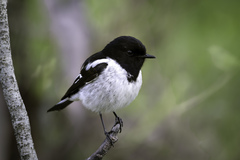
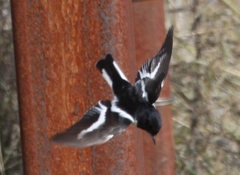
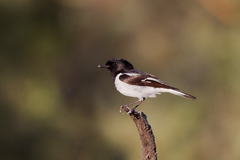
The hooded robin (Melanodryas cucullata) is a small passerine bird native to Australia. Like many brightly coloured robins of the Petroicidae, it is sexually dimorphic; the male bears a distinctive black-and-white plumage, while the female is a nondescript grey-brown.

Like all Australian robins, it is not closely related to either the European robin or the American robin, but belongs rather to the Corvida parvorder comprising many tropical and Australian passerines, including pardalotes, fairy-wrens, and honeyeaters, as well as crows. Initially thought to be related to Old World flycatchers, it was described as Muscicapa cucullata by the English ornithologist John Latham in 1801. Later described as Grallina bicolor by Nicholas Aylward Vigors and Thomas Horsfield, it was later placed in the genus Petroica for many years before being transferred to Melanodryas.

The generic name melanodryas derives from the Greek melas 'black' and dryas 'wood-nymph'. The specific name cucullata derives from Late Latin cucullatus meaning 'hooded'. Four subspecies are recognised Melanodryas cucullata cucullata (Lathan, 1801)

Melanodryas cucullata melvillensis (Zietz, 1914... Wikipedia →

Sounds

Call0:16

Australia · 2025

© Nick Talbot · XC1033760 · CC BY-NC-SA 4.0

Song0:07

Australia · 2021

© Marc Anderson · XC1001913 · CC BY-NC-ND 4.0

Call0:13

Australia · 2016

© Greg McLachlan · XC354226 · CC BY-NC-SA 4.0

Global Distribution

Parks Where Found

# Park Country Daily sighting probability
1 Hattah-Kulkyne National Park 🇦🇺 Australia
~30%
2 Uluru-Kata Tjuta National Park 🇦🇺 Australia
~10%
3 Flinders Ranges National Park 🇦🇺 Australia
<5%

Zoos & Centres Where Found

# Zoo / Centre Country
1 Alice Springs Desert Park 🇦🇺 Australia In captivity

Before you go

What are the chances of seeing a Hooded Robin in Hattah-Kulkyne National Park?

Possible

About 30% of wildlife watchers report a Hooded Robin sighting in Hattah-Kulkyne National Park on a given day, based on 514 verified sightings from GBIF citizen-science data from 2019 to 2026. It is the 37th most-seen of the 170 birds we can rate there. Over three days the chance rises to about 70%, and over a week to about 90%, if each day is a fresh chance.

When is the best time to see a Hooded Robin in Hattah-Kulkyne National Park?

September–October and December–January

In those months about 40% of wildlife watchers report a Hooded Robin in Hattah-Kulkyne National Park on a given day, against about 20% in March and May, the lowest months.

What time of day is best to see a Hooded Robin?

Between 10 am and 1 pm

Across all the parks we cover, that three-hour window holds the most Hooded Robin sightings with a recorded time, and nearly all of them come between 6 am and 6 pm: it is a daytime animal.

Is Hattah-Kulkyne National Park the best place to see a Hooded Robin?

Yes

Of the 3 parks where we can rate Hooded Robin sightings, Hattah-Kulkyne National Park has the highest daily chance: about 30%. Next come Uluru-Kata Tjuta National Park (Australia, about 10%) and Flinders Ranges National Park (Australia, under 5%).

Which relatives of the Hooded Robin live in Hattah-Kulkyne National Park?

Same family: Petroicidae

The closest relatives of the Hooded Robin that you can see in Hattah-Kulkyne National Park (family Petroicidae, Australasian Robins) are Jacky Winter (about 50%) and Red-capped Robin (about 30%), with each one's daily chance of a sighting.

Where does the Hooded Robin sighting chance come from?

GBIF citizen-science records

It is estimated from how often the Hooded Robin is recorded against all the birds logged in Hattah-Kulkyne National Park (514 verified sightings from 2019 to 2026), calibrated against known sighting rates. Figures are rounded to the nearest 10% because citizen-science data supports honest approximations, not decimals, and months with records from fewer than five people show "—". How it works.

← Back to Hattah-Kulkyne National Park