Splendid Fairywren

Splendid Fairywren

Malurus splendens

Silhouette: Michael Scroggie · PhyloPic

LCLeast ConcernNTVUENCR Endemic
Daily sighting probability ~40% · Likely
at Hattah-Kulkyne National Park

In 3 days ~80% in a week >90%

588 Verified sightings at Hattah-Kulkyne National Park From 2019 to 2026
652 In all 3 parks
December Best month
☀️ Diurnal When it's spotted

About the Splendid Fairywren

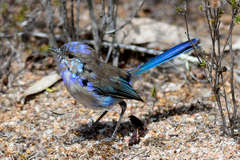
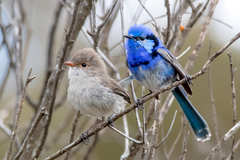
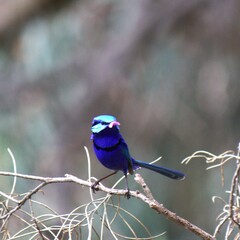
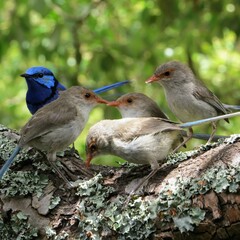
The splendid fairywren (Malurus splendens) is a passerine bird in the Australasian wren family, Maluridae. It is also known simply as the splendid wren or more colloquially in Western Australia as the blue wren. The splendid fairywren is found across much of the Australian continent from central-western New South Wales and southwestern Queensland over to coastal Western Australia. It inhabits predominantly arid and semiarid regions. Exhibiting a high degree of sexual dimorphism, the male in breeding plumage is a small, long-tailed bird of predominantly bright blue and black colouration. Nonbreeding males, females, and juveniles are predominantly grey-brown in colour; this gave the early impression that males were polygamous, as all dull-coloured birds were taken for females. It comprises several similar all blue-and-black subspecies that were originally considered separate species.

Like other fairywrens, the splendid fairywren is notable for several peculiar behavioural characteristics; the birds are socially monogamous and sexually promiscuous, meaning that although they form pairs between one male and one female, each partner mates with other individuals and even assists in raising the young from such trysts. Male fairywrens pluck pink or purple petals and display them to females as part of a courtship display.

The habitat of the splendid fairywren ranges from forest to dry scrub, generally with ample vegetation for shelter. Unlike the eastern superb fairywren, it has not adapted well to human occupation of the landscape and has disappeared from some urbanised areas. The splendid fairywren mainly eats insects and supplements its diet with seeds. Wikipedia →

Sounds

Song0:55

Australia · 2023

© Peter Boesman · XC859937 · CC BY-NC-ND 4.0

Call0:14

Australia · 2022

© Toby Esplin · XC759781 · CC BY-NC-ND 4.0

Recording0:43

Australia · 2020

© Drew Davison · XC608444 · CC BY-NC-SA 4.0

Global Distribution

Parks Where Found

# Park Country Daily sighting probability
1 Hattah-Kulkyne National Park 🇦🇺 Australia
~40%
2 Uluru-Kata Tjuta National Park 🇦🇺 Australia
~10%
3 Rottnest Island 🇦🇺 Australia
<5%

Cities Where Found

# City Country Daily sighting probability
1 Perth 🇦🇺 Australia
~10%

Zoos & Centres Where Found

# Zoo / Centre Country
1 Alice Springs Desert Park 🇦🇺 Australia In captivity
2 Featherdale Sydney Wildlife Park 🇦🇺 Australia In captivity

Before you go

What are the chances of seeing a Splendid Fairywren in Hattah-Kulkyne National Park?

Likely

About 40% of wildlife watchers report a Splendid Fairywren sighting in Hattah-Kulkyne National Park on a given day, based on 588 verified sightings from GBIF citizen-science data from 2019 to 2026. It is the 30th most-seen of the 170 birds we can rate there. Over three days the chance rises to about 80%, and over a week to over 90%, if each day is a fresh chance.

When is the best time to see a Splendid Fairywren in Hattah-Kulkyne National Park?

September and December

In those months about 50% of wildlife watchers report a Splendid Fairywren in Hattah-Kulkyne National Park on a given day, against about 20% in March, the lowest month.

What time of day is best to see a Splendid Fairywren?

Between 10 am and 1 pm

Across all the parks we cover, that three-hour window holds the most Splendid Fairywren sightings with a recorded time, and nearly all of them come between 6 am and 6 pm: it is a daytime animal.

Is Hattah-Kulkyne National Park the best place to see a Splendid Fairywren?

Yes

Of the 3 parks where we can rate Splendid Fairywren sightings, Hattah-Kulkyne National Park has the highest daily chance: about 40%. Next come Uluru-Kata Tjuta National Park (Australia, about 10%) and Rottnest Island (Australia, under 5%).

Where does the Splendid Fairywren sighting chance come from?

GBIF citizen-science records

It is estimated from how often the Splendid Fairywren is recorded against all the birds logged in Hattah-Kulkyne National Park (588 verified sightings from 2019 to 2026), calibrated against known sighting rates. Figures are rounded to the nearest 10% because citizen-science data supports honest approximations, not decimals, and months with records from fewer than five people show "—". How it works.

← Back to Hattah-Kulkyne National Park