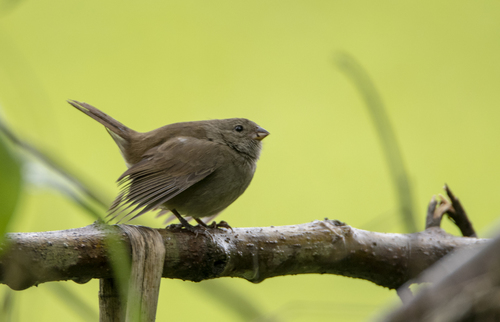
Sooty Grassquit

Sooty Grassquit

Asemospiza fuliginosa

Silhouette: Sheatherius · PhyloPic

LCLeast ConcernNTVUENCR
Daily sighting probability ~10% · With luck
at Henri Pittier National Park

In 3 days ~20% in a week ~50%

41 Verified sightings at Henri Pittier National Park From 2019 to 2026
435 In all 6 parks
October Best month
☀️ Diurnal When it's spotted

About the Sooty Grassquit

The sooty grassquit (Asemospiza fuliginosa) is a small bird in the family Thraupidae, the tanagers and allies. It is found in Argentina, Brazil, Colombia, Guyana, Paraguay, Trinidad, Venezuela, and as a vagrant to Bolivia.

The sooty grassquit was formally described in 1830 with the binomial Fringilla fuliginosa. By 1970 it had been reassigned to the genus Tiaris. Based on studies published in 2014 and 2015, in 2016 Burns et al. erected the genus Asemospiza with the sooty grassquit as the type species and including the dull-colored grassquit (A. obscura). The genus is closely related to Darwin's finches.

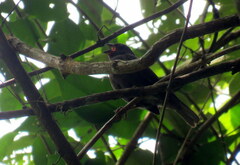
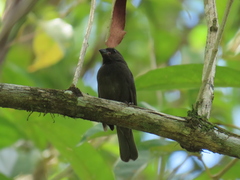
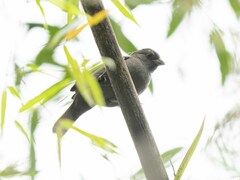
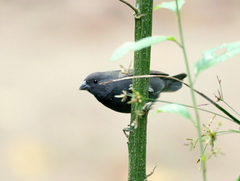
The sooty grassquit is monotypic. The sooty grassquit is 10 to 11.4 cm (3.9 to 4.5 in) long and weighs 11 to 16 g (0.39 to 0.56 oz). The species is sexually dimorphic. Adult males are sooty blackish with an olive tinge on the back and slightly paler underparts. Adult females are a rich olive-brown that is darker on their upperparts than underparts. Both sexes have a dark iris, dark legs and feet, and a dark bill though the female's is slightly lighter. Juveniles are like adult females.

The sooty grassquit... Wikipedia →

Sounds

Call0:05

Brazil · 2026

© JAYRSON ARAUJO DE OLIVEIRA · XC1166860 · CC BY-NC-SA 4.0

Song1:10

Colombia · 2022

© Frank Lambert · XC771740 · CC BY-NC-ND 4.0

Canto0:51

Brazil · 2017

© Caio Brito · XC428087 · CC BY-NC-SA 4.0

Global Distribution

Parks Where Found

# Park Country Daily sighting probability
1 Serra dos Órgãos National Park 🇧🇷 Brazil
~50%
2 Henri Pittier National Park 🇻🇪 Venezuela
~10%
3 Itatiaia National Park 🇧🇷 Brazil
<5%
4 Tijuca National Park 🇧🇷 Brazil
<5%
5 Iguazú National Park 🇦🇷 Argentina
<5%
6 Iguaçu National Park 🇧🇷 Brazil
<5%

Before you go

What are the chances of seeing a Sooty Grassquit in Henri Pittier National Park?

With luck

About 10% of wildlife watchers report a Sooty Grassquit sighting in Henri Pittier National Park on a given day, based on 41 verified sightings from GBIF citizen-science data from 2019 to 2026. It is the 146th most-seen of the 358 birds we can rate there. Over three days the chance rises to about 20%, and over a week to about 50%, if each day is a fresh chance.

When is the best time to see a Sooty Grassquit in Henri Pittier National Park?

October

In that month about 30% of wildlife watchers report a Sooty Grassquit in Henri Pittier National Park on a given day, against under 5% in June–September and November–April, the lowest months.

What time of day is best to see a Sooty Grassquit?

Between 7 and 10 am

Across all the parks we cover, that three-hour window holds the most Sooty Grassquit sightings with a recorded time, and about 9 in 10 of them come between 6 am and 6 pm: it is a daytime animal.

Is Henri Pittier National Park the best place to see a Sooty Grassquit?

2nd of 6

Of the 6 parks where we can rate Sooty Grassquit sightings, Henri Pittier National Park ranks 2nd at about 10%. The best odds are in Serra dos Órgãos National Park (Brazil, about 50%).

Where does the Sooty Grassquit sighting chance come from?

GBIF citizen-science records

It is estimated from how often the Sooty Grassquit is recorded against all the birds logged in Henri Pittier National Park (41 verified sightings from 2019 to 2026), calibrated against known sighting rates. Figures are rounded to the nearest 10% because citizen-science data supports honest approximations, not decimals, and months with records from fewer than five people show "—". How it works.

← Back to Henri Pittier National Park