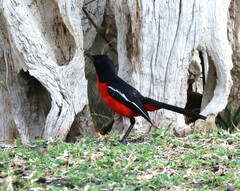

Crimson-breasted Gonolek

Crimson-breasted Gonolek

Laniarius atrococcineus

Silhouette: Sheatherius · PhyloPic

LCLeast ConcernNTVUENCR
Daily sighting probability ~20% · Possible
at Hwange National Park

In 3 days ~40% in a week ~70%

89 Verified sightings at Hwange National Park From 2019 to 2026
1,858 In all 8 parks
October Best month
☀️ Diurnal When it's spotted

About the Crimson-breasted Gonolek

The crimson-breasted shrike (Laniarius atrococcineus) or the crimson-breasted gonolek, ('gonolek' - supposedly imitative of its call), or the crimson-breasted boubou, is a southern African bird. It has black upper parts with a white flash on the wing, and bright scarlet underparts. The International Union for Conservation of Nature has rated it as a "least-concern species".

The species was first collected by William John Burchell in 1811 near the confluence of the Vaal and Orange Rivers. He named it atrococcineus meaning 'black/red', finding the striking colour combination quite remarkable. The generic name Laniarius was coined by the French ornithologist Louis Pierre Vieillot and was meant to call attention to the butcher-like habits of the group. In South West Africa its colours reminded Germans of their homeland flag and it therefore became the Reichsvogel ("Empire bird"). The species is closely related to two other bushshrikes, the yellow-crowned gonolek (Laniarius barbarus) and the black-headed gonolek (Laniarius erythrogaster) of East Africa, but DNA research has shown that it does not form a superspecies with the yellow-crowned gonolek (L. barbarus), the black... Wikipedia →

Sounds

Call0:30

Botswana · 2023

© Marc Anderson · XC1071002 · CC BY-NC-ND 4.0

Duet0:31

Botswana · 2024

© Ehren Eksteen · XC960874 · CC BY-NC-SA 4.0

Alarm call0:10

South Africa · 2022

© Tony Archer · XC715696 · CC BY-NC-SA 4.0

Global Distribution

Parks Where Found

# Park Country Daily sighting probability
1 Kgalagadi Transfrontier Park 🇿🇦 South Africa
~60%
2 Waterberg Plateau Park 🇳🇦 Namibia
~50%
3 Pilanesberg National Park 🇿🇦 South Africa
~50%
4 Etosha National Park 🇳🇦 Namibia
~40%
5 Moremi Game Reserve 🇧🇼 Botswana
~20%
6 Hwange National Park 🇿🇼 Zimbabwe
~20%
7 Chobe National Park 🇧🇼 Botswana
~10%
8 Kruger National Park 🇿🇦 South Africa
<5%

Cities Where Found

# City Country Daily sighting probability
1 Pretoria 🇿🇦 South Africa
<5%

Before you go

What are the chances of seeing a Crimson-breasted Gonolek in Hwange National Park?

Possible

About 20% of wildlife watchers report a Crimson-breasted Gonolek sighting in Hwange National Park on a given day, based on 89 verified sightings from GBIF citizen-science data from 2019 to 2026. It is the 89th most-seen of the 308 birds we can rate there. Over three days the chance rises to about 40%, and over a week to about 70%, if each day is a fresh chance.

When is the best time to see a Crimson-breasted Gonolek in Hwange National Park?

October and November

In those months about 30% of wildlife watchers report a Crimson-breasted Gonolek in Hwange National Park on a given day, against under 5% in January, the lowest month.

What time of day is best to see a Crimson-breasted Gonolek?

Between 10 am and 1 pm

Across all the parks we cover, that three-hour window holds the most Crimson-breasted Gonolek sightings with a recorded time, and about 9 in 10 of them come between 6 am and 6 pm: it is a daytime animal.

Where does the Crimson-breasted Gonolek sighting chance come from?

GBIF citizen-science records

It is estimated from how often the Crimson-breasted Gonolek is recorded against all the birds logged in Hwange National Park (89 verified sightings from 2019 to 2026), calibrated against known sighting rates. Figures are rounded to the nearest 10% because citizen-science data supports honest approximations, not decimals, and months with records from fewer than five people show "—". How it works.

← Back to Hwange National Park