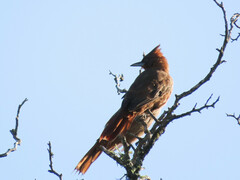

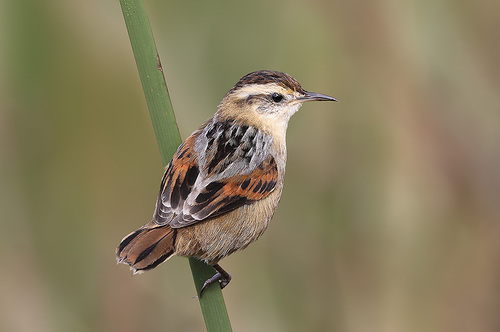
Brown Cacholote

Brown Cacholote

Pseudoseisura lophotes

Silhouette: Sheatherius · PhyloPic

LCLeast ConcernNTVUENCR
Daily sighting probability <5% · Rare
at Iberá National Park

In 3 days <5%

9 Verified sightings at Iberá National Park From 2019 to 2026
33 In all 2 parks
January Best month
☀️ Diurnal When it's spotted

About the Brown Cacholote

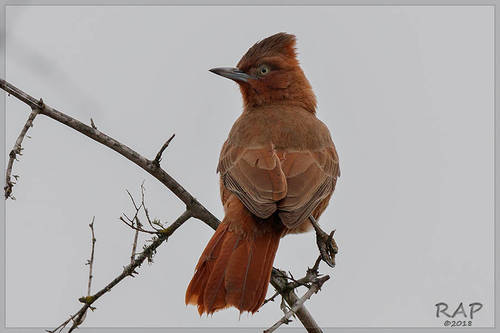
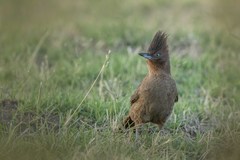
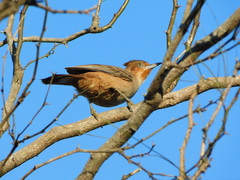
The brown cacholote (Pseudoseisura lophotes) is a medium-sized bird of the ovenbird family Furnariidae. It was described by Ludwig Reichenbach in 1853, with its subspecies, argentina, described in 1960 by Kenneth Carroll Parkes. It is nonmigratory, and is found in the forests and parks of Argentina, Bolivia, Brazil, Paraguay, and Uruguay. Unlike many other birds, the brown cacholote builds large, pitcher-like nests year-round, each weighing many times more than the bird itself. Breeding begins in mid-November, with both parents sharing the responsibility for taking care of the nest equally. Incubation takes 17–20 days, and nestlings fledge at 19 days. They are omnivorous, primarily eating various arthropods, along with the eggs of other birds, fruits, and grain. The causes of death in adults is not well researched; however, nestlings are subject to parasitism from various insects. Egg success rate is 59%. They are a least-concern species.

The brown cacholote was first described as Homorus lophotes by Ludwig Reichenbach in 1853 in his book Handbuch der speciellen Ornithologie. It was later moved into the genus Pseudoseisura by Miguel Lillo in 1902. The... Wikipedia →

Sounds

Recording0:13

Argentina · 2024

© Sabrina Andrea Rendon Anaya · XC891769 · CC BY-NC-SA 4.0

Duet0:20

Argentina · 2023

© Bernard BOUSQUET · XC831031 · CC BY-NC-SA 4.0

Song0:22

Brazil · 2021

© JAYRSON ARAUJO DE OLIVEIRA · XC686604 · CC BY-NC-SA 4.0

Global Distribution

Parks Where Found

# Park Country Daily sighting probability
1 El Impenetrable National Park 🇦🇷 Argentina
~10%
2 Iberá National Park 🇦🇷 Argentina
<5%

Cities Where Found

# City Country Daily sighting probability
1 Cordoba 🇦🇷 Argentina
~70%
2 Mendoza 🇦🇷 Argentina
~40%

Before you go

What are the chances of seeing a Brown Cacholote in Iberá National Park?

Rare

Under 5% of wildlife watchers report a Brown Cacholote sighting in Iberá National Park on a given day, based on 9 verified sightings from GBIF citizen-science data from 2019 to 2026. It is the 260th most-seen of the 284 birds we can rate there. Over three days the chance rises to under 5%, if each day is a fresh chance.

When is the best time to see a Brown Cacholote in Iberá National Park?

Any time of year

In every month with enough records, under 5% of wildlife watchers report a Brown Cacholote in Iberá National Park on a given day, so our monthly data shows no clear season.

What time of day is best to see a Brown Cacholote?

Between 8 and 11 am

Across all the parks we cover, that three-hour window holds the most Brown Cacholote sightings with a recorded time, and about 9 in 10 of them come between 6 am and 6 pm: it is a daytime animal.

Is Iberá National Park the best place to see a Brown Cacholote?

2nd of 2

Of the 2 parks where we can rate Brown Cacholote sightings, Iberá National Park ranks 2nd at under 5%. The best odds are in El Impenetrable National Park (Argentina, about 10%).

Which relatives of the Brown Cacholote live in Iberá National Park?

Same family: Furnariidae

The closest relatives of the Brown Cacholote that you can see in Iberá National Park (family Furnariidae, Ovenbirds and Woodcreepers) are Rufous Hornero (about 80%), Greater Thornbird (about 60%) and Yellow-chinned Spinetail (about 50%), with each one's daily chance of a sighting.

Where does the Brown Cacholote sighting chance come from?

GBIF citizen-science records

It is estimated from how often the Brown Cacholote is recorded against all the birds logged in Iberá National Park (9 verified sightings from 2019 to 2026), calibrated against known sighting rates. Figures are rounded to the nearest 10% because citizen-science data supports honest approximations, not decimals, and months with records from fewer than five people show "—". How it works.

← Back to Iberá National Park