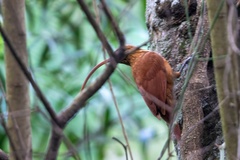

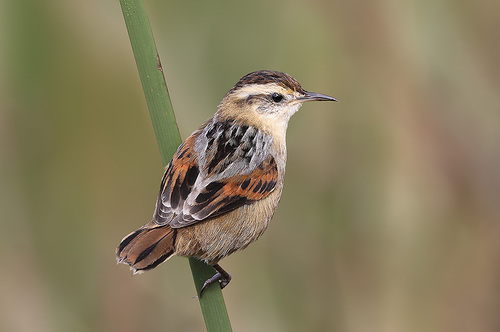
Red-billed Scythebill

Red-billed Scythebill

Campylorhamphus trochilirostris

Silhouette: Sheatherius · PhyloPic

LCLeast ConcernNTVUENCR
Daily sighting probability <5% · Rare
at Iberá National Park

In 3 days ~10% in a week ~20%

57 Verified sightings at Iberá National Park From 2019 to 2026
801 In all 8 parks
February Best month
☀️ Diurnal When it's spotted

About the Red-billed Scythebill

The red-billed scythebill (Campylorhamphus trochilirostris) is a species of bird in the subfamily Dendrocolaptinae of the ovenbird family Furnariidae. It is found in Argentina, Bolivia, Brazil, Colombia, Ecuador, Panama, Paraguay, Peru, and Venezuela.

The red-billed scythebill and black-billed scythebill (C. falcularius) have at times been considered conspecific and also as sister species, but genetic data indicate neither is true. The red-billed and curve-billed scythebill (C. procurvoides) have also been suggested as sister species. Some of the subspecies are difficult to distinguish from each other. In addition, a small number of additional subspecies have been suggested to be split from existing... Wikipedia →

Sounds

Call0:34

Brazil · 2026

© JAYRSON ARAUJO DE OLIVEIRA · XC1135380 · CC BY-NC-SA 4.0

Aberrant0:35

Ecuador · 2025

© Charlie Vogt · XC1053611 · CC BY-NC-SA 4.0

Song0:07

Argentina · 2024

© Luciano Buck · XC973332 · CC BY-NC-SA 4.0

Global Distribution

Parks Where Found

# Park Country Daily sighting probability
1 El Impenetrable National Park 🇦🇷 Argentina
~50%
2 Parque Estadual Encontro das Águas 🇧🇷 Brazil
~10%
3 Manu National Park 🇵🇪 Peru
~10%
4 Henri Pittier National Park 🇻🇪 Venezuela
~10%
5 Machalilla National Park 🇪🇨 Ecuador
<5%
6 Iberá National Park 🇦🇷 Argentina
<5%
7 Tambopata National Reserve 🇵🇪 Peru
<5%
8 Yasuní National Park 🇪🇨 Ecuador
<5%

Cities Where Found

# City Country Daily sighting probability
1 Goiânia 🇧🇷 Brazil
~10%
2 Campo Grande 🇧🇷 Brazil
<5%
3 Caracas 🇻🇪 Venezuela
<5%
4 Asuncion 🇵🇾 Paraguay
<5%

Before you go

What are the chances of seeing a Red-billed Scythebill in Iberá National Park?

Rare

Under 5% of wildlife watchers report a Red-billed Scythebill sighting in Iberá National Park on a given day, based on 57 verified sightings from GBIF citizen-science data from 2019 to 2026. It is the 205th most-seen of the 284 birds we can rate there. Over three days the chance rises to about 10%, and over a week to about 20%, if each day is a fresh chance.

When is the best time to see a Red-billed Scythebill in Iberá National Park?

February and November

In those months about 10% of wildlife watchers report a Red-billed Scythebill in Iberá National Park on a given day, against under 5% in March–October and December–January, the lowest months.

What time of day is best to see a Red-billed Scythebill?

Between 9 am and noon

Across all the parks we cover, that three-hour window holds the most Red-billed Scythebill sightings with a recorded time, and about 9 in 10 of them come between 6 am and 6 pm: it is a daytime animal.

Which relatives of the Red-billed Scythebill live in Iberá National Park?

Same family: Furnariidae

The closest relatives of the Red-billed Scythebill that you can see in Iberá National Park (family Furnariidae, Ovenbirds and Woodcreepers) are Rufous Hornero (about 80%), Greater Thornbird (about 60%) and Yellow-chinned Spinetail (about 50%), with each one's daily chance of a sighting.

Where does the Red-billed Scythebill sighting chance come from?

GBIF citizen-science records

It is estimated from how often the Red-billed Scythebill is recorded against all the birds logged in Iberá National Park (57 verified sightings from 2019 to 2026), calibrated against known sighting rates. Figures are rounded to the nearest 10% because citizen-science data supports honest approximations, not decimals, and months with records from fewer than five people show "—". How it works.

← Back to Iberá National Park