
Brazilian Lancehead

Brazilian Lancehead

Bothrops moojeni

Silhouette: Steven Traver · PhyloPic

LCLeast ConcernNTVUENCR
Daily sighting probability ~20% · Possible
at Iguazú National Park

In 3 days ~50% in a week ~80%

24 Verified sightings at Iguazú National Park From 2019 to 2026
60 In all 3 parks
August Best month
☀️🌙 Day & Night When it's spotted

About the Brazilian Lancehead

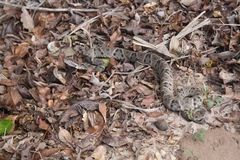
Bothrops moojeni, commonly known in English as the Brazilian lancehead, is a species of highly venomous snake in the family Viperidae. It is a pit viper endemic to South America. The specific name, moojeni, is in honor of Brazilian zoologist João Moojen de Oliveira (1904–1985).

Bothrops moojeni grows to an average total length (tail included) of 1.6 m (5.2 ft), with a maximum of 2.3 m (7.5 ft) already reported. It has a tan, gray-brown or olive-gray color, with 14–21 trapezoidal side markings that are dark gray or completely black. There are 23–29 rows of dorsal scales on the body. The belly is usually white or cream, with scattered dark gray spots. Juveniles have a white tail. The species is terrestrial and nocturnal.

It is considered very defensive. Its body varies from medium to heavy. The broad head is flattened in a lance shape when seen from above, and is distinct from the narrow neck. The snout is not elevated. The eyes are medium in size, with vertically elliptical pupils. The dorsal scales are keeled. B. moojeni is viviparous. Gestation lasts around four months, occurs once a year, and litter size is usually 12–14 neonates. B.... Wikipedia →

Global Distribution

Parks Where Found

# Park Country Daily sighting probability
1 Emas National Park 🇧🇷 Brazil
~30%
2 Iguazú National Park 🇦🇷 Argentina
~20%
3 Iguaçu National Park 🇧🇷 Brazil
~20%

Zoos & Centres Where Found

# Zoo / Centre Country
1 Zoo Miami 🇺🇸 United States In captivity
2 Zoológico de Brasília 🇧🇷 Brazil In captivity
3 São Paulo Zoo 🇧🇷 Brazil In captivity
4 Zoológico de Goiânia 🇧🇷 Brazil In captivity
5 Houston Zoo 🇺🇸 United States In captivity
6 Philadelphia Zoo 🇺🇸 United States In captivity
7 Municipal Zoological Park Quinzinho de Barros 🇧🇷 Brazil In captivity
8 Rio de Janeiro Zoological Garden 🇧🇷 Brazil In captivity
9 Parque Ecológico de São Carlos 🇧🇷 Brazil In captivity
10 Reptile Gardens 🇺🇸 United States In captivity

Before you go

What are the chances of seeing a Brazilian Lancehead in Iguazú National Park?

Possible

About 20% of wildlife watchers report a Brazilian Lancehead sighting in Iguazú National Park on a given day, based on 24 verified sightings from GBIF citizen-science data from 2019 to 2026. It is the 8th most-seen of the 18 reptiles we can rate there. Over three days the chance rises to about 50%, and over a week to about 80%, if each day is a fresh chance.

When is the best time to see a Brazilian Lancehead in Iguazú National Park?

January–February and August

In those months about 30% of wildlife watchers report a Brazilian Lancehead in Iguazú National Park on a given day, against under 5% in May and June, the lowest months.

What time of day is best to see a Brazilian Lancehead?

Between 6 and 9 pm

Across all the parks we cover, that three-hour window holds the most Brazilian Lancehead sightings with a recorded time, and about 6 in 10 of them come between 6 am and 6 pm: it is seen both by day and at night.

Is Iguazú National Park the best place to see a Brazilian Lancehead?

2nd of 3

Of the 3 parks where we can rate Brazilian Lancehead sightings, Iguazú National Park ranks 2nd at about 20%. The best odds are in Emas National Park (Brazil, about 30%).

Which relatives of the Brazilian Lancehead live in Iguazú National Park?

Same genus: Bothrops

The closest relatives of the Brazilian Lancehead that you can see in Iguazú National Park (genus Bothrops, Neotropical Lanceheads) are Jararacussu (about 10%) and Painted Lancehead (about 10%), with each one's daily chance of a sighting.

Where does the Brazilian Lancehead sighting chance come from?

GBIF citizen-science records

It is estimated from how often the Brazilian Lancehead is recorded against all the reptiles logged in Iguazú National Park (24 verified sightings from 2019 to 2026), calibrated against known sighting rates. Figures are rounded to the nearest 10% because citizen-science data supports honest approximations, not decimals, and months with records from fewer than five people show "—". How it works.

← Back to Iguazú National Park