Lichtenstein's Green Racer

Lichtenstein's Green Racer

Philodryas olfersii

Silhouette: Alex Slavenko · PhyloPic

LCLeast ConcernNTVUENCR
Daily sighting probability ~10% · With luck
at Iguazú National Park

In 3 days ~20% in a week ~50%

8 Verified sightings at Iguazú National Park From 2019 to 2026
15 In all 2 parks
October Best month
☀️ Diurnal When it's spotted

About the Lichtenstein's Green Racer

Philodryas olfersii is a species of venomous snake in the subfamily Dipsadinae of the family Colubridae. The species is endemic to South America. Common names for Philodryas olfersii include Lichtenstein's green racer, South American green racer, and eastern green whiptail,

The specific name, olfersii, is in honor of German naturalist Ignaz von Olfers. Philodryas olfersii is native to southern South America, including northern Argentina, Brazil, Bolivia, and northwestern Paraguay. Philodryas olfersii reaches 1 to 1.5 meters (about 40 to 60 inches) in maximum total length (including tail).

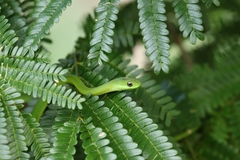
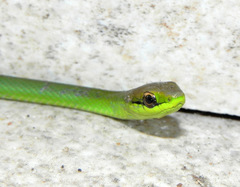
Dorsally, it is green in color; ventrally, it is yellowish. The dorsal scales are smooth, without apical pits, and are arranged in 19 rows at midbody. Philodryas olfersii can be found in many habitat types, including the Cerrado, Caatinga, forest, forest transition, and restinga. It has been found at altitudes from sea level to 1,700 m (5,600 ft). The species Philodryas olfersii is often arboreal, but it also forages on the ground. It is diurnal, though it has been observed mating late in the evening... Wikipedia →

Global Distribution

Parks Where Found

# Park Country Daily sighting probability
1 Iguazú National Park 🇦🇷 Argentina
~10%
2 Iguaçu National Park 🇧🇷 Brazil
~10%

Cities Where Found

# City Country Daily sighting probability
1 Fortaleza 🇧🇷 Brazil
~20%
2 Recife 🇧🇷 Brazil
~10%

Zoos & Centres Where Found

# Zoo / Centre Country
1 Zoológico de Brasília 🇧🇷 Brazil In captivity
2 Ménagerie du Jardin des Plantes 🇫🇷 France In captivity

Before you go

What are the chances of seeing a Lichtenstein's Green Racer in Iguazú National Park?

With luck

About 10% of wildlife watchers report a Lichtenstein's Green Racer sighting in Iguazú National Park on a given day, based on 8 verified sightings from GBIF citizen-science data from 2019 to 2026. It is the 13th most-seen of the 18 reptiles we can rate there. Over three days the chance rises to about 20%, and over a week to about 50%, if each day is a fresh chance.

When is the best time to see a Lichtenstein's Green Racer in Iguazú National Park?

October and December

In those months about 20% of wildlife watchers report a Lichtenstein's Green Racer in Iguazú National Park on a given day, against under 5% in January–July and November, the lowest months. Those are among Iguazú National Park's wettest months, with about 230 mm of rain a month against 90 mm in August.

What time of day is best to see a Lichtenstein's Green Racer?

Between 9 am and noon

Across all the parks we cover, that three-hour window holds the most Lichtenstein's Green Racer sightings with a recorded time, and about 9 in 10 of them come between 6 am and 6 pm: it is a daytime animal.

Is Iguazú National Park the best place to see a Lichtenstein's Green Racer?

Yes

Of the 2 parks where we can rate Lichtenstein's Green Racer sightings, Iguazú National Park has the highest daily chance: about 10%. Next come Iguaçu National Park (Brazil, about 10%).

Which relatives of the Lichtenstein's Green Racer live in Iguazú National Park?

Same family: Colubridae

The closest relatives of the Lichtenstein's Green Racer that you can see in Iguazú National Park (family Colubridae, Colubrid Snakes) are Chicken Snake (about 20%), Aesculapian False Coral Snake (about 10%) and Forest Flame Snake (about 10%), with each one's daily chance of a sighting.

Where does the Lichtenstein's Green Racer sighting chance come from?

GBIF citizen-science records

It is estimated from how often the Lichtenstein's Green Racer is recorded against all the reptiles logged in Iguazú National Park (8 verified sightings from 2019 to 2026), calibrated against known sighting rates. Figures are rounded to the nearest 10% because citizen-science data supports honest approximations, not decimals, and months with records from fewer than five people show "—". How it works.

← Back to Iguazú National Park