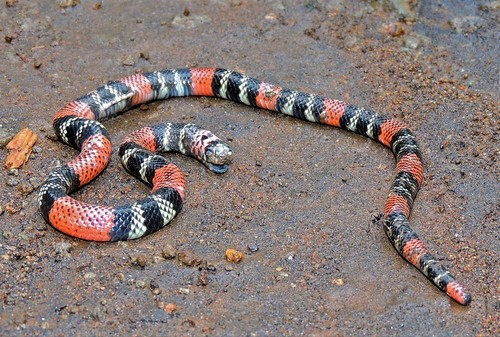
Aesculapian False Coral Snake

Aesculapian False Coral Snake

Erythrolamprus aesculapii

Silhouette: Alex Slavenko · PhyloPic

LCLeast ConcernNTVUENCR
Daily sighting probability ~10% · With luck
at Iguazú National Park

In 3 days ~20% in a week ~50%

7 Verified sightings at Iguazú National Park From 2019 to 2026
12 In all 2 parks
December Best month
☀️ Diurnal When it's spotted

About the Aesculapian False Coral Snake

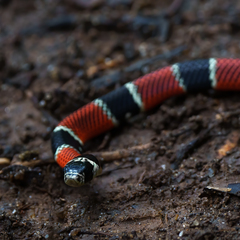
Erythrolamprus aesculapii, also known commonly as the Aesculapian false coral snake, the South American false coral snake, and in Portuguese as bacorá, or falsa-coral, is a species of mildly venomous snake in the family Colubridae. The species is endemic to South America.

The specific name, aesculapii, refers to Aesculapius, the Greek mythological god of medicine, who is depicted with a snake-entwined staff. Erythrolamprus aesculapii belongs to the genus Erythrolamprus, which contains over 50 species. The genus Erythrolamprus belongs to the subfamily Dipsadinae, which is sometimes referred to as the family Dipsadidae.

Molecular phylogenetic DNA analysis has shown that Erythrolamprus aesculapii is likely paraphyletic, as shown in the cladogram below of Erythrolamprus species located in northern South America: E. aesculapii is found in the Amazon rainforest of South America. It is also found on the island of Trinidad (in the Republic of Trinidad and Tobago). E. aesculapii is often found in the leaf litter or burrowing in the soil in rain forests, at altitudes from sea level to 2,300 m (7,500 ft).... Wikipedia →

Sounds

Recording0:34

Brazil · 2024

© Marco Silva · iNaturalist · CC BY-NC 4.0

Global Distribution

Parks Where Found

# Park Country Daily sighting probability
1 Iguazú National Park 🇦🇷 Argentina
~10%
2 Iguaçu National Park 🇧🇷 Brazil
~10%

Zoos & Centres Where Found

# Zoo / Centre Country
1 Snakeroom Serpentarium 🇪🇸 Spain In captivity

Before you go

What are the chances of seeing an Aesculapian False Coral Snake in Iguazú National Park?

With luck

About 10% of wildlife watchers report an Aesculapian False Coral Snake sighting in Iguazú National Park on a given day, based on 7 verified sightings from GBIF citizen-science data from 2019 to 2026. It is the 13th most-seen of the 18 reptiles we can rate there. Over three days the chance rises to about 20%, and over a week to about 50%, if each day is a fresh chance.

When is the best time to see an Aesculapian False Coral Snake in Iguazú National Park?

July and December

In those months about 20% of wildlife watchers report an Aesculapian False Coral Snake in Iguazú National Park on a given day, against under 5% in February, April–June, August–September and November, the lowest months.

What time of day is best to see an Aesculapian False Coral Snake?

Between 9 am and noon

Across all the parks we cover, that three-hour window holds the most Aesculapian False Coral Snake sightings with a recorded time, and about 9 in 10 of them come between 6 am and 6 pm: it is a daytime animal.

Is Iguazú National Park the best place to see an Aesculapian False Coral Snake?

Yes

Of the 2 parks where we can rate Aesculapian False Coral Snake sightings, Iguazú National Park has the highest daily chance: about 10%. Next come Iguaçu National Park (Brazil, about 10%).

Which relatives of the Aesculapian False Coral Snake live in Iguazú National Park?

Same family: Colubridae

The closest relatives of the Aesculapian False Coral Snake that you can see in Iguazú National Park (family Colubridae, Colubrid Snakes) are Chicken Snake (about 20%), Lichtenstein's Green Racer (about 10%) and Forest Flame Snake (about 10%), with each one's daily chance of a sighting.

Where does the Aesculapian False Coral Snake sighting chance come from?

GBIF citizen-science records

It is estimated from how often the Aesculapian False Coral Snake is recorded against all the reptiles logged in Iguazú National Park (7 verified sightings from 2019 to 2026), calibrated against known sighting rates. Figures are rounded to the nearest 10% because citizen-science data supports honest approximations, not decimals, and months with records from fewer than five people show "—". How it works.

← Back to Iguazú National Park