Green-Veined Emperor

Green-Veined Emperor

Charaxes candiope

Daily sighting probability <5% · Rare
at iSimangaliso Wetland Park

In 3 days ~10% in a week ~30%

6 Verified sightings at iSimangaliso Wetland Park From 2019 to 2026
73 In all 7 parks
July Best month
☀️ Diurnal When it's spotted

About the Green-Veined Emperor

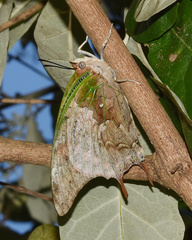
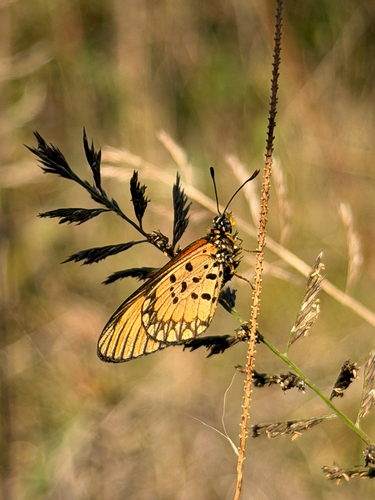
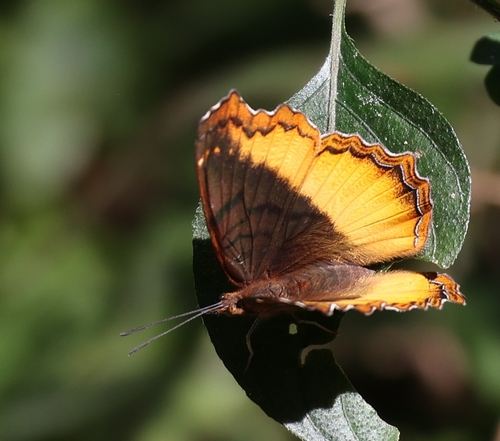
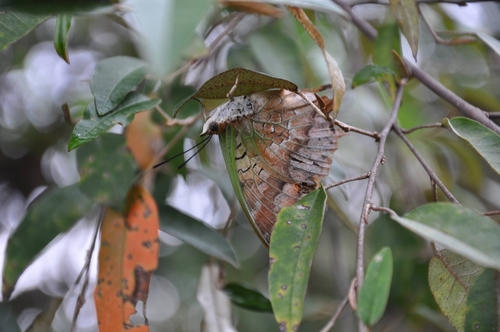
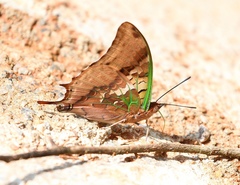
Charaxes candiope, the green-veined emperor or green-veined charaxes, is a butterfly of the family Nymphalidae. It is common in sub-Saharan Africa. The habitat is forest and savanna excluding arid savanna. It also occurs in gardens and agricultural areas. Notes on the biology of candiope are given by Pringle et al. (1994), Larsen, T.B. (1991), Larsen, T.B. (2005) and Kielland, J. (1990).

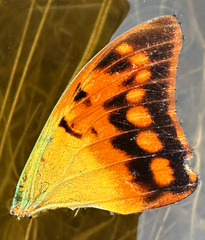
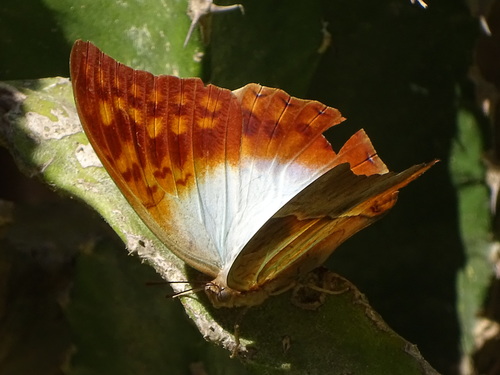
Flight period is from October to June. The wingspan is 45–55 mm in males and 50–60 mm in females. The basic colour of the upperside wings is tawny or orange tawny, with a basal area slightly paler or pale ochre yellow. The unscaled veins and the costal edge of forewing are green. The hindwings have a submarginal black band with a series of tawny ochreous or whitish interstitial spots. The undersides of the forewings are clayish, slightly ochreous, while the hindwings are sepia colour. Forewings are rather falcate, while the hindwings have two small tails protruding from the lower edge.

A full description is given by Walter Rothschild and Karl Jordan, 1900 Novitates Zoologicae volume 7:287-524. [1] page 364 et seq. (for terms see Novitates Zoologicae... Wikipedia →
Global Distribution

Parks Where Found

# Park Country Daily sighting probability
1 Waterberg Plateau Park 🇳🇦 Namibia
~40%
2 Nairobi National Park 🇰🇪 Kenya
~20%
3 Odzala-Kokoua National Park 🇨🇬 Republic of the Congo
~20%
4 Moremi Game Reserve 🇧🇼 Botswana
~10%
5 Masai Mara National Reserve 🇰🇪 Kenya
~10%
6 Kruger National Park 🇿🇦 South Africa
~10%
7 iSimangaliso Wetland Park 🇿🇦 South Africa
<5%

Cities Where Found

# City Country Daily sighting probability
1 Nairobi 🇰🇪 Kenya
~20%
2 Harare 🇿🇼 Zimbabwe
~10%
3 Durban 🇿🇦 South Africa
~10%

Before you go

What are the chances of seeing a Green-Veined Emperor in iSimangaliso Wetland Park?

Rare

Under 5% of wildlife watchers report a Green-Veined Emperor sighting in iSimangaliso Wetland Park on a given day, based on 6 verified sightings from GBIF citizen-science data from 2019 to 2026. It is the 272nd most-seen of the 316 insects we can rate there. Over three days the chance rises to about 10%, and over a week to about 30%, if each day is a fresh chance.

When is the best time to see a Green-Veined Emperor in iSimangaliso Wetland Park?

February–May and July

In those months about 10% of wildlife watchers report a Green-Veined Emperor in iSimangaliso Wetland Park on a given day, against under 5% in June and August–January, the lowest months.

What time of day is best to see a Green-Veined Emperor?

Between 10 am and 1 pm

Across all the parks we cover, that three-hour window holds the most Green-Veined Emperor sightings with a recorded time, and nearly all of them come between 6 am and 6 pm: it is a daytime animal.

Is iSimangaliso Wetland Park the best place to see a Green-Veined Emperor?

7th of 7

Of the 7 parks where we can rate Green-Veined Emperor sightings, iSimangaliso Wetland Park ranks 7th at under 5%. The best odds are in Waterberg Plateau Park (Namibia, about 40%), Nairobi National Park (Kenya, about 20%) and Odzala-Kokoua National Park (Republic of the Congo, about 20%).

Which relatives of the Green-Veined Emperor live in iSimangaliso Wetland Park?

Same genus: Charaxes

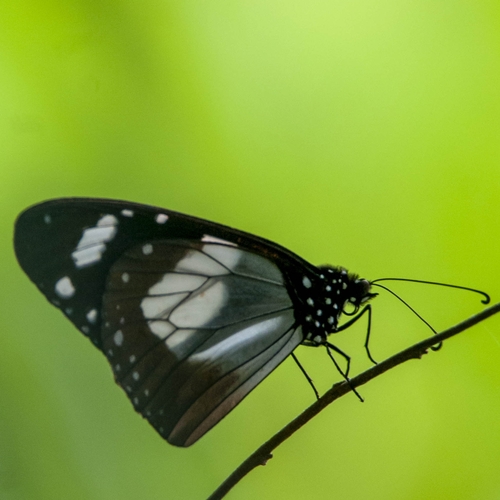
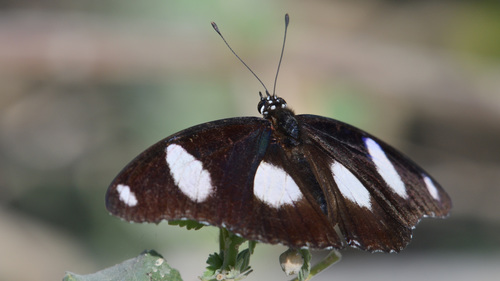
The closest relatives of the Green-Veined Emperor that you can see in iSimangaliso Wetland Park (genus Charaxes, Emperor Butterflies) are White Pearl Emperor (about 10%), White-Barred Emperor (about 10%) and Forest Queen (about 10%), with each one's daily chance of a sighting.

Where does the Green-Veined Emperor sighting chance come from?

GBIF citizen-science records

It is estimated from how often the Green-Veined Emperor is recorded against all the insects logged in iSimangaliso Wetland Park (6 verified sightings from 2019 to 2026), calibrated against known sighting rates. Figures are rounded to the nearest 10% because citizen-science data supports honest approximations, not decimals, and months with records from fewer than five people show "—". How it works.

← Back to iSimangaliso Wetland Park