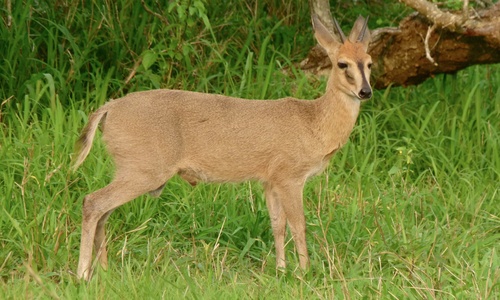
Southern Reedbuck

Southern Reedbuck

Redunca arundinum

Silhouette: Jan A. Venter, Herbert H. T. Prins, David A. Balfour & Rob Slotow (vectorized by T. Michael Keesey) · PhyloPic

LCLeast ConcernNTVUENCR
Daily sighting probability ~30% · Possible
at iSimangaliso Wetland Park

In 3 days ~60% in a week ~90%

106 Verified sightings at iSimangaliso Wetland Park From 2019 to 2026
191 In all 6 parks
September Best month
☀️ Diurnal When it's spotted

About the Southern Reedbuck

The southern reedbuck, rietbok or common reedbuck (Redunca arundinum) is a diurnal antelope typically found in southern Africa. It was first described by Pieter Boddaert, a Dutch physician and naturalist, in 1785. It is placed in the genus Redunca and family Bovidae. This antelope has an average mass of 58 kg (128 lb) and a body length of about 134–167 cm (53–66 in).

It was first described by Pieter Boddaert, a Dutch physician and naturalist, in 1785. It is placed in the genus Redunca and family Bovidae. It gets its name from two Latin words: reduncas (meaning bent backwards and curved, while the horns are bent forwards) and arundo (harundo) (meaning a reed; hence arundinum, pertaining to reeds).

The southern reedbuck is larger than the other species in Redunca, namely R. redunca (Bohor reedbuck) and R. fulvorufula (mountain reedbuck). It stands 80–90 cm (31–35 in) at the shoulder. Females weigh 48 kg (106 lb), while the males weigh 68 kg (150 lb). It has distinctive dark lines running down the front of each of its forelegs and lower hindlegs and whitish rings around the eyes. It has a lifespan of 10 years.

The coat is silky and almost... Wikipedia →

Sounds

Recording0:16

South Africa · 2023

© michelerey · iNaturalist · CC BY-NC 4.0

Recording0:08

South Africa · 2023

© nicky001 · iNaturalist · CC BY-NC 4.0

Global Distribution

Parks Where Found

# Park Country Daily sighting probability
1 Moremi Game Reserve 🇧🇼 Botswana
~40%
2 iSimangaliso Wetland Park 🇿🇦 South Africa
~30%
3 Kafue National Park 🇿🇲 Zambia
~20%
4 Liwonde National Park 🇲🇼 Malawi
~20%
5 Hwange National Park 🇿🇼 Zimbabwe
~20%
6 Kruger National Park 🇿🇦 South Africa
~10%

Before you go

What are the chances of seeing a Southern Reedbuck in iSimangaliso Wetland Park?

Possible

About 30% of wildlife watchers report a Southern Reedbuck sighting in iSimangaliso Wetland Park on a given day, based on 106 verified sightings from GBIF citizen-science data from 2019 to 2026. It is the 11th most-seen of the 34 mammals we can rate there. Over three days the chance rises to about 60%, and over a week to about 90%, if each day is a fresh chance.

When is the best time to see a Southern Reedbuck in iSimangaliso Wetland Park?

September and October

In those months about 40% of wildlife watchers report a Southern Reedbuck in iSimangaliso Wetland Park on a given day, against about 20% in April–June and August, the lowest months.

What time of day is best to see a Southern Reedbuck?

Between 8 and 11 am

Across all the parks we cover, that three-hour window holds the most Southern Reedbuck sightings with a recorded time, and about 9 in 10 of them come between 6 am and 6 pm: it is a daytime animal.

Is iSimangaliso Wetland Park the best place to see a Southern Reedbuck?

2nd of 6

Of the 6 parks where we can rate Southern Reedbuck sightings, iSimangaliso Wetland Park ranks 2nd at about 30%. The best odds are in Moremi Game Reserve (Botswana, about 40%). All parks ranked.

Which relatives of the Southern Reedbuck live in iSimangaliso Wetland Park?

Same family: Bovidae

The closest relatives of the Southern Reedbuck that you can see in iSimangaliso Wetland Park (family Bovidae, Bovids) are Greater Kudu (about 40%), African Buffalo (about 40%) and Waterbuck (about 40%), with each one's daily chance of a sighting.

Where does the Southern Reedbuck sighting chance come from?

GBIF citizen-science records

It is estimated from how often the Southern Reedbuck is recorded against all the mammals logged in iSimangaliso Wetland Park (106 verified sightings from 2019 to 2026), calibrated against known sighting rates. Figures are rounded to the nearest 10% because citizen-science data supports honest approximations, not decimals, and months with records from fewer than five people show "—". How it works.

← Back to iSimangaliso Wetland Park