


Completed
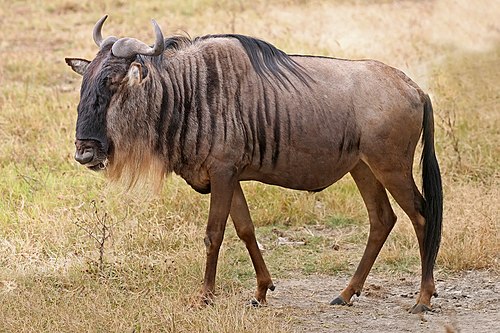

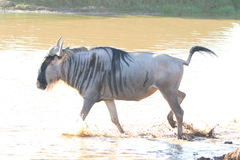

Blue Wildebeest
Connochaetes taurinus
Silhouette: [unknown] · PhyloPic
- KingdomAnimalia (Animals)
- PhylumChordata (Chordates)
- ClassMammalia (Mammals)
- OrderArtiodactyla (Even-toed Ungulates and Cetaceans)
- FamilyBovidae (Bovids)
- GenusConnochaetes (Wildebeests)
- SpeciesConnochaetes taurinus (Blue Wildebeest)
In 3 days ~60% in a week ~90%
96 Verified sightings at iSimangaliso Wetland Park From 2019 to 2026
4,256 In all 26 parks
August Best month
☀️ Diurnal When it's spotted


Completed


Completed


Completed
About the Blue Wildebeest
The blue wildebeest (Connochaetes taurinus), also called the common wildebeest, white-bearded gnu or brindled gnu, is a large antelope and one of the two species of wildebeest. It is placed in the genus Connochaetes and family Bovidae, and has a close taxonomic relationship with the black wildebeest. The blue wildebeest is known to have five subspecies. This broad-shouldered antelope has a muscular, front-heavy appearance, with a distinctive, robust muzzle. Young blue wildebeest are born tawny brown, and begin to take on their adult coloration at the age of 2 months. The adults' hues range from a deep slate or bluish-gray to light gray or even grayish-brown. Both sexes possess a pair of large curved horns.
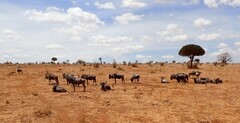
The blue wildebeest is an herbivore, feeding primarily on short grasses. It forms herds which move about in loose aggregations, the animals being fast runners and extremely wary. The mating season begins at the end of the rainy season and a single calf is usually born after a gestational period of about 8.5 months. The calf remains with its mother for 8 months, after which it joins a juvenile herd. Blue wildebeest are found in short-grass plains bordering bush-covered acacia savannas in southern and eastern Africa, thriving in areas that are neither too wet nor too arid. Three African populations of blue wildebeest take part in a long-distance migration, timed to coincide with the annual pattern of rainfall and grass growth on the short-grass plains where they can find the nutrient-rich forage necessary for lactation and calf growth.
The blue wildebeest is native to Angola, Botswana, Eswatini, Kenya, Mozambique, South Africa, Tanzania, Zambia, and Zimbabwe. Today, it is extinct in Malawi, but has been successfully reintroduced in Namibia. The southern limit of the blue wildebeest range is the Orange River, while the western limit is bounded by Lake Victoria and Mount Kenya. The blue wildebeest is widespread and is being introduced into private game farms, reserves, and conservancies. The International Union for Conservation of Nature and Natural Resources rates the blue wildebeest as being of least concern. The population has been estimated to be around 1.5 million, and the population trend is stable. Wikipedia →
Sounds
Recording0:57
Tanzania · 2018
© Bernard BOUSQUET · XC1059109 · CC BY-NC-SA 4.0
Recording0:05
Tanzania · 2025
© Nicolás Ortiz Durán · iNaturalist · CC BY-NC 4.0
Recording0:13
Botswana · 2018
© Dewald du Plessis · iNaturalist · CC BY-NC 4.0
Recent sightings of Blue Wildebeest in iSimangaliso Wetland Park
LIVEiNaturalistGlobal Distribution
Parks Where Found
Zoos & Centres Where Found
Closest Relatives at iSimangaliso Wetland Park






Before you go
What are the chances of seeing a Blue Wildebeest in iSimangaliso Wetland Park?
Possible
About 30% of wildlife watchers report a Blue Wildebeest sighting in iSimangaliso Wetland Park on a given day, based on 96 verified sightings from GBIF citizen-science data from 2019 to 2026. It is the 14th most-seen of the 34 mammals we can rate there. Over three days the chance rises to about 60%, and over a week to about 90%, if each day is a fresh chance.
When is the best time to see a Blue Wildebeest in iSimangaliso Wetland Park?
August
In that month about 40% of wildlife watchers report a Blue Wildebeest in iSimangaliso Wetland Park on a given day, against about 20% in February–April, July and December, the lowest months. That is one of iSimangaliso Wetland Park's driest months, with about 30 mm of rain against 130 mm in February.
What time of day is best to see a Blue Wildebeest?
Between 8 and 11 am
Across all the parks we cover, that three-hour window holds the most Blue Wildebeest sightings with a recorded time, and about 9 in 10 of them come between 6 am and 6 pm: it is a daytime animal.
Is iSimangaliso Wetland Park the best place to see a Blue Wildebeest?
21st of 26
Of the 26 parks where we can rate Blue Wildebeest sightings, iSimangaliso Wetland Park ranks 21st at about 30%. The best odds are in Amboseli National Park (Kenya, about 80%), Etosha National Park (Namibia, about 70%) and Ngorongoro Conservation Area (Tanzania, about 70%). All parks ranked.
Which relatives of the Blue Wildebeest live in iSimangaliso Wetland Park?
Same family: Bovidae
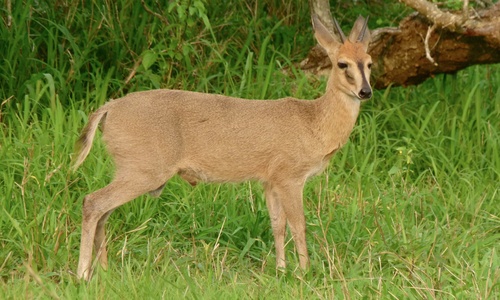
The closest relatives of the Blue Wildebeest that you can see in iSimangaliso Wetland Park (family Bovidae, Bovids) are Greater Kudu (about 40%), African Buffalo (about 40%) and Waterbuck (about 40%), with each one's daily chance of a sighting.
Where does the Blue Wildebeest sighting chance come from?
GBIF citizen-science records
It is estimated from how often the Blue Wildebeest is recorded against all the mammals logged in iSimangaliso Wetland Park (96 verified sightings from 2019 to 2026), calibrated against known sighting rates. Figures are rounded to the nearest 10% because citizen-science data supports honest approximations, not decimals, and months with records from fewer than five people show "—". How it works.
