
Hellmayr's Pipit

Hellmayr's Pipit

Anthus hellmayri

Silhouette: Susan Murphy (original photograph), T. Michael Keesey (vectorization) · PhyloPic

LCLeast ConcernNTVUENCR
Daily sighting probability <5% · Rare
at Itatiaia National Park

In 3 days <5% in a week ~10%

24 Verified sightings at Itatiaia National Park From 2019 to 2026
160 In all 4 parks
October Best month
☀️ Diurnal When it's spotted

About the Hellmayr's Pipit

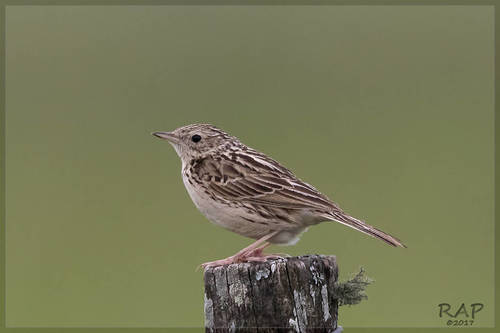
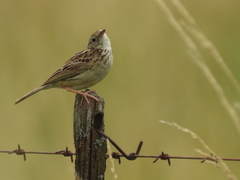
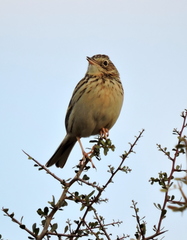
Hellmayr's pipit (Anthus hellmayri) is a species of bird in the family Motacillidae, the wagtails and pipits. It is found in Argentina, Bolivia, Brazil, Chile, Paraguay, Peru, and Uruguay. Hellmayr's pipit was described by Ernst Hartert in 1909 with its current binomial Anthus hellmayri. Hartert's specific epithet hellmayri honors Austrian ornithologist Carl Eduard Hellmayr; its English name came later.

Hellmayr's pipit has these three subspecies: Some authors suggest that genetic differences among the subspecies are large enough that two full species may be present. Hellmayr's pipit is about 14 to 16 cm (5.5 to 6.3 in) long. Subspecies A. h. brasilianus weighs 16.5 to 20 g (0.58 to 0.71 oz) The sexes have the same plumage. Adults of the nominate subspecies A. h. hellmayri have a pale buff head with a paler area around the eye. Their upperparts are pale buff with bold blackish brown streaks. Their wings are dusky with whitish edges on the primaries and tertials and buff edges on the secondaries. Their wing coverts have buff edges that... Wikipedia →

Sounds

Call0:30

Brazil · 2025

© JAYRSON ARAUJO DE OLIVEIRA · XC1052977 · CC BY-NC-SA 4.0

Flight call0:12

Argentina · 2022

© Franco Vushurovich · XC743511 · CC BY-NC-SA 4.0

Song0:12

Brazil · 2015

© Robson Silva e Silva · XC723661 · CC BY-NC-SA 4.0

Global Distribution

Parks Where Found

# Park Country Daily sighting probability
1 Iberá National Park 🇦🇷 Argentina
~10%
2 Serra da Canastra National Park 🇧🇷 Brazil
<5%
3 Itatiaia National Park 🇧🇷 Brazil
<5%
4 Nahuel Huapi National Park 🇦🇷 Argentina
<5%

Cities Where Found

# City Country Daily sighting probability
1 Curitiba 🇧🇷 Brazil
<5%
2 Buenos Aires 🇦🇷 Argentina
<5%

Before you go

What are the chances of seeing a Hellmayr's Pipit in Itatiaia National Park?

Rare

Under 5% of wildlife watchers report a Hellmayr's Pipit sighting in Itatiaia National Park on a given day, based on 24 verified sightings from GBIF citizen-science data from 2019 to 2026. It is the 271st most-seen of the 352 birds we can rate there. Over three days the chance rises to under 5%, and over a week to about 10%, if each day is a fresh chance.

When is the best time to see a Hellmayr's Pipit in Itatiaia National Park?

Any time of year

In every month with enough records, under 5% of wildlife watchers report a Hellmayr's Pipit in Itatiaia National Park on a given day, so our monthly data shows no clear season.

What time of day is best to see a Hellmayr's Pipit?

Between 8 and 11 am

Across all the parks we cover, that three-hour window holds the most Hellmayr's Pipit sightings with a recorded time, and about 9 in 10 of them come between 6 am and 6 pm: it is a daytime animal.

Is Itatiaia National Park the best place to see a Hellmayr's Pipit?

3rd of 4

Of the 4 parks where we can rate Hellmayr's Pipit sightings, Itatiaia National Park ranks 3rd at under 5%. The best odds are in Iberá National Park (Argentina, about 10%) and Serra da Canastra National Park (Brazil, under 5%).

Which relatives of the Hellmayr's Pipit live in Itatiaia National Park?

Same order: Passeriformes

The closest relatives of the Hellmayr's Pipit that you can see in Itatiaia National Park (order Passeriformes, Perching Birds) are Rufous-collared Sparrow (about 80%), Golden-crowned Warbler (about 70%) and Saffron Finch (about 60%), with each one's daily chance of a sighting.

Where does the Hellmayr's Pipit sighting chance come from?

GBIF citizen-science records

It is estimated from how often the Hellmayr's Pipit is recorded against all the birds logged in Itatiaia National Park (24 verified sightings from 2019 to 2026), calibrated against known sighting rates. Figures are rounded to the nearest 10% because citizen-science data supports honest approximations, not decimals, and months with records from fewer than five people show "—". How it works.

← Back to Itatiaia National Park