Rusty-barred Owl

Rusty-barred Owl

Strix hylophila

Silhouette: Sharon Wegner-Larsen · PhyloPic

LCLeast ConcernNTVUENCR
Daily sighting probability <5% · Rare
at Itatiaia National Park

In 3 days ~10%

39 Verified sightings at Itatiaia National Park From 2019 to 2026
142 In all 3 parks
June Best month
🌙 Nocturnal When it's spotted

About the Rusty-barred Owl

The rusty-barred owl (Strix hylophila) is a medium-sized "typical owl" in subfamily Striginae. It is found in Argentina, Brazil (where it is known as the Brazilian owl), and Paraguay. The rusty-barred owl is one of seven members of genus Strix found in South America, according to the International Ornithological Committee (IOC). It appears to be most closely related to the Chaco owl (S. chacoensis) and rufous-legged owl (S. rufipes). All three have vocalizations that are very different from those of other Strix owls and genetic studies may find that they belong in their own genus. The rusty-barred owl is monotypic.

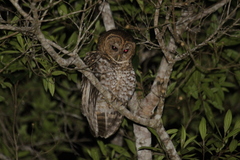
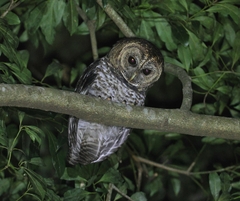
The rusty-barred owl is about 35 cm (14 in) long. Males weigh 250 to 340 g (8.8 to 12 oz) and females 275 to 395 g (9.7 to 14 oz). The species has light rusty brown facial discs with concentric darker brown rings and small white "eyebrows". Adults' upperparts have white, brown, and orange-buff barring. The chest and flanks are orangish buff and the belly is whiter; both areas have dark brown bars. The legs are feathered. The eyes are dark brown, the bill yellowish horn, and the toes yellowish gray. Juveniles are overall buff... Wikipedia →

Sounds

Call0:26

Brazil · 2024

© Miguel Angelo Biz · XC941722 · CC BY-NC-SA 4.0

Song0:08

Brazil · 2023

© Ricardo José Mitidieri · XC786267 · CC BY-NC-SA 4.0

Duet0:38

Argentina

© Dante Gabriel Moresco · XC657405 · CC BY-NC-SA 4.0

Global Distribution

Parks Where Found

# Park Country Daily sighting probability
1 Itatiaia National Park 🇧🇷 Brazil
<5%
2 Iguazú National Park 🇦🇷 Argentina
<5%
3 Iguaçu National Park 🇧🇷 Brazil
<5%

Cities Where Found

# City Country Daily sighting probability
1 São Paulo 🇧🇷 Brazil
<5%

Zoos & Centres Where Found

# Zoo / Centre Country
1 Small Breeds Farm Park 🇬🇧 United Kingdom In captivity

Before you go

What are the chances of seeing a Rusty-barred Owl in Itatiaia National Park?

Rare

Under 5% of wildlife watchers report a Rusty-barred Owl sighting in Itatiaia National Park on a given day, based on 39 verified sightings from GBIF citizen-science data from 2019 to 2026. It is the 256th most-seen of the 352 birds we can rate there. Over three days the chance rises to about 10%, if each day is a fresh chance.

When is the best time to see a Rusty-barred Owl in Itatiaia National Park?

January, April and June

In those months about 10% of wildlife watchers report a Rusty-barred Owl in Itatiaia National Park on a given day, against under 5% in February–March, May and July–December, the lowest months.

What time of day is best to see a Rusty-barred Owl?

Between 6 and 9 pm

Across all the parks we cover, that three-hour window holds the most Rusty-barred Owl sightings with a recorded time, and about 9 in 10 of them come between 6 pm and 6 am: it is mostly seen at night.

Is Itatiaia National Park the best place to see a Rusty-barred Owl?

Yes

Of the 3 parks where we can rate Rusty-barred Owl sightings, Itatiaia National Park has the highest daily chance: under 5%. Next come Iguazú National Park (Argentina, under 5%) and Iguaçu National Park (Brazil, under 5%).

Where does the Rusty-barred Owl sighting chance come from?

GBIF citizen-science records

It is estimated from how often the Rusty-barred Owl is recorded against all the birds logged in Itatiaia National Park (39 verified sightings from 2019 to 2026), calibrated against known sighting rates. Figures are rounded to the nearest 10% because citizen-science data supports honest approximations, not decimals, and months with records from fewer than five people show "—". How it works.

← Back to Itatiaia National Park