Saffron Toucanet

Saffron Toucanet

Pteroglossus bailloni

Silhouette: Edwin Price · PhyloPic

LCNTNear ThreatenedVUENCR
Daily sighting probability ~10% · With luck
at Itatiaia National Park

In 3 days ~10% in a week ~30%

85 Verified sightings at Itatiaia National Park From 2019 to 2026
154 In all 4 parks
April Best month
☀️ Diurnal When it's spotted

About the Saffron Toucanet

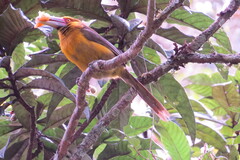
The saffron toucanet (Pteroglossus bailloni) is a species of bird in the family Ramphastidae found in the Atlantic Forest in far north-eastern Argentina, south-eastern Brazil, and eastern Paraguay. This species' scientific name honors Louis Antoine François Baillon. The saffron toucanet was originally described in the genus Ramphastos and has also been placed in the genus Andigena by some authorities. It was formerly placed in the monotypic genus Baillonius, but Kimura et al. (2004) were able to show that the saffron toucanet belongs in the genus Pteroglossus.

In a later study, it was later confirmed by analyzing the molecular sequence of the saffron by Pereira et al. (2008). The finding was supported by vocalization and anatomical characteristics that were similar to other Pteroglossus species.

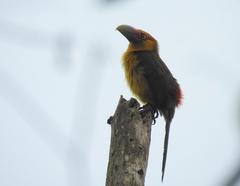
Alternate names include Baillon's toucan, banana toucan, saffron-colored araçari and yellow toucanet. It is a relatively long-tailed toucan with a total length of 35–40 cm (14–15.5 in). As suggested by its common name, it is, uniquely among toucans, overall saffron yellow. The back and tail are darker, more olive in color. The rump, ocular skin... Wikipedia →

Sounds

Alarm call0:19

Brazil · 2020

© Daniel Mello · XC530230 · CC BY-NC-SA 4.0

Call0:32

Argentina · 1999

© Rosendo Manuel Fraga · XC446979 · CC BY-NC-SA 4.0

Flight call0:04

Brazil · 2010

© Douglas Meyer · XC174379 · CC BY-NC-SA 4.0

Global Distribution

Parks Where Found

# Park Country Daily sighting probability
1 Itatiaia National Park 🇧🇷 Brazil
~10%
2 Serra dos Órgãos National Park 🇧🇷 Brazil
<5%
3 Iguazú National Park 🇦🇷 Argentina
<5%
4 Iguaçu National Park 🇧🇷 Brazil
<5%

Zoos & Centres Where Found

# Zoo / Centre Country
1 Dallas Zoo 🇺🇸 United States In captivity
2 Johor Zoo 🇲🇾 Malaysia In captivity

Before you go

What are the chances of seeing a Saffron Toucanet in Itatiaia National Park?

With luck

About 10% of wildlife watchers report a Saffron Toucanet sighting in Itatiaia National Park on a given day, based on 85 verified sightings from GBIF citizen-science data from 2019 to 2026. It is the 193rd most-seen of the 352 birds we can rate there. Over three days the chance rises to about 10%, and over a week to about 30%, if each day is a fresh chance.

When is the best time to see a Saffron Toucanet in Itatiaia National Park?

January, April, August–September and November

In those months about 10% of wildlife watchers report a Saffron Toucanet in Itatiaia National Park on a given day, against under 5% in February–March, May–July, October and December, the lowest months.

What time of day is best to see a Saffron Toucanet?

Between 8 and 11 am

Across all the parks we cover, that three-hour window holds the most Saffron Toucanet sightings with a recorded time, and about 9 in 10 of them come between 6 am and 6 pm: it is a daytime animal.

Is Itatiaia National Park the best place to see a Saffron Toucanet?

Yes

Of the 4 parks where we can rate Saffron Toucanet sightings, Itatiaia National Park has the highest daily chance: about 10%. Next come Serra dos Órgãos National Park (Brazil, under 5%) and Iguazú National Park (Argentina, under 5%).

Which relatives of the Saffron Toucanet live in Itatiaia National Park?

Same family: Ramphastidae

The closest relatives of the Saffron Toucanet that you can see in Itatiaia National Park (family Ramphastidae, Toucans) are Red-breasted Toucan (about 50%) and Toco Toucan (about 10%), with each one's daily chance of a sighting.

Where does the Saffron Toucanet sighting chance come from?

GBIF citizen-science records

It is estimated from how often the Saffron Toucanet is recorded against all the birds logged in Itatiaia National Park (85 verified sightings from 2019 to 2026), calibrated against known sighting rates. Figures are rounded to the nearest 10% because citizen-science data supports honest approximations, not decimals, and months with records from fewer than five people show "—". How it works.

← Back to Itatiaia National Park