Hispaniolan Parrot

Hispaniolan Parrot

Amazona ventralis

Silhouette: Ferran Sayol · PhyloPic

LCNTVUVulnerableENCR Endemic
Daily sighting probability ~10% · With luck
at Jaragua National Park

In 3 days ~30% in a week ~50%

16 Verified sightings at Jaragua National Park From 2019 to 2026
57 In all 2 parks
February Best month
☀️🌙 Day & Night When it's spotted

About the Hispaniolan Parrot

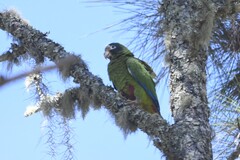
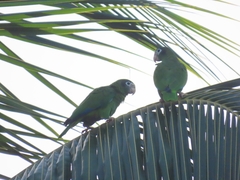
The Hispaniolan parrot (Amazona ventralis), also known as Hispaniolan amazon, is a species of psittaciform bird of the family Psittacidae endemic to Hispaniola, which includes the Dominican Republic and Haiti. Its white forehead, light beak, white eye-ring, blue ear patch, and maroon belly patch are the main features that differentiate it from other amazons. Its body measures about 28 centimeters in length. A typical adult weighs 250g (8.75 oz).

This species was widespread in Hispaniola, but it suffered a significant decline during the twentieth century. Its range was mainly limited to inland mountains in the 1930s and is becoming more typical in metropolitan cities such as Santo Domingo.

German biologist Philipp Ludwig Statius Müller published the first scientific description in 1776. In 1535, Spanish historian Gonzalo Fernández de Oviedo published written descriptions of the Hispaniolan parrot. Oviedo describes them as Higuacas name derived from the Taíno word for these birds. Oviedo describes them:

In this island are three species of them large some, others minor and very small. The great ones are called by the Indians Higuacas, the middle long syllable [stressed... Wikipedia →

Sounds

Call1:05

Dominican Republic · 2023

© Barry Edmonston · XC794475 · CC BY-NC-SA 4.0

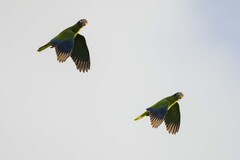
Flight call0:30

Dominican Republic · 2000

© Ante Strand · XC15749 · CC BY-NC-ND 2.5

Call0:32

Dominican Republic · 2018

© George Wagner · XC438071 · CC BY-NC-SA 4.0

Global Distribution

Parks Where Found

# Park Country Daily sighting probability
1 Jaragua National Park 🇩🇴 Dominican Republic
~10%
2 Los Haitises National Park 🇩🇴 Dominican Republic
~10%

Cities Where Found

# City Country Daily sighting probability
1 Santo Domingo 🇩🇴 Dominican Republic
~10%

Zoos & Centres Where Found

# Zoo / Centre Country
1 Paphos Zoo 🇨🇾 Cyprus In captivity
2 MaST Center Aquarium 🇺🇸 United States In captivity
3 Acuario Nacional (República Dominicana) 🇩🇴 Dominican Republic In captivity

Before you go

What are the chances of seeing a Hispaniolan Parrot in Jaragua National Park?

With luck

About 10% of wildlife watchers report a Hispaniolan Parrot sighting in Jaragua National Park on a given day, based on 16 verified sightings from GBIF citizen-science data from 2019 to 2026. It is the 60th most-seen of the 92 birds we can rate there. Over three days the chance rises to about 30%, and over a week to about 50%, if each day is a fresh chance.

When is the best time to see a Hispaniolan Parrot in Jaragua National Park?

February and May

In those months about 20% of wildlife watchers report a Hispaniolan Parrot in Jaragua National Park on a given day, against under 5% in January, the lowest month. June to September have too few records to rate.

What time of day is best to see a Hispaniolan Parrot?

Between 7 and 10 am

Across all the parks we cover, that three-hour window holds the most Hispaniolan Parrot sightings with a recorded time, and about 6 in 10 of them come between 6 am and 6 pm: it is seen both by day and at night.

Is Jaragua National Park the best place to see a Hispaniolan Parrot?

Yes

Of the 2 parks where we can rate Hispaniolan Parrot sightings, Jaragua National Park has the highest daily chance: about 10%. Next come Los Haitises National Park (Dominican Republic, about 10%).

Where does the Hispaniolan Parrot sighting chance come from?

GBIF citizen-science records

It is estimated from how often the Hispaniolan Parrot is recorded against all the birds logged in Jaragua National Park (16 verified sightings from 2019 to 2026), calibrated against known sighting rates. Figures are rounded to the nearest 10% because citizen-science data supports honest approximations, not decimals, and months with records from fewer than five people show "—". How it works.

← Back to Jaragua National Park