Russet Sparrow

Russet Sparrow

Passer cinnamomeus

Silhouette: Andrew Butko (modified) · PhyloPic

LCLeast ConcernNTVUENCR
Daily sighting probability <5% · Rare
at Jim Corbett National Park

In 3 days <5% in a week ~10%

23 Verified sightings at Jim Corbett National Park From 2019 to 2026
347 In all 6 parks
December Best month
☀️ Diurnal When it's spotted

About the Russet Sparrow

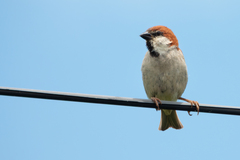
The russet sparrow (Passer cinnamomeus), also called the cinnamon or cinnamon tree sparrow, is a passerine bird of the sparrow family Passeridae. A chunky little seed-eating bird with a thick bill, it has a body length of 14 to 15 cm (5.5–5.9 in). Its plumage is mainly warm rufous above and grey below. It exhibits sexual dimorphism, with the plumage of both sexes patterned similarly to that of the corresponding sex of house sparrow. Its vocalisations are sweet and musical chirps, which when strung together form a song.

Three subspecies are recognised, differing chiefly in the yellowness of their underparts. The subspecies rutilans and intensior breed in parts of eastern Asia, where they are usually found in light woodland, and the subspecies cinnamomeus breeds in the Himalayas, where it is usually associated with terrace cultivation. The russet sparrow is the typical sparrow of human habitations in towns where the house and tree sparrows are absent. In the southern part of its range, the russet sparrow prefers higher altitudes, but in the north it breeds by the sea. The russet sparrow is known well enough in the Himalayas to have a distinct name in some languages, and is depicted in Japanese art.

This sparrow feeds mainly on the seeds of herbs and grains, but it also eats berries and insects, particularly during the breeding season. This diet makes it a minor pest in agricultural areas, but also a predator of insect pests. While breeding, it is not social, as its nests are dispersed. It forms flocks when not breeding, although it associates with other bird species infrequently. In some parts of its range, the russet sparrow migrates, at least to lower altitudes. Its nest is located in a tree cavity, or a hole in a cliff or building. The male chooses the nest site before finding a mate and uses the nest for courtship display. The typical clutch contains five or six whitish eggs. Both sexes incubate and feed the young. Wikipedia →

Sounds

Call0:46

China · 2026

© Bo Shunqi 薄顺奇 · XC1172779 · CC BY-NC-SA 4.0

Song0:31

China · 2026

© Peter Boesman · XC1147660 · CC BY-NC-ND 4.0

Alarm call0:30

China · 2023

© Dave GUO · XC892620 · CC BY-NC-SA 4.0

Global Distribution

Parks Where Found

# Park Country Daily sighting probability
1 Nikko National Park 🇯🇵 Japan
~20%
2 Taroko National Park 🇹🇼 Taiwan
~10%
3 Jiuzhaigou National Park 🇨🇳 China
~10%
4 Manas National Park 🇮🇳 India
<5%
5 Jim Corbett National Park 🇮🇳 India
<5%
6 Royal Manas National Park 🇧🇹 Bhutan
<5%

Cities Where Found

# City Country Daily sighting probability
1 Guiyang 🇨🇳 China
~20%
2 Srinagar 🇮🇳 India
~10%
3 Kunming 🇨🇳 China
<5%
4 Kathmandu 🇳🇵 Nepal
<5%
5 Beijing 🇨🇳 China
<5%
6 Osaka 🇯🇵 Japan
<5%

Before you go

What are the chances of seeing a Russet Sparrow in Jim Corbett National Park?

Rare

Under 5% of wildlife watchers report a Russet Sparrow sighting in Jim Corbett National Park on a given day, based on 23 verified sightings from GBIF citizen-science data from 2019 to 2026. It is the 288th most-seen of the 368 birds we can rate there. Over three days the chance rises to under 5%, and over a week to about 10%, if each day is a fresh chance.

When is the best time to see a Russet Sparrow in Jim Corbett National Park?

Any time of year

In every month with enough records, under 5% of wildlife watchers report a Russet Sparrow in Jim Corbett National Park on a given day, so our monthly data shows no clear season.

What time of day is best to see a Russet Sparrow?

Between 8 and 11 am

Across all the parks we cover, that three-hour window holds the most Russet Sparrow sightings with a recorded time, and about 8 in 10 of them come between 6 am and 6 pm: it is a daytime animal.

Is Jim Corbett National Park the best place to see a Russet Sparrow?

5th of 6

Of the 6 parks where we can rate Russet Sparrow sightings, Jim Corbett National Park ranks 5th at under 5%. The best odds are in Nikko National Park (Japan, about 20%), Taroko National Park (Taiwan, about 10%) and Jiuzhaigou National Park (China, about 10%).

Where does the Russet Sparrow sighting chance come from?

GBIF citizen-science records

It is estimated from how often the Russet Sparrow is recorded against all the birds logged in Jim Corbett National Park (23 verified sightings from 2019 to 2026), calibrated against known sighting rates. Figures are rounded to the nearest 10% because citizen-science data supports honest approximations, not decimals, and months with records from fewer than five people show "—". How it works.

← Back to Jim Corbett National Park
