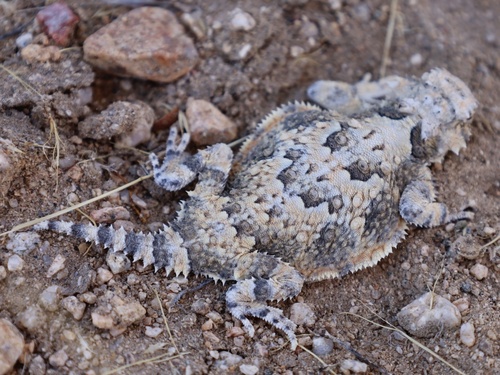
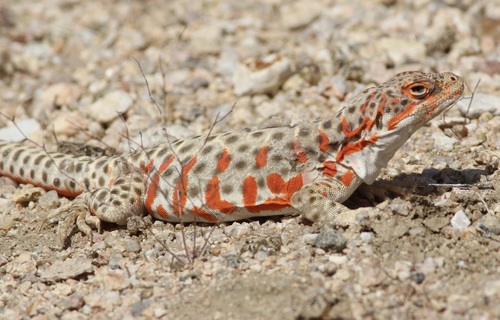
Desert Night Lizard

Desert Night Lizard

Xantusia vigilis

Silhouette: Beth Reinke · PhyloPic

LCLeast ConcernNTVUENCR
Daily sighting probability ~20% · Possible
at Joshua Tree National Park

In 3 days ~60% in a week ~80%

84 Verified sightings at Joshua Tree National Park From 2019 to 2026
84 In 1 park
September Best month
☀️ Diurnal When it's spotted

About the Desert Night Lizard

The desert night lizard (Xantusia vigilis) is a night lizard native to the Southern California Eastern Sierra and the San Gabriel Mountains into Baja California, southern Nevada, southwestern Utah and extreme western areas of Arizona.

The desert night lizard attains a snout-to-vent length (SVL) of 1.5 to 2.75 in (3.8 to 7.0 cm) with a tail roughly the same length. The lizard's coloring is usually grey, yellow-brownish, or olive. Despite their name, night lizards are active during the day. They are known to easily change their color, from light olive (usually during the evening) to dark brown during the day. It is a good climber and usually eats termites, small insects, spiders and other arthropods.

The desert night lizard is small for a reptile, with the average adult female at 80 mm in total length and 1.3 g in weight. Adult males are slightly smaller at 65 mm in total length and 1.1 g in weight. Male desert night lizards are distinguishable from females as they are lighter and shorter in length. They also have a stouter and wider tail, as well as enlarged femoral pores. Most desert night lizards have 12 longitudinal rows of rectangular ventral scales with 30-50... Wikipedia →

Global Distribution

Parks Where Found

# Park Country Daily sighting probability
1 Joshua Tree National Park 🇺🇸 United States
~20%

More parks will be added in future updates.

Cities Where Found

# City Country Daily sighting probability
1 Las Vegas 🇺🇸 United States
~10%

Closest Relatives at Joshua Tree National Park

No species of the same family or order lives in Joshua Tree National Park, so these are its closest relatives here: other reptiles.

Before you go

What are the chances of seeing a Desert Night Lizard in Joshua Tree National Park?

Possible

About 20% of wildlife watchers report a Desert Night Lizard sighting in Joshua Tree National Park on a given day, based on 84 verified sightings from GBIF citizen-science data from 2019 to 2026. It is the 16th most-seen of the 39 reptiles we can rate there. Over three days the chance rises to about 60%, and over a week to about 80%, if each day is a fresh chance.

When is the best time to see a Desert Night Lizard in Joshua Tree National Park?

May and August–September

In those months about 30% of wildlife watchers report a Desert Night Lizard in Joshua Tree National Park on a given day, against about 10% in December and January, the lowest months.

What time of day is best to see a Desert Night Lizard?

Between 9 am and noon

Across all the parks we cover, that three-hour window holds the most Desert Night Lizard sightings with a recorded time, and about 8 in 10 of them come between 6 am and 6 pm: it is a daytime animal.

Where else can you see a Desert Night Lizard?

Only Joshua Tree National Park, in our data

Joshua Tree National Park is the only park on Wallace's Line with enough records to rate Desert Night Lizard sightings: about 20% of wildlife watchers there report one on a given day.

Where does the Desert Night Lizard sighting chance come from?

GBIF citizen-science records

It is estimated from how often the Desert Night Lizard is recorded against all the reptiles logged in Joshua Tree National Park (84 verified sightings from 2019 to 2026), calibrated against known sighting rates. Figures are rounded to the nearest 10% because citizen-science data supports honest approximations, not decimals, and months with records from fewer than five people show "—". How it works.

← Back to Joshua Tree National Park