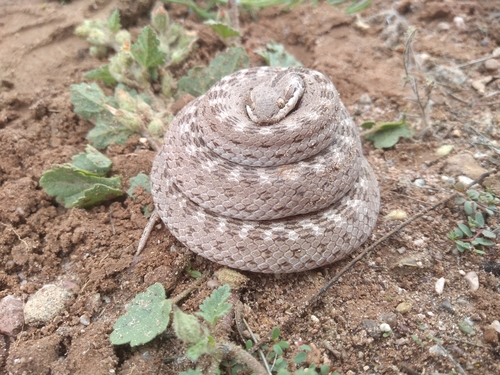
Glossy Snake

Glossy Snake

Arizona elegans

Silhouette: Alex Slavenko · PhyloPic

LCLeast ConcernNTVUENCR
Daily sighting probability ~20% · Possible
at Joshua Tree National Park

In 3 days ~40% in a week ~70%

46 Verified sightings at Joshua Tree National Park From 2019 to 2026
111 In all 3 parks
August Best month
☀️🌙 Day & Night When it's spotted

About the Glossy Snake

Arizona elegans is a species of medium-sized colubrid snake commonly referred to as the glossy snake or the faded snake, which is native to southwestern United States and northern Mexico. It has several subspecies. Some have recommended that A. elegans occidentalis be granted full species status.

Subspecies of Arizona elegans include: Arizona elegans arenicola Dixon, 1960 – Texas glossy snake Arizona elegans candida Klauber, 1946 – Western Mojave glossy snake Arizona elegans eburnata Klauber, 1946 – Desert glossy snake

Arizona elegans elegans Kennicott, 1859 – Kansas glossy snake Arizona elegans expolita Klauber, 1946 – Chihuahua glossy snake Arizona elegans noctivaga Klauber, 1946 – Arizona glossy snake Arizona elegans occidentalis Blanchard, 1924 – California glossy snake

Arizona elegans philipi Klauber, 1946 – Painted Desert glossy snake The glossy snake and its many subspecies are all similar in appearance to gopher snakes. However, they are smaller than gopher snakes, with narrow, pointed heads, and a variety of skin patterns and colors. They appear "washed-out" or pale, hence the common name, "faded snakes".

Most subspecies are ca. 75–130 cm... Wikipedia →

Global Distribution

Parks Where Found

# Park Country Daily sighting probability
1 Joshua Tree National Park 🇺🇸 United States
~20%
2 Big Bend National Park 🇺🇸 United States
~10%
3 Saguaro National Park 🇺🇸 United States
~10%

Zoos & Centres Where Found

# Zoo / Centre Country
1 Phoenix Zoo 🇺🇸 United States In captivity

Before you go

What are the chances of seeing a Glossy Snake in Joshua Tree National Park?

Possible

About 20% of wildlife watchers report a Glossy Snake sighting in Joshua Tree National Park on a given day, based on 46 verified sightings from GBIF citizen-science data from 2019 to 2026. It is the 21st most-seen of the 39 reptiles we can rate there. Over three days the chance rises to about 40%, and over a week to about 70%, if each day is a fresh chance.

When is the best time to see a Glossy Snake in Joshua Tree National Park?

August and September

In those months about 30% of wildlife watchers report a Glossy Snake in Joshua Tree National Park on a given day, against under 5% in December to February, the lowest months.

What time of day is best to see a Glossy Snake?

Between 8 and 11 pm

Across all the parks we cover, that three-hour window holds the most Glossy Snake sightings with a recorded time, and about 7 in 10 of them come between 6 pm and 6 am: it is seen both by day and at night.

Is Joshua Tree National Park the best place to see a Glossy Snake?

Yes

Of the 3 parks where we can rate Glossy Snake sightings, Joshua Tree National Park has the highest daily chance: about 20%. Next come Big Bend National Park (United States, about 10%) and Saguaro National Park (United States, about 10%).

Which relatives of the Glossy Snake live in Joshua Tree National Park?

Same family: Colubridae

The closest relatives of the Glossy Snake that you can see in Joshua Tree National Park (family Colubridae, Colubrid Snakes) are Gopher Snake (about 30%), Coachwhip (about 30%) and Western Patch-nosed Snake (about 20%), with each one's daily chance of a sighting.

Where does the Glossy Snake sighting chance come from?

GBIF citizen-science records

It is estimated from how often the Glossy Snake is recorded against all the reptiles logged in Joshua Tree National Park (46 verified sightings from 2019 to 2026), calibrated against known sighting rates. Figures are rounded to the nearest 10% because citizen-science data supports honest approximations, not decimals, and months with records from fewer than five people show "—". How it works.

← Back to Joshua Tree National Park