Bat Hawk

Bat Hawk

Macheiramphus alcinus

Silhouette: Sheatherius · PhyloPic

LCLeast ConcernNTVUENCR
Daily sighting probability <5% · Rare
at Kafue National Park

In 3 days <5% in a week ~10%

7 Verified sightings at Kafue National Park From 2019 to 2026
580 In all 19 parks
February Best month
☀️ Diurnal When it's spotted

About the Bat Hawk

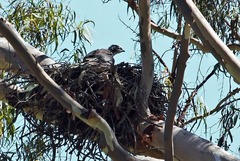
The bat hawk (Macheiramphus alcinus) is a raptor found in sub-Saharan Africa and south Asia to New Guinea. It is named for its diet, which consists mainly of bats. It requires open space in which to hunt, but will live anywhere from dense rainforest to semi-arid veld.

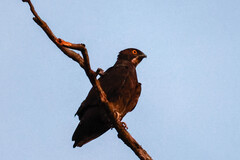
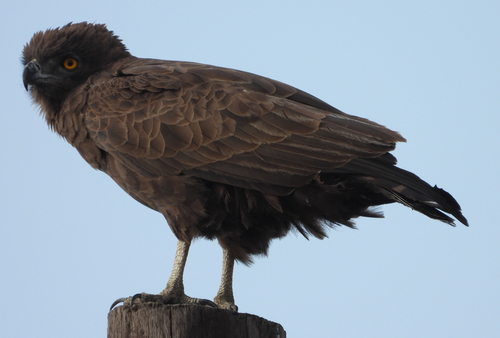
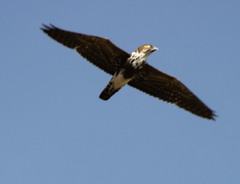
The bat hawk is a slender, medium-sized bird of prey, 45 cm long and weighing 600–650 grams. It has long wings and a falcon-like silhouette while in flight. Adults are dark brown or black, with a white patch on the throat and chest, and have a white streak above and below each eye. Juveniles are mottled brown and have more white plumage than adults.

Bats are the usual prey of the bat hawk, although they may eat small birds, such as swallows, swifts, and nightjars, or even insects. They hunt by chasing their prey at high speeds in flight. 49.3% of their hunts are successful. Bats are captured by the use of small talons, and swallowed whole immediately in flight. Hunting methods may be similar to that of Swainson's Hawk, which makes use of different approach types (Up-stream, Down-stream and cross-stream) and grab directions/body positions (pitch down, pitch up and roll manoeuvres... Wikipedia →

Sounds

Call0:13

Malaysia · 2008

© Hans Matheve · XC520243 · CC BY-NC-ND 4.0

Call0:20

Malaysia · 2015

© Mike Nelson · XC244201 · CC BY-NC-SA 4.0

Recording0:32

Malaysia · 2025

© Hobart WQH · iNaturalist · CC BY-NC 4.0

Global Distribution

Parks Where Found

# Park Country Daily sighting probability
1 Kinabatangan Wildlife Sanctuary 🇲🇾 Malaysia
~10%
2 Way Kambas National Park 🇮🇩 Indonesia
~10%
3 South Luangwa National Park 🇿🇲 Zambia
<5%
4 Khao Sok National Park 🇹🇭 Thailand
<5%
5 Lower Zambezi National Park 🇿🇲 Zambia
<5%
6 Mana Pools National Park 🇿🇼 Zimbabwe
<5%
7 Danum Valley Conservation Area 🇲🇾 Malaysia
<5%
8 Taman Negara National Park 🇲🇾 Malaysia
<5%
9 Lake Mburo National Park 🇺🇬 Uganda
<5%
10 Kafue National Park 🇿🇲 Zambia
<5%
11 Lake Nakuru National Park 🇰🇪 Kenya
<5%
12 Kerinci Seblat National Park 🇮🇩 Indonesia
<5%
13 Murchison Falls National Park 🇺🇬 Uganda
<5%
14 Tarangire National Park 🇹🇿 Tanzania
<5%
15 Sepilok 🇲🇾 Malaysia
<5%
16 Chobe National Park 🇧🇼 Botswana
<5%
17 Moremi Game Reserve 🇧🇼 Botswana
<5%
18 Masai Mara National Reserve 🇰🇪 Kenya
<5%
19 Kruger National Park 🇿🇦 South Africa
<5%

Cities Where Found

# City Country Daily sighting probability
1 Kampala 🇺🇬 Uganda
~20%
2 Harare 🇿🇼 Zimbabwe
<5%
3 Kigali 🇷🇼 Rwanda
<5%
4 Singapore 🇸🇬 Singapore
<5%

Before you go

What are the chances of seeing a Bat Hawk in Kafue National Park?

Rare

Under 5% of wildlife watchers report a Bat Hawk sighting in Kafue National Park on a given day, based on 7 verified sightings from GBIF citizen-science data from 2019 to 2026. It is the 318th most-seen of the 338 birds we can rate there. Over three days the chance rises to under 5%, and over a week to about 10%, if each day is a fresh chance.

When is the best time to see a Bat Hawk in Kafue National Park?

February

In that month about 10% of wildlife watchers report a Bat Hawk in Kafue National Park on a given day, against under 5% in March to January, the lowest months. That is one of Kafue National Park's wettest months, with about 170 mm of rain against almost none in June.

What time of day is best to see a Bat Hawk?

Between 4 and 7 pm

Across all the parks we cover, that three-hour window holds the most Bat Hawk sightings with a recorded time, and about 7 in 10 of them come between 6 am and 6 pm: it is a daytime animal.

Which relatives of the Bat Hawk live in Kafue National Park?

Same family: Accipitridae

The closest relatives of the Bat Hawk that you can see in Kafue National Park (family Accipitridae, Hawks, Eagles, and Kites) are African Fish-Eagle (about 70%), Bateleur (about 50%) and White-backed Vulture (about 50%), with each one's daily chance of a sighting.

Where does the Bat Hawk sighting chance come from?

GBIF citizen-science records

It is estimated from how often the Bat Hawk is recorded against all the birds logged in Kafue National Park (7 verified sightings from 2019 to 2026), calibrated against known sighting rates. Figures are rounded to the nearest 10% because citizen-science data supports honest approximations, not decimals, and months with records from fewer than five people show "—". How it works.

← Back to Kafue National Park